New ‘aerogel’ space-age insulating material is world’s lightest
August 21, 2012
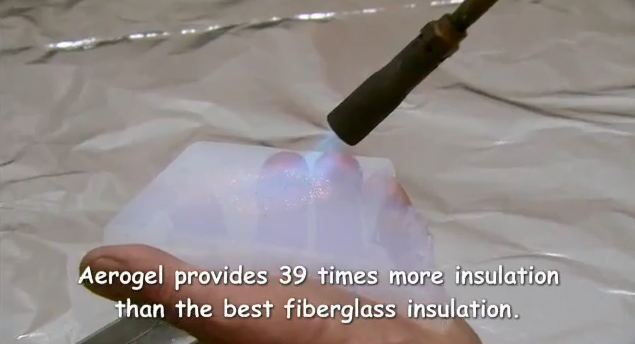
Lawrence Livermore National Laboratory chemists have developed a new flexible “aerogel” — stuff so light it has been called “solid smoke” — described as the world’s lightest solid material and best solid insulating material.
“The new aerogels are up to 500 times stronger than their silica counterparts,” said Mary Ann B. Meador at the annual meeting of the American Chemical Society.
“A thick piece actually can support the weight of a car. And they can be produced in a thin form, a film so flexible that a wide variety of commercial and industrial uses are possible.”
Flexible aerogels, for instance, could be used in a new genre of super-insulating clothing that keeps people warm in the cold with less bulk than traditional “thermal” garments. Tents and sleeping bags would have the same advantages.Home refrigerator and freezer walls insulated with other forms of the material would shrink in thickness, increasing storage capacity.
Meador said that the aerogel is 5–10 times more efficient than existing insulation, with a quarter-inch-thick sheet providing as much insulation as 3 inches of fiberglass. And there could be multiple applications in thin-but-high-efficiency insulation for buildings, pipes, water heater tanks and other devices.
NASA envisions one use in an advanced re-entry system for spacecraft returning to Earth from the International Space Station, and perhaps other missions. Re-entry vehicles need a heat shield that keeps them from burning up due to frictional heating from Earth’s atmosphere. Those shields can be bulky and heavy. So NASA is exploring use of a heat shield made from flexible aerogel that inflates like a balloon when spacecraft enter the atmosphere. Meador said the material also could be used to insulate spacesuits.
Scientists produced the stronger new aerogels in two ways. One involved making changes in the innermost architecture of traditional silica aerogels. They used a polymer, a plastic-like material, to reinforce the networks of silica that extend throughout an aerogel’s structure. Another involved making aerogels from polyimide, an incredibly strong and heat-resistant polymer, or plastic-like material, and then inserting brace-like cross-links to add further strength to the structure.

Comments (17)
by ATP14
If this becomes economically viable, this will undoubtedly become the “go-to” way of insulating a building!
by blue
As a sound engineer I would just love seeing this used for acoustic isolation, can’t wait till it gets much cheaper!
by Derek
http://en.wikipedia.org/wiki/Aerogel#Applications
by hostage nape
1/4″ – 1/2″ of this stuff could be inserted in walls without having to remove or dispose of shrunken or collapsed fiberglass. I need some RIGHT NOW !! It’s probably not commercially available yet, so I guess I’m stuck with cellulose this time out.
by Kevin C
Apparently, it is VERY expensive to produce which is probably the only reason it’s not used everywhere.
by melajara
I would like to see this used to make lighter and less brittle robots.
I’m wondering who has the patents too. (S)he will make a killing!
by Tab Cocovillea
Amazes me every time I see this stuff.
by Nicolas
Fantastique…
by Devon
Strong enough to hold a vehicle? If it is cheap maybe this could form the foundation on which we will build our floating cities of the future!
by cfox
How is this different from, or superior to, existing aerogels that have been around for the last 10 years or so? The article is a bit vague about that. I have played with the original and it weighs virtually nothing, and yet is strong. Why and how is this an improvement.?
by Dan Robinson
I agree, this article lacks much new specific information, though possibilities and dreams are many.
by Richard Sittel
Wow, sounds like great stuff, but you left out some of the most basic information in your story. Specifically, how much it costs, how easy it is to make, what it’s made of, is it toxic, will it burn, are the burning fumes toxic, will ants and termites eat it, does it conduct electricity, is it an electrical insulator, will it rot, will it mildew, does it smell, does it emit any chemical fumes, can it be injected into wall spaces……….
Go back and ask some questions, PLEASE!!!
by Ian Clarke
I may be moving to live on boat soon. Aerogel insulation would offer superb protection against harsh winters, and keep me cool in summer. Shame it isn’t available right now.
by Joe
Aerogel for marine application is currently available. Great for this application as it is hydrophobic. http://www.pacorinc.com
by Judy
Is it biodegradable or compostable? Or will it last forever like Styrofoam?
by Bri
Styrofoam breaks down fairly quickly in the environment. It’s when it’s in landfills that it lasts so long. Many of the other plastics last much longer. I would imagine this would degrade fairly easily. There’s almost nothing there.
by Bri
How expensive is it to produce? Three inches of this in a new home construction and you could passively heat and cool the structure easily!