New benchtop sequencers shipping; sequence genome in under a day
September 14, 2012
Life Technologies began shipments of its new Ion Proton benchtop sequencing instrument on Thursday, but the sequencing race is still on.
Illumina and Oxford Nanopore have also promised new machines by the end of the year, each capable of sequencing a human genome in less than a day, Nature News Blog reports.
The Ion Proton machine costs $150,000 and performs 4-hour sequencing runs using $1,000 disposable chips. A chip can sequence 60–80 million filtered DNA fragments, with lengths of up to 200 bases, enough to provide several-fold coverage on a human exome (the protein-coding genes). A second-generation chip capable of sequencing a full human genome is scheduled to be released next year.
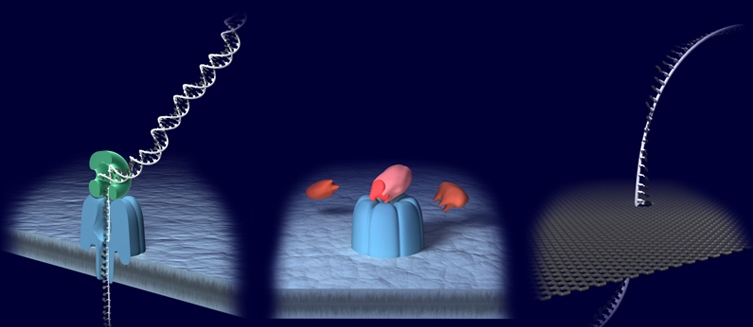
The machines from each companies read DNA bases in different ways. Illumina reads different colors of light depending on whether A,C,T, or G is incorporated. Life Technologies’ Ion Proton detects tiny changes in pH as different bases are added, and Oxford Nanopore detects disruption in an electrical current as a single DNA molecule slides through a nano-sized hole.
Competition in the clinical setting is set to be fierce. Both Life and Illumina have released products for use with clinical samples, and plan to file for FDA approval of their instruments next year.

Comments (10)
by Jim
Sequencing the DNA is only the tip of the iceburg. Next gen sequencers need to look also at methylation of amino acids in order to determine gene expression. As related to methylation, 3d configuration of the genome will also start to become important as more is learnt about structure to gene expression. Sequencing 3 billion base pairs is only the beginning and will one day look like mendelian genetics does now to us.
by EM
Big Brother approves. Double plus good.
by asiwel
One assumes that having your DNA sequenced is something that needs to be done only once in a lifetime – if done “correctly” and stored in your electronic medical records. This is not like MRIs and expensive lab tests and explorations that are done every whipstitch for whatever ails you. So if the benefits are as great as are hoped for (and they should be), the customer and insurance company should benefit and the cost be amortized over one’s entire lifetime and all the points and ailments in between, Why not simply add DNA analysis to the OB/GYN fees at birth?
by Bruce Wright
That’s true for congenital genetic illnesses, but it’s not true for diseases like cancer, which usually involve mutations from one’s original DNA makeup. However even for cancer, knowing the original DNA baseline can be helpful, since some genetic profiles are more prone to the development of cancer than others.
I can easily see this being used for sequencing several samples of cancer cells from cancer patients (very often not all cancer cells from a single tumor share the exact same DNA profile).
by Grey
I’m curious about – How much memory would be required to store human DNA?
by Chrispium
I put: How much memory would be required to store human DNA? into Google and got a range of answers from about 700 Mb to about 6 Gb.
by Stephen
Presumably that could be reduced if you only recorded the differences with an average genome and put it in a zip file.
by gaoptimize
So, lets assume 25% profit, 25% to amoritize the equipment in one year, 25% labor at $150K/year, and $1,000 of materials per genome, 200 a year per device. I think we are still looking at about a $4,000 genome, not $1,000 as recently advertised in response to an x-prize. We are still 2 or 3 years away from a $1,000 genome, when I will get mine done.
by Bri
It will probably be only research at first anyway. No insurance company is going to want to pay for it, until it save them money.
by Bri
These things are going to turbo charge genetic research. It’s effects on medicine will be equally profound. For cancer treatments of today it will remove so much of the guess work. Soon their use will be as common as an MRI.