New flexible classroom design
February 8, 2013
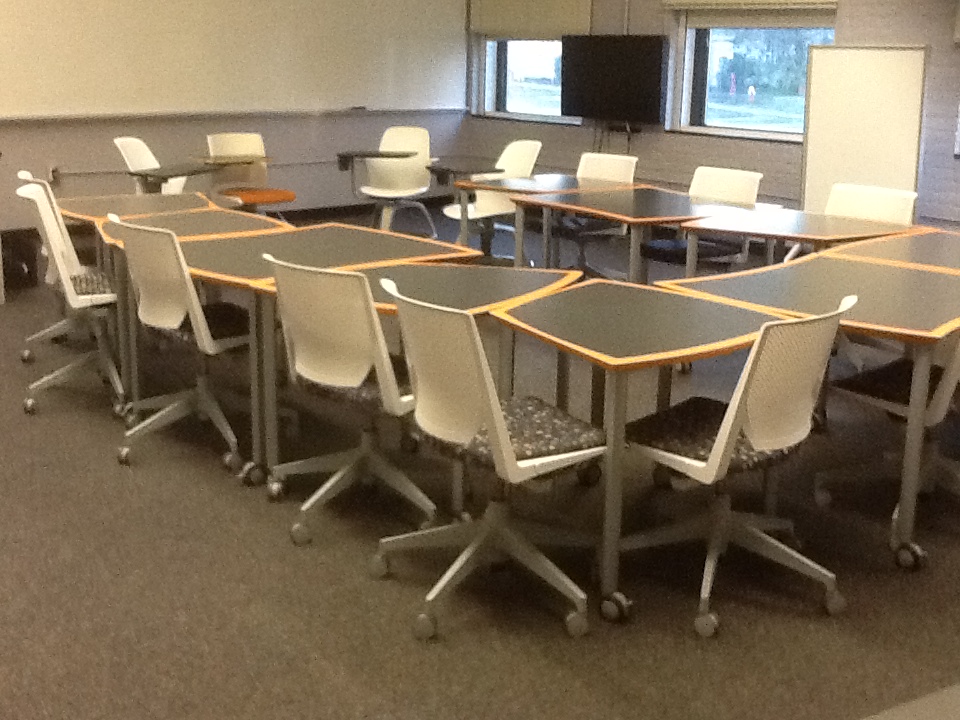
Researchers at North Carolina State University have developed a classroom design that gives instructors increased flexibility in how to teach their courses and improves accessibility for students, while slashing administrative costs.
The new flexible approach acknowledges the fact that students are now bringing their own laptops to class. The classrooms also include mobile infrastructure, where whiteboards, desks and tables can be reconfigured according to the needs of students and instructors.
“These classrooms work really well in terms of engaging students, particularly in regard to helping students bridge the gap between in-class instruction and out-of-classroom assignments,” says Dr. Susan Miller-Cochran, an associate professor of English and director of the First-Year Writing Program at NC State and lead author of a paper on the flexible classroom design.
The flexible design also improves access for students with special needs.
This approach could also lead to more creativity and active involvement by students, replacing the centuries-old, mind-numbing passive lecture format. Would this also improve some working environments? — Editor

Comments (24)
by Mr.X
I guess the colonies lag behind more than I thought.But ,at least I know now what I have to think when some of these settlers start making a big fuss about their “creativity” again.Still a long way to go haha^^
by Aaron
As a student I find that engaging curriculum is more important for stimulating neuron development than classroom layout. However I enjoy the interaction of looking people in the face when engaging in discusion. It is a valuable ability to look people in the eye when talking to them. This is a characteristic that is being lost in American culture. I also agree with MikeB that using chalk makes more sense than contributing to global destruction through the use of dry-erase boards.
by Sue Tamani
Since starting to teach in 1967 here in Australia, I don’t remember ever having “rows of desks” all facing the front. And I have taught students from 5 to 18 years old plus adults in Technical colleges.
by Editor
Headline corrected
by Cybernettr
A classroom where all the students face each other would make things really hard on the shyer students. The ones who may excel now might be put at a serious disadvantage under such an arrangement.
by Jason F
One of the causes of “shyness” among older students in the US is the current seating arrangements that we have in schools. If we were to use this new seating method, starting with the younger age groups and working up towards high schools, we would most likely notice a reduction in awkwardness among students. These students would have been made accustomed to social interaction from a young age and thus be more likely to be comfortable in a communal environment. Furthermore it is a known fact that facing others makes you more likely to be free with your thoughts, feelings, and opinions. This seating arrangement is a good thing.
by Spotted Marley
Looks like they’ll be used to their cubicles by the time they graduate school. Perfect!
by Simon
Those chairs look like they’re about 20 years old and specifically designed to cause back pain. Also, the chaotic, cramped arrangement of the furniture in the picture can’t be good for learning. (The two students sharing a tiny desk in the corner closest to the camera better be legless and not wanting to use anything but a small calculator.)
by Editor
Right, good observations. The real purpose of compulsory education appears to be creating good little efficient workers and obedient citizens, for whom pain is to be expected and accepted.
by Tom
Great Comment! More robots for the machine! :)
by Editor
I think the real benefit of ubiquitious robots will be to eliminate the need to make children into robots. Once that burden is lifted, schools will have no purpose and children will be free to develop their intelligence and creativity, learning only what they need, and doing it at high speed via Internet-based speed learning. People of the future will look in horror at compulsory education as absurd and barbaric.
Note: I hope to have time to write about what I have discovered about self-managed speed learning. For example, I discovered that children can instantly speak Spanish rapidly and fluently and learn it at high speed while running around throwing balls and screaming, but only if they didn’t have exposure to a school language course (virtual lobotomy) and only while they were having fun (“no more teachers’ dirty looks”) and not trying to “learn” (go into robot mode) anything.
I think this method could be extended to any subject via a combination of VR with full-body motion sensing in a simulator and videogame elements.
by OsirisX
So true. Question nothing, just do what we say little future worker bee. You guys rock. Enjoying the comments.
by WLGJR
Obedience. That’s what we want to hardwire into the future superhuman AIs.
Imagine a superhuman slave, who does everything better than you yet follow all your orders.
by Editor
Yes, exactly. Big Dog with a brain. “Fetch!”
by Piman
As long as it enjoys the work. (Else being a slave might be no fun; unethical. And plenty of mistakes like this will probably happen, as people adjust to the new technologies).
by Patricia Napolitano
Elementary school teachers have been rearranging desks and chairs into circles or squares, breaking classes into smaller groups of students, as well as using “learning stations” for decades! Duh!
by Editor
The researcher was focused on older students with laptops.
by Aaron Wright
This is nothing new. When I was in high school we had all of this, including the white boards and projectors.
by Percival
Indeed, it seems like a misnomer to call it new. In all my years at school I never saw a classroom with a “rigid row-column design”. Putting wheel to the legs of the tables is the only improvement. I’m sure there’s some zealous type out there ready to pounce with the magic ‘R’ word.
by Talita
I went to school in Brazil in the 60′s. your innovation was our everyday class. Is this serious?
by steve
On what planet is turning your desks to face each other considered an innovative design? what next from these geniuses at NCSU?? lead based writing implements !!!
by René Milan
Cutting edge !
Is this the retro-edition of KAI ?
When i was in 6th grade over 50 years ago, we started using this sort of design.
by Arctic Poppy
Really? with rolling chairs, white boards and desks? You were in the minority then.
by MikeB
50 years ago … instead of white boards, there were chalk boards … more eco-friendly as you weren’t always throwing away felt and plastic cylinders. not sure that chalk dust is bad for your lungs.