New metamaterial lens focuses radio waves
November 15, 2012
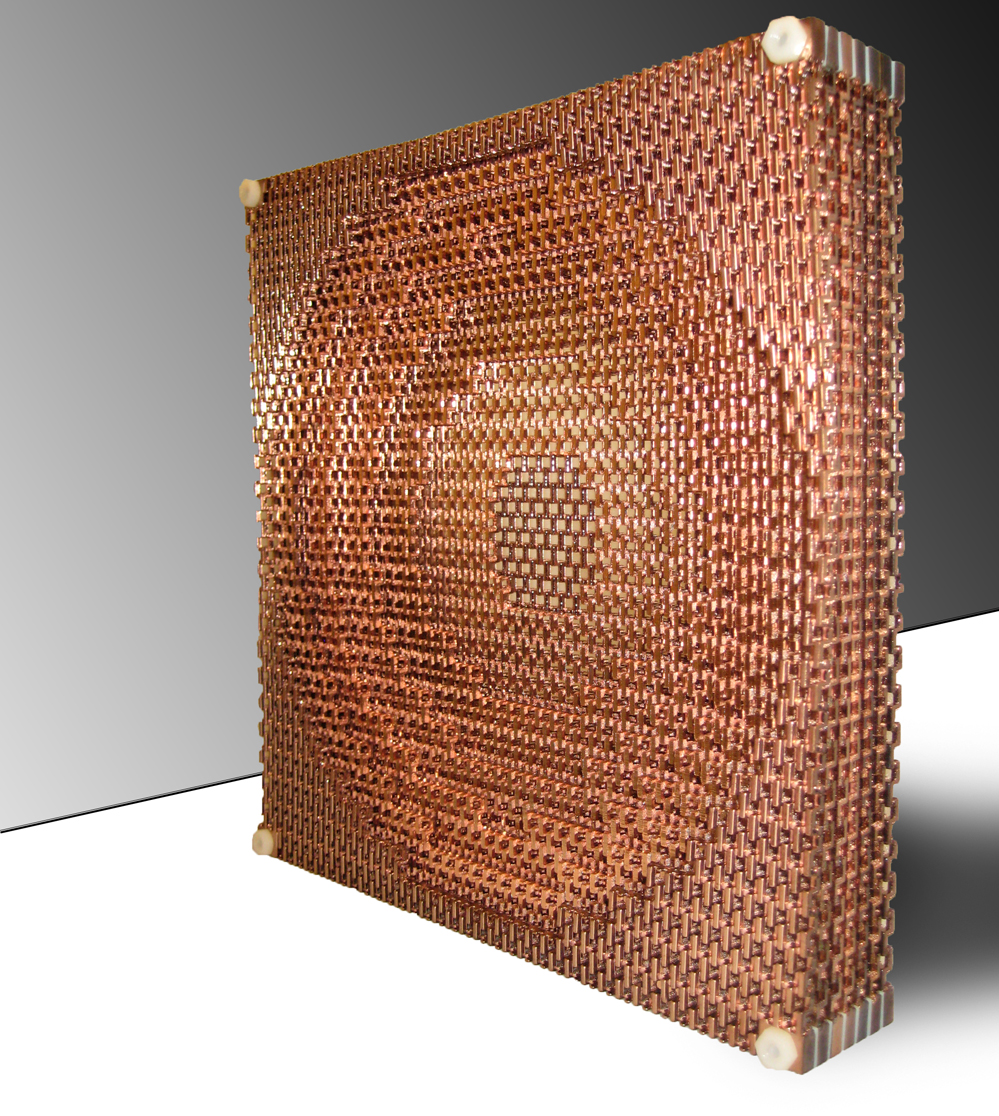
The orientation of 4,000 S-shaped units forms a metamaterial lens that focuses radio waves with extreme precision, and very little energy lost (credit: Dylan Erb/MIT)
MIT researchers have fabricated a three-dimensional, lightweight metamaterial lens that focuses radio waves with extreme precision.
The concave lens exhibits a property called negative refraction, bending electromagnetic waves — in this case, radio waves — in exactly the opposite sense from which a normal concave lens would work.
Concave lenses typically radiate radio waves outward. In this new metamaterial lens, however, radio waves converge, focusing on a single, precise point — a property impossible to replicate in natural materials.
For Isaac Ehrenberg, an MIT graduate student in mechanical engineering, the device evokes an image from the movie “Star Wars”: the Death Star, a space station that shoots laser beams from a concave dish, the lasers converging to a point to destroy nearby planets.
While the researchers’ fabricated lens won’t be blasting any planetary bodies in the near future, Ehrenberg says there are other potential applications for the device, such as molecular and deep-space imaging.
“There’s no solid block of any material in the periodic table which will generate this effect,” Ehrenberg says. “This device refracts radio waves like no other material found in nature.”
Shaping a cell
A metamaterial’s extraordinary properties are determined largely by its structure — similar to how a diamond’s crystals impart strength. A material can refract light differently depending on the shape of individual units within a material, and the arrangement of those units as a whole.
Prior to this recent paper, Wu and others have studied how certain shapes of metamaterials can affect the propagation of electromagnetic waves. The team came up with a blocky, S-shaped “unit cell” whose shape refracts radio waves in particular directions. Ehrenberg used the unit shape as the basis for his concave lens, creating the rough shape from more than 4,000 unit cells, each only a few millimeters wide.
To fabricate his design, Ehrenberg utilized 3-D printing, building a lens layer by intricate layer from a polymer solution. He then washed away any residue with a high-pressure water jet and coated each layer with a fine mist of copper to give the lens a conductive surface.
To test the lens, the researchers placed the device between two radio antennae and measured the energy transmitted through it. Ehrenberg found that most of the energy was able to travel through the lens, with very little lost within the metamaterial — a significant improvement in energy efficiency when compared with past negative-refraction designs. The team also found that radio waves converged in front of the lens at a very specific point, creating a tight, focused beam.
Imaging space and beyond
Sarma says the combination of the device’s “low loss” and tight focus is a promising step toward engineering practical metamaterial lenses.
“There are a lot of phenomena in the world that you can demonstrate, but whether you can achieve it at scale is the issue,” Sarma says. “We’ve taken the negative refraction concept from the realm of proof-of-concept to the realm of practicality.”
The device, which weighs less than a pound, may be used to focus radio waves precisely on molecules to create high-resolution images — images that are currently produced using bulky, heavy and expensive lenses. Ehrenberg says that such a lightweight device could also be mounted on satellites to image stars and other celestial bodies in space, “where you don’t want to bring up a hefty lens.”
Cheng Sun, an assistant professor of mechanical engineering at Northwestern University, says the metamaterial design is a promising demonstration that may lead to stronger, faster telecommunications.
“The low-loss design can be considered a significant step forward toward practical applications at microwave or radio-frequencies ranges,” Sun says.
Beyond the lens’ applications, Ehrenberg says its fabrication is simple and easily replicated, allowing other scientists to investigate 3-D metamaterial designs.
“You can really fully explore the space of metamaterials,” Ehrenberg says. “There’s a whole other dimension that now people will be able to look into.”
Ehrenberg published the results of his research in the Journal of Applied Physics. His co-authors on the paper are Sanjay Sarma, the Fred Fort Flowers and Daniel Fort Flowers Professor of Mechanical Engineering at MIT, and Bae-Ian Wu, a researcher at the Air Force Research Laboratory.
Comments (11)
by gary
If this device can focus radio waves with extreme precision then perhaps it could be used to improve brain imaging in the sense that if, in the presence of a strong magnetic field, one could stimulate a specific molecular species inside neurons and monitor the subsequent radio emissions then it may be possible to assemble a picture of the concentration of these molecules throughout the brain
by Larry Miller
This isn’t new!
Radar antennas have used this principle since at least the 1980′s.
And Lansing speakers used this idea for audio waves from the 1950′s.
The 3-D printing is new, though.
by A4i
Recently there was a demonstration of extremely precise metamaterial optical lens. Semiconductor technology was used and the lens was made by simply engraving silicon substrate. Strangely that lens worked for RF too.
by MikeB
Correct fresnel lenses have been around for a very long time. Cool thing … you can make them out of plywood to refract RF at certain frequency ranges.
by M
What is novel here is the NEGATIVE refractive index, not just the lensing of radio waves. All EM waves follow the same physical laws, the scale and thus the behavior vary according to wavelength. The possibilities of negative refractive index meta-materials are immense. For instance, NRI optical lenses that allow the capture of evanescent light and submicroscopic imaging beyond the diffraction limit. This could offer similar possibilities to the fields of astronomy and communications. And we thought the hubble pictures were cool. The applications I’m most excited about are localized emf stimulation of biological tissue such as the brain.
by GatorALLin
..I understand this was focusing radio waves and not sound waves…but had me wondering if they could use this same idea to focus other types of waves…. I have a history of kidney stone problems…. passed 13 total and they are no fun. Everyone chimes in with the typical helpful suggestion…”hey can’t you sit in that tub of water and let them blast ‘em with sound waves and break them up….” . The answer so far is No… that tank is reserved for people who have a really huge stones and who can’t pass them naturally. and btw..that tank is $10,000 cost per use and btw it breaks them up “hopefully” into smaller stones you can pass, but not always…so we may have to try this a few times and for those of you who have never pissed out broken glass for a few weeks….its like that only worse.
…anyhow…had to wonder if with the advancements in imaging and conebeams….could they learn to use this to better focus sound or other waves to use to break up things like kidney stones and do it in a way that turned them 100% to micro-sand instead of broken up rocks…?? Hand to think maybe this brings the cost down also…so maybe $1,000 per visit vs. the 10k we somehow charge now… anyhow… love it when new options show up and suddenly have a new/better way to do things like focus waves…
right now the Dr.’s just tell patients like me…. Just wait to see if another stone wants to come out…if they pass naturally, then your just fine… You ask…well how many more stones do I have still to pass? (this takes more than one scan btw…as they don’t want to be held accountable if their count is wrong and they normally don’t bother to look, caring only about the 1 stone you are passing at the moment)… so I have 3 total still to pass… one in the right kidney and 2 in the left… one big one that they think “could be passed, but won’t be fun”. But could never pass and your just fine where you are…. don’t fix what is not broken is the holding theory. Except the reality is that 13 did pass and they are like sitting on a timebomb with no idea when suddenly they want to pass. I spent 13 hours on a flight from Germany to USA and stone decided to pass 15minutes into the flight…. and all pills checked in luggage of course. 13 hours of hell and it did pass 2 days later. That was the 4th worst one…. and won’t go into the other 3, but will tell you one got stuck and they had to go get it….2 months later. Anyhow… would be cool if they could better blast things with waves for medical uses….
Smiles….and apologies for the TMI
by asiwel
This whole metamaterials area with active “microscopic” elements (at least on the scale of the incident waves) is fascinating for mathematical, scientific, and engineering purposes. From light waves to microwaves to now radio waves to sound waves to seismic waves in the ground and the sea, new “devices” are being reported all the time nowadays. Interesting times we live in.
by David Thibault
Might this be the missing piece for beaming microwave energy back to earth from space-based solar panels?
by Gorden Russell
“To fabricate his design, Ehrenberg utilized 3-D printing, building a lens layer by intricate layer…”
Now imagine what the future will be like when there are 3-D printers on the moon or meeting up with asteroids.
by GatorALLin
…cool thought…. Yeah these 3d printers open up a lot of very exciting possibilities… can’t wait to see what they can do next. rock on.
by Daniel
And everywhere locally so things don’t have to be shipped thus dramatically reducing end costs not to mention all the design freedom that it expands.