New results indicate that new particle is a Higgs boson
March 14, 2013
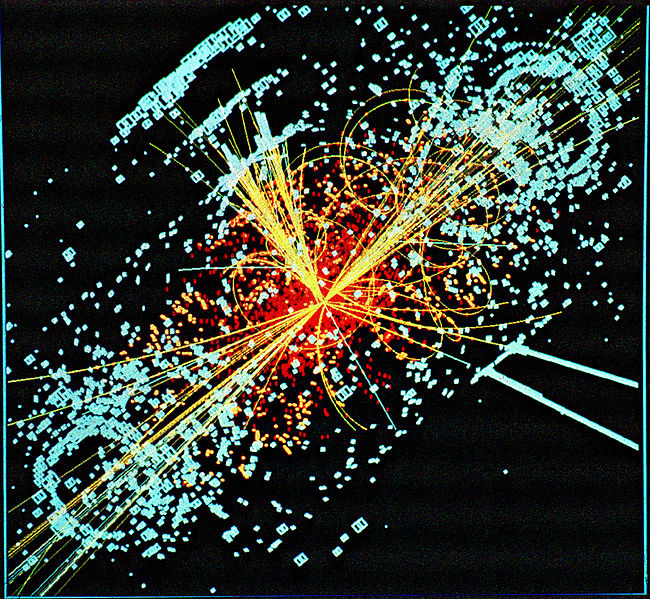
An example of simulated data modelled for the CMS particle detector on the Large Hadron Collider (LHC) at CERN. Here, following a collision of two protons, a (hypothetical) Higgs boson is produced, which decays into two jets of hadrons and two electrons. The lines represent the possible paths of particles produced by the proton-proton collision in the detector while the energy these particles deposit is shown in blue. (Image credit: CERN)
At the recent Moriond Conference, the ATLAS and CMS collaborations at the Large Hadron Collider (LHC) presented preliminary new results, finding that the new particle is looking more and more like a Higgs boson, the particle linked to the mechanism that gives mass to elementary particles.
It remains an open question, however, whether this is the Higgs boson of the Standard Model of particle physics, or possibly the lightest of several bosons predicted in some theories that go beyond the Standard Model. Finding the answer to this question will take time.
Whether or not it is a Higgs boson is demonstrated by how it interacts with other particles, and its quantum properties. For example, a Higgs boson is postulated to have no spin, and in the Standard Model its parity — a measure of how its mirror image behaves — should be positive.
CMS and ATLAS have compared a number of options for the spin-parity of this particle, and these all prefer no spin and positive parity. This, coupled with the measured interactions of the new particle with other particles, strongly indicates that it is a Higgs boson.
“The preliminary results with the full 2012 data set are magnificent and to me it is clear that we are dealing with a Higgs boson though we still have a long way to go to know what kind of Higgs boson it is,” says CMS spokesperson Joe Incandela.
“The beautiful new results represent a huge effort by many dedicated people. They point to the new particle having the spin-parity of a Higgs boson as in the Standard Model. We are now well started on the measurement programme in the Higgs sector,” says ATLAS spokesperson Dave Charlton.
To determine if this is the Standard Model Higgs boson, the collaborations have, for example, to measure precisely the rate at which the boson decays into other particles and compare the results to the predictions. The detection of the boson is a very rare event — it takes around 1 trillion (1012) proton-proton collisions for each observed event. To characterize all of the decay modes will require much more data from the LHC.
Comments (16)
by CKDexterHaven
Standard Model physics sure have a pre-copernican flavor to them.
by NakedApe
Why bother to discover the makeup of the Universe when I have car payments to make…
by steve
Oh is it funding season already?
by Dan Robinson
That’s great, but what does it mean in the context of cliamte and financial, ultimately population, crises? In the 22nd century, maybe we’ll be getting back to convincing people the earth isn’t flat.
by Pete
Discovering new types of subatomic particles can help in advancing “femtotechnology” (in Dr. Hugo de Garis’ lingo, computer techs in the 10^-15 m scale, with computational parts the size of nucleons and quarks)
or even more miniaturized technologies.
If femtotech computers are built, they will have processing power orders of magnitude greater (faster, more storage space) than most computers today.
A femtotech computer the size of a small molecule (combined with quantum computing effects) can outperform the combination of all existing computers and human brains on Earth.
A super AI can be created in such femtotech computers, which can solve (I guess) all of the world’s problems.
by Scott
Pete, nice commentary. But seriously, you and I both know that the core of many of the world’s problems lie within the nature of man (and perhaps life on this planet). I believe that humans generally do not take collective action to correct something seemingly intangible, until it negatively, and uncomfortably affects their lives.
I fear that a sentient AI, would decide that humans are the problem, and decide to “modify” (or eliminate) us. That being said, I still look forward to the singularity, because I do not believe humans will remain as they are, 50-100 years from now. With technological advancement comes enlightenment, although I would argue that the latter trails the pace of the former to a LARGE degree.
by Tom
Do you mean solve, as in eliminating just the problems, or solve, as in eliminating man?
by Bri
If we didn’t have an understanding of the atomic world we wouldn’t even be able to tell that the earth is heating up. Never mind figuring out possible solutions to those problems. If we could understand gravity better we might be able to cancel out it’s effects. That could save a tremendous amount of fossil fuel. It may seem a waste of time and money, but a closer examination of it’s possible impacts could lead to the solutions that we need.
by mormovies
the ‘crisis’ is in your mind.
by tflahive
Humans have got fission figured out.
We’re close to controlling fusion.
Get bosion.
Poof – It’s all gone.
by Tom B.
So what you’re saying is that an infinite number of Benny Hill’s with an infinite number of sexy sub-atomic lab assistants could discover all the secrets of the universe?
by Spotted Marley
If anybody has been looking for a really great way to visualize what the search for the Higgs boson is like, just imagine the theme song from Benny Hill and some sped up old-timey footage of some scientists in lab coats chasing a sexy little sub atomic particle around the lab … shenanigans etc
by john
This is awesome. Thank you
by DC
Now I totally get it!
by Jesse
Quote of the day.
by stevo
Shenanigons, I would say.