New way to store solar energy for use whenever it’s needed
July 14, 2011
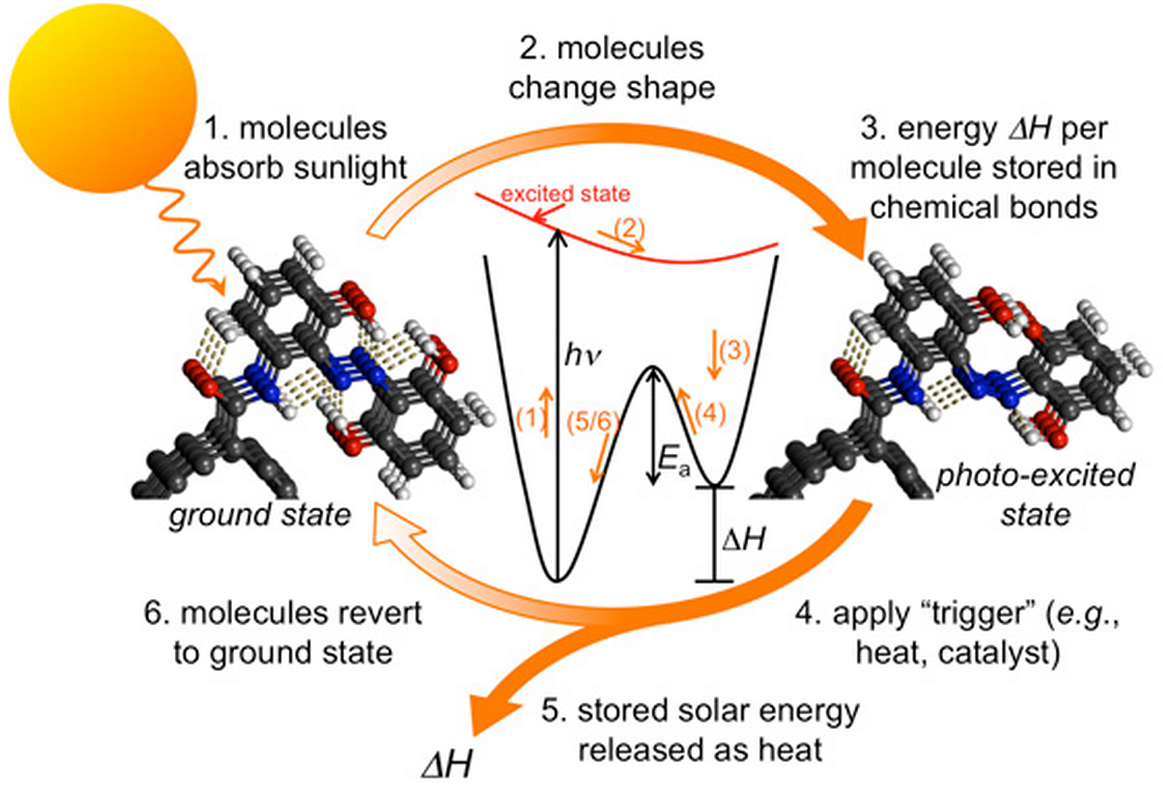
Storing solar energy in chemical form (credit: Grossman/Kolpak)
MIT researchers have developed a new application of carbon nanotubes that shows promise as an innovative approach to storing solar energy for use whenever it’s needed.
Storing the sun’s heat in chemical form — rather than first converting it to electricity or storing the heat itself in a heavily insulated container — has significant advantages: in principle, the chemical material can be stored for long periods of time without losing any of its stored energy.
The researchers created carbon nanotubes in combination with a compound called azobenzene. The resulting molecules, produced using nanoscale templates to shape and constrain their physical structure, and the concept that can be applied to many new materials.
This material is vastly more efficient at storing energy in a given amount of space — about 10,000 times higher in volumetric energy density, making its energy density comparable to lithium-ion batteries, the researchers said.
Ref.: Alexie M. Kolpak, Jeffrey C. Grossman, Azobenzene-Functionalized Carbon Nanotubes As High-Energy Density Solar Thermal Fuels, Nano Letters, 2011; 110705085331088 [DOI: 10.1021/nl201357n]
Comments (15)
by Tine van der Meer
When will these new panels be available? Where? How much would each panel cost?
by Gaston Savoie TD
benzene is the most carcinogen substance. Nanotubes is a questionable technic as nanotubes can penetrate in all living organism and interfere with cell functions.
by SJ Smith
I understood this to mean they can be used like a furnace, to heat the home, not power it? I would be interested in learning about this. I have a home in the low desert and there are few days without sun. But it can get very cold at night sometimes. It would be great to have a small system absorbing the sun’s heat during the day, and then use it on demand when needed. So, did I misunderstand the article?
by Editor
You got it. Still in the R&D phase. There are some more practical approaches we’ve covered. You can Google this to find them: sun store energy heat site:kurzweilai.net’
by Gulshan Lal Bhakhri
the concept using solar energy for day to day requirement is very useful. if there is any possibility and availability, i would like to install project at my residence and in my farm. kindly guide and convey the message
by william wetzstein
next comment . if this technology does in fact exist let us use it to extract the H3 from the moon which would solve all of our energy problems for the next 1000 years
by william wetzstein
if im not mistaken even if nonotube technology were possible it would still have to be miniaturized to the size of a watch battery and if that were possible the military would already be using this for their air- craft (ufo’s) and other military and science uses long before it became public.
by Joe Hamilton
This new nano technology sounds great. My question is: What company has developed this type of battery and where is it being marketed? Energy 1 was working on this technology but to my knowledge it failed. There is another Co. that has developed a battery that separates a charged liquid from the terminals which gives it the longest storage life. When you need the power you just break the barrier and you have a powered battery. But this won’t work for solar storage and backup.
by Jack Mann
I have embraced. An study now to the soon being a conclusion by Dr. Bill Tiller a prototype of imprinting a composite structure to modify itself to a energy drone commutator. Soon hopefully disclosed to the World with reachable goals of enormous capabilities .
by ROBERT MERRITT
—- WHAT —–
by Paula
yes, WHAT?
by Brad Bougher
LOL – ya what he said.
by Susan Lundquist
The use of “nanotubes” lead me to believe these are compact units. Could they potentially be used in the RV industry to replace the banks of storage batteries? Our unit has 6 really big deep cycle batteries.
While looking for more information on the size/capacity/output of the storage units. Wonder how well they would travel. Wikipedia notes there are switches using this technology and describes azobenzene as: “Stable. Combustible. Incompatible with strong oxidizing agents. Air and light sensitive.”
by Susan Lundquist
Just realized there is an 18 month gap in comments, so there must be more complete research in this area. Appreciate any links to information.
by William Beasy
Frank, Thanks for the information and product updates. Things are changing so fast maybe the meager amounts I’m saving will buy more when it’s time!
Regards,
Bill