New world-record efficiency for thin-film silicon solar cells
February 14, 2013
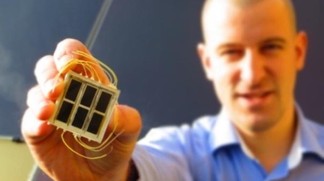
EPFL’s Institute of Microengineering has reached a remarkable 10.7% efficiency for a single-junction microcrystalline silicon solar cell, surpassing the previous world record of 10.1% held by the Japanese company Kaneka Corporation since 1998.
The efficiency increase was also achieved with with only 1.8 microns of photovoltaic active material — 100 times less material than with standard wafer-based crystalline silicon PV technology.
The new thin-film silicon technology can be scaled up to module (panel) production, enabling prices as low as 35 €/m2 ($47/m2), reaching the price level of standard roof tiles, according to the EPFL scientists.
Thin-film silicon technology indeed offers the advantages of saving up on raw material and offering low energy payback time, thus allowing module production prices as low as 35 €/m2 ($47/m2), reaching the price level of standard roof tiles.
Work leading to this result was supported by the Swiss Federal Office of Energy (SFOE), the EU-FP7 program, the Swiss National Science Foundation (SNSF), and the Commission for Technology and Innovation (CTI).

Comments (26)
by Paul in Vancouver
I’m starting to believe that small roof-top installations of solar panels is inefficient and inadequate, except for remote locations. Installation cost, maintenance cost, consultation & sales costs, etc are all impediments to widepread use of solar technology. It would be far more efficient to install thousands of square miles of solar panels in the Nevada desert, using specially designed robots, and financed using bonds or equity. This could be a precursor to building even larger installations on the lunar surface in the not too distant future.
by Walter Baltzley
It depends on where you live. In areas that receive large amounts of sunlight, smaller installations make sense because you can meet all your power needs ON-SITE…without the need for additional distribution infrastructure. However, in areas that receive less sunlight, large installations…like the ones you describe…will be necessary.
In fact ground-based solar installations may not even be viable in countries like Canada or Russia which in some places only receive ONE hour of direct sunlight per day. They would have to make use of SPACE-based solar…but it will be nearly a decade before that becomes viable.
by Bri
I believe space based solar is a potent energy source that deserves more R&D money. It is costly to bring the necessary materials into space but we will need energy for space activities. Space based systems would negate the need to use large tracts of land and transmission lines. The resource in space is so many times larger than what the earth recieves. Any investment in it would pay off in numerous ways. At ten years off it’s comparable to asteroid mining. Both have the potential to vastly increase our resource base. Any investment there will pay off handsomely in the near future.
by NakedApe
The Japanese were exploring this option some years back. I wonder what happened to the project? Probably should be revisited as our technological know-how increases.
by Paul in Vancouver
Solar technology is moving so fast right now, that it actually hampers consumer demand in the short-term. i.e. consumers don’t have an incentive to invest in solar panels that may take 10 years to pay off, if they believe that a new and better technology is just around the corner which may only take 5 years to pay off.
by Walter Baltzley
You are ABSOLUTELY correct…in fact, I have strongly advised my friends and family NOT to purchase solar panels until after 2015 for this very reason…they will get the most “bang for their buck”.
By 2015 I believe that THREE solar technologies will break parity with fossil fuels…Thin-Film (like in this article), Nano-Rectennas, and Organic…each has its advantages and disadvantages. Personally, I believe that nano-rectennas will ultimately win out.
by Dr. X
Wholesale panel prices are starting $0.65 per watt. Installed watt in US costs $4+. Difference is mostly pocketed by installers…
So panel price is mostly irrelevant for solar energy, at least for now.
by A4i
Probably theoretical maximum efficiency for silicon based solar cell is around 30% and that is derived from quantum laws for electon holes recombination rate with free electrons.
by WLGJR
We should cover all our walls and roofs with these cells.
Before we build space solar energy harvesters and eventually Dyson swarms, we should capture as much as we can on Earth.
by sweetmuseek
I don’t know what all the letters mean but you all make it sound very promising. We could use a new roof on our condo ( hit hard by Sandy) IF someone wants to test it on our buiilding (complimentary), Please give me a contact. :-)
by Gorden Russell
Thanks for giving us a link to EPFL, Amara. I couldn’t remember that they were the École polytechnique fédérale de Lausanne and had to click on the blue letters EPFL to see just who they were.
Sure, you’ve posted articles about news from Lausanne before, but a lot of us just don’t know EPFL like we do RPI or MIT or USC.
by gaoptimize
Here we go again. No discussion of $/KW installed cost, and I’ll bet the range of kit (on ebay) and installed costs (local contractors) will be the same at the end of the year as it was at the beggining. Time to shut down some of the labs and get the best of these people up on some roofs.
by Walter Baltzley
1 m^2 of sunlight = 1kw or 1,000 w
10.7% conversion rate = 93.5 w/m^2
1m^2 costs $45 :: 1w = $0.48 / w
In temperate climates people get on average 4 hours of direct sunlight per day this translates into 1,460 hours per year. If the solar cells last 10 year without losing capacity that equates to 14,600 hours of production…generating a total of 1.4 million watt-hours or 1,400 kilo-watt hours per m^2.
At $45 per m^2 that translates to $0.03 per Kilo-Watt Hour (Kwh). This is about half the cost of coal power, and on par with natural gas.
by Gorden Russell
Your math makes it look good, Walter.
by Gorden Russell
Say, Walter, if your panels are on heliostats, how much more direct sunlight can they get? Just how much intensity of light is lost an hour or two before sunset?
by Walter Baltzley
That is a good question, I have often wondered this myself…to find this answer we would have to use calculus, factoring in the rate at which the angle of the sun is changing over the course of the day and year, and how this angle reduces the energy that hits the ground. On top of that, We would also have to factor in average cloud-cover
Unfortunately, I am LAZY and this is far too much math for me…although it would only serve to INCREASE the numbers I have already given. The only exception would be places where there are unusually high levels of cloud coverage
by gaoptimize
I very much doubt that the panels made from this will, in the coming year, beat the ~$1/watt advertised for ~230W, 16% cell efficient, from Huydai or Sharp Polycrystalline photovoltaic modules once mounted with enphase connectors. For my needs, the current benchmark solar system kit (lowest gris-tied $/watt at ~$1.60/watt) is ebay item 270963839034. It should be the goal of the developers of this to demonstrate, or build a convincing argument that they can beat this. If they can, I’ll be an early adopter/customer.
by Walter Baltzley
This is a THIN FILM technology, which uses far less material than polycrystaline cells…plus it can be produced using an automated roll-to-roll process.
You are correct in that we won’t see it “in the next year”. I estimate it will take at least TWO years to design and implement large-scale processes. However, at $45/m^2 solar panels can be integrated directly into roofing materials that average people can afford…this is GAME-CHANGING technology.
by jvanput
Where does “1 m^2 of sunlight = 1 kw” come from?
by Mel
I have read about many solar cells reaching much higher efficiencies than this one. Just Google it. I even read a Kurzwiel link about a week or two ago which had efficiencies of 18.7% if I remember correctly. Solar cells in production in the UK have 21.6% efficiency, and I have read the National Renewable Energy Labs in the US have achieved over 40%, but I didn’t check out that story. These cells may be dirt cheap, but are not the world record. Maybe that’s only the world record for thin film technology.
by Atmic
Well… that *is* what it says in the article title…
by Walter Baltzley
World Record for THIN FILM Solar Cells…as opposed to mono-silicon, multi-junction, or organic solar cells. This is actually significant, because before this year efficiencies for THIN FILM were only in the single digits.
THIN FILM is really promising because it can be manufactured using ROLL-TO-ROLL processing…which can scale well at high speed.
by anon
Since it increased so little, seems they’ve hit diminishing returns, the end of the s-curve.
Anyone know the theoretical maximum efficiency that we might some day attain?
by Stephen
100%
by Ian Clarke
I believe it’s 70-80%, assuming we can harness the power of the full spectrum of sunlight (at the moment we only utilise part of the spectrum).
by Walter Baltzley
There will always be SOME losses, but in conjunction with THERMAL electric technology I have seen theoretical limits as high as 95%.