Next year’s 3D printers
December 5, 2012
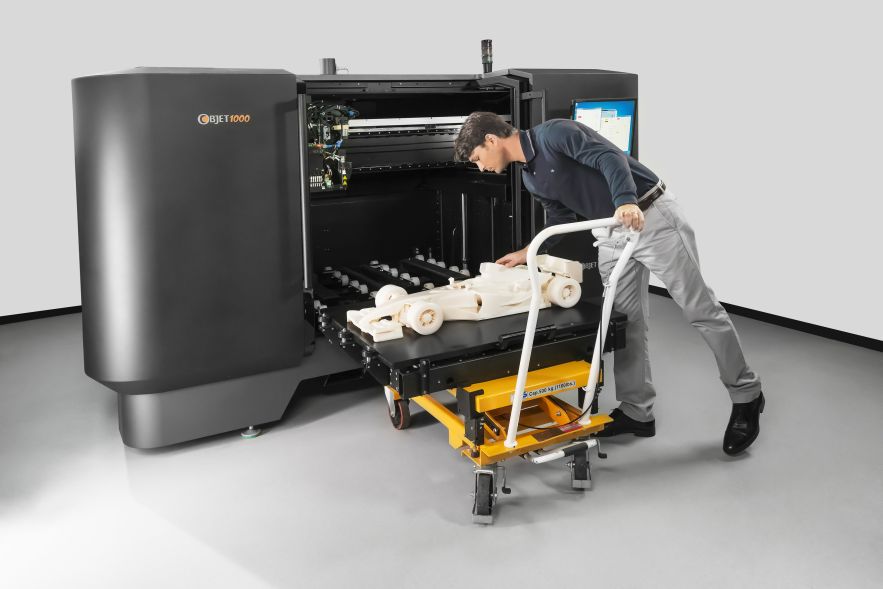
Large 3D printer (credit: Objet)
The 3-D printing industry is on track to be a $3.1 billion business by 2016 and the innovations on display this week at Euromold, a manufacturing trade show, show its foundation is growing — both in revenue and in physical print size, Wired News reports.
Objet 1000
The big news out of Euromold is the new Objet 1000 3-D printer, named for its 1000 x 800 x 500 mm (39.3 x 31.4 x 19.6 inches) — more than three times the size of competitive printers.
Instead of being limited to printing small components like a bike helmet or pedal, engineers can now print an entire bike frame in one shot.
VoxelJet
VoxelJet makes a line of machines that print sand. Voxeljet software takes 3-D models and inverts them to create empty voids along with channels for funneling in molten metal. The printed sand molds are delivered to foundries where they are filled with liquid aluminum, bronze, or other metals. After the metal has cooled, the 3-D printed mold is smashed with hammers, revealing a metal version of the designer’s original CAD model.
MCOR Technologies
MCOR 3-D printers use paper instead of plastic to make models. Their machines glue sheets of standard 20 lb. bond paper together while a knife cuts the cross section for the 3-D model. The machine repeats the process thousands of times until a solid paper model is removed from the build chamber. This week, they also announced the new MCOR Iris, which adds color printing to the specs, giving designers access to millions of colors via inkjet printheads.
Concept Laser
Concept Laser produces high-quality parts by melting metal powders using high-powered lasers. Their systems can process precious metals to create jewelry, or high-performance titanium to create turbine components for jet engines, including medical-grade products out of stainless steel and pure titanium.
Geomagic
Geomagic Spark allows engineers to capture 3-D data with a scanner, and convert it into parametric data that can be modeled, expanded, and refined. Tools like this would be ideal for engineers who need to quickly fix a complex piece of machinery, without requiring them to remodel every feature of a complicated part.
3D Systems
3D Systems announced a pair of new high-resolution printers (16 micron layer thickness), the ProJet 3500 HDMax (plastic) & CPXMax (wax), with larger format print areas (298 x 185 x 203 mm / 11.75 x 7.3 x 8 inches), and tablet apps to control and monitor the print jobs. They also announced a new offering as part of their desktop Cubify system, called FreshFiber sculpture cases. Customers choose a phone model, color, and an photograph, and their web-based software converts them into a 3-D model which can be printed and shipped.
Comments (9)
by Waldo Hitcher
These are just bigger more accurate versions of the same limited R&D toy makers.
3D manufacturing will continue to be limited to art and expensive weak parts for the forseeable future. The problem is the part molecular arrangement, part precision, part cost, manufacturing volume, cycle time and multi part generation of 3d printers is poor. There is no technology on the horizon that addresses this combination of weaknesses.
Parts when – Forged, rolled, machined, drawn, heat treated, surface treated, injection moulded etc etc have combinatory abilities far beyond the mere projection casting ability of additive manufacturing. Consider the loading and assembly options a 6mm forged screw can impart to an assembly.
Furthermore, starting with micon sized material and heating it together to make things, is for many decades going to struggle in cost terms against mass material processes.
A rethink is necessary. Radically new methods are needed. No more squirt casting. Or otherwise we just carry on with R&D toys and star wars models.
by Bri
These systems are still mainly for R&D in fairly large companies. The best printer is Objet’s 1000. it’s size of print, plus range of material mimics is quite impressive. Particularly it’s materials and ability to incorporate numerous materials in the same build. The characteristics of these new print materials is the real story. Going from hard, durable plastics to rubber. These are mimics of materials that are used in consumer products. This in it’s self really makes 3D printing more viable as a producer of consumer goods, as opposed to a prototype fabricator. If they make a consumer sized machine it will be able to produce more useful items than what is currently available from low end 3D printers. Most of what I would like to use these printers for would fall into this type of printer. The vast majority of items that I would like to produce fall into the metal sintering type machines. These spear to be mainly industrial in scale at this moment, but the article did state a machine capable of making jewelry with precious metals. If this would fall into consumer sizes and prices, it would be intstrumentsl for my business applications that I envision. It could also make far more useful items for the day to day consumer, or small business. Hopefully we will see this soon.
by Foye Lowe
The potential for the basic idea of additive construction, layer by layer or ion by ion, is awesome, particularly once a nano-scale technique is perfected. Perhaps it’s time for a new name. 3D compilers?
by Gorden Russell
I like the sound of that Foye.
by Phil
Getting to that level, the ’3D compiler’ would be software to take a description and turn it into a 3D model, which would then be created by a nano fabricator, or desktop factory.
by Dwight
Somebody already beat you to it. In Neal Stephenson’s 1995 book, ‘The Diamond Age’ they use nano-scale “matter compilers” to create just about anything, from sofas to rice.
http://en.wikipedia.org/wiki/The_Diamond_Age
Mention of “matter compilers” is made in the first paragraph under “Setting.”
On a side note, I wonder if Ray Kurzweil and Neal Stephenson know each other? I imagine they’d get along.
On another side note, apparently my new Windows Phone knows to put Kurzweil after Ray, and Stevenson after Neal. That was unexpected.
by JC
I doubt that compiler will ever be accepted broadly by society, my guess is the ‘omp…eye’ sound being hard to make. How about matter composer, or matter editor? A funny name would be thing excretor.
by GatorALLin
Great article, love the info (wish there were more direct links for things like pricing and websites).
by Gorden Russell
Yes, a great article, thanks, Amara.
Just imagine how advanced 3D printers will be by the year 2025, when NASA expects to rendezvous with an asteroid. These printers will certainly be used for manufacturing in orbit and on the moon.