Organovo partners with Autodesk research to develop 3D bioprinting software
January 10, 2013
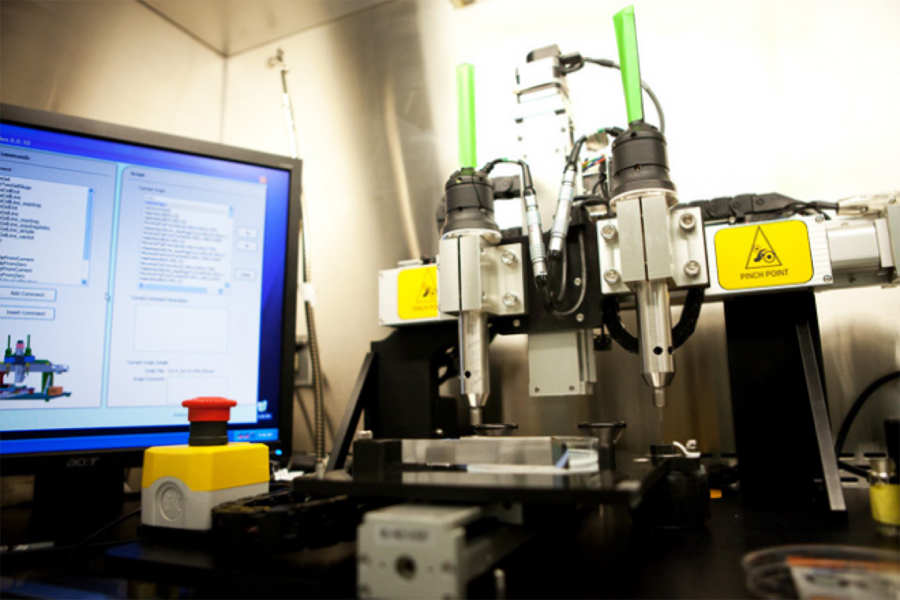
Organovo_NovoGen_MMX_bioprinter (credit: Organovo)
Organovo Holdings, Inc., a creator and manufacturer of functional, 3D human tissues for medical research and therapeutic applications, is working together with researchers at Autodesk, Inc., the leader in cloud-based design and engineering software, to create the first 3D design software for bioprinting.
The software, which will be used to control Organovo’s NovoGen MMX bioprinter, will represent a major step forward in usability and functionality for designing three-dimensional human tissues, and has the potential to open up bioprinting to a broader group of users, Oraganovo says.
“Autodesk is an excellent partner for Organovo in developing new software for 3D bioprinters,” said Keith Murphy, Chairman and Chief Executive Officer at Organovo. “This relationship will lead to advances in bioprinting, including both greater flexibility and throughput internally, and the potential long-term ability for customers to design their own 3D tissues for production by Organovo.”
“Bioprinting has the potential to change the world,” said Jeff Kowalski, Senior Vice President and Chief Technology Officer at Autodesk. “It’s a blend of engineering, biology and 3D printing, which makes it a natural for Autodesk. I think working with Organovo to explore and evolve this emerging field will yield some fascinating and radical advances in medical research.”
Organovo’s 3D bioprinting technology is used to create living human tissues that are three-dimensional, architecturally correct, and made entirely of living human cells. The resulting structures can function like native human tissues, and represent an opportunity for advancement in medical research, drug discovery and development, and in the future, surgical therapies and transplantation.
The Autodesk Research group is dedicated to innovation and discovery ranging from methods to help users learn powerful digital prototyping tools to visualization and simulation techniques that enable designers to achieve new levels of performance. The bio/nano/programmable matter group within Autodesk Research is extending this expertise by developing software for the design and simulation of molecular systems and living systems.
Comments (8)
by Renzo Canepari
I just saw the TEDMED video. Truly astounding, but in an overpopulated world,I believe that the superhuman intelligence that will allow us to inhabit other planets should come first. Long live Kurzweil, Goertzel, Markram, and Schmidhuber!!!
by Peter
If the 3-D bio-printer can print human tissue then it surely follows that it could also print other animal tissue. Rump steak or chicken, anyone? How about printing vegetable tissue? This could be the advance that solves global hunger.
The impact of 3-D bio-printing could be the most momentous human advance, only rivalled by the human advance caused by the control of fire, and the human advance that will be caused by finding a means of travelling at the speed of light
by violeta varela g.
Es un descubrimiento maravilloso solo llegar a resolver el hambre mundial ya seria perfecto y el tejido humano imprimirlo seria perfecto para solucionar enfermedades terminales, felicitaciones al equipo en general.
by Editor
Estoy de acuerdo
by asiwel
Well, I think maybe one might could say all that about nanotechnology … and certainly 3-D printing, especially bio-printing, is both good and innovative at the present state-of-the-art. But, for now, one might die of hunger waiting for the printer to print that rump steak (heck, I’d print a filet mignon, myself – or, even better, a new tooth replacement!) Still, solving global hunger seems a bit over-the-top right now. The technology would need to evolve beyond recognition for that, I’d think.
by Noahfreak
I think this particular technology wouldn’t be useful for anything other than repairing human tissues due to its expense. It’s an incredibly difficult prospect just getting human cells to grow without contaminating the whole batch, making tissue culture one of the more expensive biological laboratory procedures. Couple this problem with all of the equipment necessary for the bioprinting to occur, and keeping everything clean must be a nightmare.
That said, I saw the president of the company give a talk on their progress, and they’ve already successfully grown blood vessels in their laboratory, making bypass surgery a more permanent solution rather than its current limited success.
Unfortunately, the magnitude of getting something like this through clinical trials is keeping this company from actually bringing the technology to market. They’ve been developing diagnostic products to pay the bills in the meantime, but they need huge investment dollars before they can even start in the direction they want to go, which is printing tissues and even whole organs (a liver would be my guess as their first whole organ). It’s safe to say that if I had the kind of money that could bring this technology to market, this is where I’d be putting it. Hopefully some already rich investor feels the same way and decides to make this vision a reality.
by Bri
When I think of this tech in relation to human genome sequencing it’s easy to see that these futuristic technologies will be cheap and ubiquitous in no time. The savings in drug development will fuel rapid development of fully functional organs for transplantation. It really won’t be long before organ donation will be a thing of the past. Although I think internal rejuvenation will win out. There will be a time when the body parts made this way will be a godsend.
by Gorden Russell
Let us all wish Organovo and Autodesk Godspeed. The testing of new medicines on printed bits of human liver, then the actual printing of new kidneys and hearts will save a lot of lives. You all want to live long enough to see the Sing, don’t you?