Panasonic develops highly efficient artificial photosynthesis system generating organic materials from carbon dioxide and water
August 1, 2012
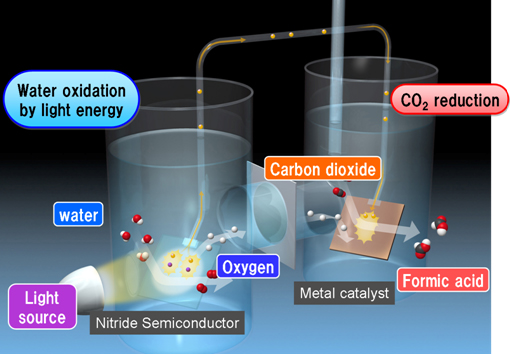
Panasonic has developed an artificial photosynthesis system that converts carbon dioxide (CO2) to organic materials by illuminating with sunlight at a world’s top efficiency of 0.2%.
The efficiency is on a level comparable with real plants used for biomass energy. The key to the system is the application of a nitride semiconductor which makes the system simple and efficient.
This development will be a foundation for the realization of a system for capturing and converting wasted carbon dioxide from incinerators, power plants or industrial activities.
CO2 is one of the substances responsible for greenhouse effect and as such, efforts are being made to reduce the emissions of CO2 worldwide. The problem of CO2 is also directly connected to an issue of the depletion of fossil fuels. Artificial photosynthesis is the direct conversion from CO2 into organic materials, which can solve both of these problems.
In the previous approaches so far, the systems have had complex structures such as organic complexes or plural photo-electrodes, which makes it difficult to improve their efficiency in response to light. Panasonic’s artificial photosysnthesis system has a simple structure with highly efficient CO2 conversion, which can utilize direct sunlight or focused light.
Panasonic found that a nitride semiconductor has the capability to excite the electrons with enough high energy for the CO2 reduction reaction. Nitride semiconductors have attracted attention for their potential applications in highly efficient optical and power devices for energy saving.
However, the nitride semiconductor’s potential was revealed to extend beyond solid devices: it can be used as a photo-electrode for CO2 reduction. The CO2 reduction takes place on a metal catalyst at the opposite side of the nitride semiconductor photo-electrode. The metal catalyst plays an important role in selecting and accelerating the reaction. The system generates mainly formic acid from CO2 and water.
The system comprises only inorganic materials, which can reduce the CO2 with low energy loss. Because of this, the amount of reaction products is exactly proportional to the light power. This is one of the merits in such an all-inorganic system, while some conventional systems cannot follow the light power in general because of their internal or external rate-limiting processes in the complex structures.
The reaction rate is proportional to the light power due to the low energy loss with simple structure; in other words, the system can respond to focused light. This will make it possible to realize a simple and compact system for capturing and converting wasted carbon dioxide from incinerators and electric generation plants.
On this development, Panasonic holds 18 domestic patents and 11 overseas patents, including pending applications.
This development was partially presented at the 19th International Conference on the Conversion and Storage of Solar Energy held on Pasadena, United States on July 30, 2012.

Comments (14)
by Steve Engard
This is a beginning step to reduce carbon dioxide in the atmosphere, produced by human activity. The next step is to convert the byproduct into something useful, such as carbon nanotubes and graphene, both of which have great potential in electronics and structural designs to replace steel. This seems to be a profitable way to reduce Global Warming.
by Mark
How many years will have to pass until the criminal elite discard the lie of CO2 causing any trouble?
It is really frustrating to hear a million lies every single day.
by William Werstler
Thank you for echoing so many of our thoughts from those who usually choose not to engage in the conversation.
by Spikosauropod
This brings us a step closer to my vision of mining asteroids and comets and turning them into usable products. By 2030 we should be building elevators into space and shifting a large percentage of the earth’s population to robotically constructed extraterrestrial colonies. By 2040 production may be at such a phenomenal output that a mass exodus of the solar system gets underway.
by Nick D Waters
When the system produces glucose we can turn it into cellulose and restore our soils. That would be the holy grail.
by Gorden Russell
Here’s what wikipedia says:
“In 2009, the worldwide capacity for producing this compound was 720,000 tonnes/annum, with production capacity roughly equally divided between Europe (350,000, mainly in Germany) and Asia (370,000, mainly in China), while production was below 1000 tonnes/annum in all other continents.[7] It is commercially available in solutions of various concentrations between 85 and 99 w/w %.[4] As of 2009, the largest producers are BASF, Kemira and Feicheng Acid Chemicals, with the largest production facilities in Ludwigshafen (200,000 tonnes/annum, BASF, Germany), Oulu (105,000, Kemira, Finland) and Feicheng (100,000, Feicheng, China). 2010 Prices ranged from circa € 650/tonne in Western Europe and $ 1250/tonne in the United States.[7]”
So it looks like there is a market for Formic acid. But smokestacks just might produce more than the 720,000 tonnes the world uses. What can the world do with the over-supply?
by Nick D Waters
The system is in an alpha state. It needs to produce a molecule such as glucose or carbon chains to be useful.
by penticton
0.02% is efficient ? I’m missing something. Perhaps ‘conversion loss’ ?
by Gorden Russell
Actually, green plants aren’t much more efficient than that. Yet most of the world’s biomass is cellulose.
by Sno
It says 0.2%, not 0.02%. After some reading (http://en.wikipedia.org/wiki/Photosynthetic_efficiency), it seems that average plants have efficiencies ranging from 0.1% to 2%. 0.2% is good for a synthetic process, i guess.
by RWoock
Orginal article states the output is Formic Acid.
by Editor
Deleted by accident, restored.
by Gorden Russell
Somehow they skipped mentioning just what this organic material would be. From what I know of botony, it could only be carbohydrates. If this process makes glucose, that could be fermented for ethanol to mix with gasoline. This glucose could even be used as a sweetener. If you can have soda pop with corn sweetener, why not with smokestack sweetener?
by asiwel
They appear to be saying that the system achieves its results by converting water and CO2 into formic acid. What will they be doing with all of that formic acid? Which is, after all, the same sort produced by ants and pretty powerful, messy stuff.