Passing of the typewriter
April 27, 2011 by Amara D. Angelica
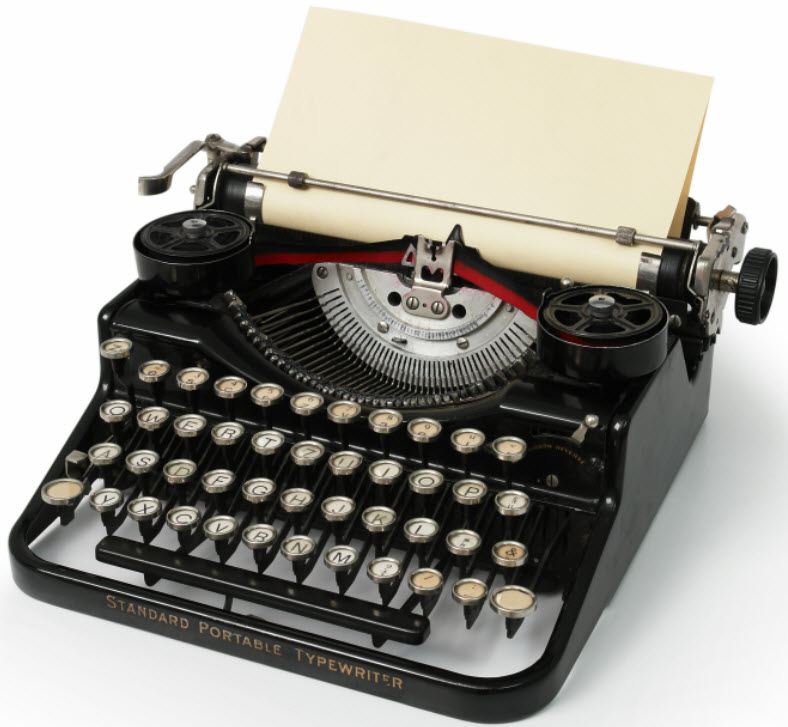
Sadly, one of the world’s last remaining typewriter factories, Godrej & Boyce in Mumbai, India, is closing down its typewriter production line, survived only by Moonachie, N.J.-based Swintec.
We may not know what we’ve lost. Despite its limitations, with a typewriter, you are pressed to think out the entirety of what you are trying to say in your head to avoid endless retyping (or using White-Out). And you have to seriously focus to avoid typos. This is powerful mental training.
Word processing can engender sloppy thinking, tendentious verbosity, and half-baked ideas that haven’t been thoroughly thought out, often scattered across meandering, random run-on sentences — like this one.
But more importantly, will a typewriter — and a good supply of White-Out, carbon paper, and paper — someday be an essential backup to communicate information after loss of power and destruction of electronic devices from catastrophic natural disasters, electromagnetic pulse (EMP) attack, bio/nuclear terrorism …. or a nuclear power plant disaster?
Maybe it’s time to think about what kind of mechanical devices … or hardened (radio frequency-blocking) electronic devices and systems we need to develop that maintain what’s left of civilization in such a scenario?
Your ideas?
Related Site Content:
No related posts.

Comments (5)
by sabsavvy
“There’s nothing to writing. All you do is sit down at a typewriter and open a vein.”
— Red Smith
by DanR
One thing we’ve lost with the demise of typewriters is the ability to fill out a pre-printed form using a keyboard. There might be such programs, but I haven’t seen them. With today’s printers, I guess it would involve scanning the form onto the screen and being able to type and see the print in it’s proper place, then putting the original in the printer to only print what I typed.
OTOH, we’re still dealing with a keyboard designed for mechanical typewriters, and not just in the letter placements. Keyboard keys are arranged in horizontal and diagonal rows. But, for instance, diagonal row C-6 slopes more than N-6. Why is that? Because on typewriters, each key had a bar attached to the mechanism beyond, and if the slopes were the same, V, for instance, would be in line with T, and that’s not possible on a mechanical typewriter. Also, today there are lots of keys at the ends of the keyboard, closest to the pinkys, the least capable fingers, as well as the most poorly positioned finger for a flat keyboard. Let’s think about whole new designs for typed input. See http://www.efn.org/~danrob/comm/keyboard.htm for some ideas I thought of years ago – as you can tell by my web site. I’d be interested to discuss your thoughts at the address given.
“Word processing can engender sloppy thinking, tendentious verbosity, and half-baked ideas that haven’t been thoroughly thought out, often scattered across meandering, random run-on sentences — like this one.”
I agree, but then how do you feel about the spoken word? I prefer typing, because I have time to think about what is being said, by ‘you’ and me. I’m guessing many of you autism spectrum futurists would agree.
And I agree about the need for simpler systems, not dependent on electric power grids, in the future.
by calzakk
@DanR: Interesting article – however, IMHO you’re underestimating Dvorak.
I had a wrist injury many years ago that was frequently aggravated when typing. I switched to a Dvorak layout on an ergonomic Qwerty keyboard (only changing the keyboard layout within the OS) and had a very significant reduction in discomfort. (The transition period was somewhat difficult, but I’m extremely glad I persisted with it!)
Ok, so it’s just a standard Qwerty keyboard with rearranged keys, but its concepts (most common letters in the centre row and reduced movement of fingers – at least for English) can’t be faulted.
by Editor
That’s not typing, it’s writing (to reverse Truman Capote).
by sagarzazu
I love typewriters – even though I cannot type. (A writer that cannot type, ha, ha) I also love film cameras. They may both be antiques today, but there is something visceral and appealing about their mechanical processes, whirring gears and the clack-clacking of metal keyes and shutters. Diesel locomotives, and antique automobiles have a similar effect on me. Beautiful antique works of machine art.