Paul Allen, supersizing space flight
December 14, 2011

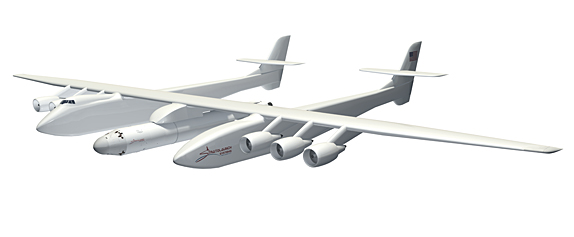
Stratolaunch (credit: Stratolaunch Systems)
Microsoft Corp. co-founder Paul Allen is prepared to commit $200 million or more to build the world’s largest airplane as a mobile platform for launching satellites at low cost, which he believes could transform the space industry.
Dubbed Stratolaunch, the venture seeks to meld decades-old airplane technology with cutting-edge booster-rocket designs in an unprecedented way to assemble a hybrid that would offer the first totally privately funded space transportation system.
The ultimate goal — which has eluded corporate and government rocket scientists for decades — is to build a reliable and flexible aircraft-based launch option capable of hurling satellites as heavy as a pickup truck into low-earth orbit. The concept envisions a behemoth mother ship with twin, narrow fuselages, featuring six Boeing Co. 747 engines attached to a record 385-foot wingspan, plus a smaller rocket pod nestled underneath. It is expected to weigh roughly 1.2 million pounds.
“Stratolaunch Systems will bring airport-like operations to the launch of commercial and government payloads and, eventually, human missions,” the company said in a statement. “Plans call for a first flight within five years. The air-launch-to-orbit system will mean lower costs, greater safety, and more flexibility and responsiveness than is possible today with ground-based systems. Stratolaunch’s quick turnaround between launches will enable new orbital missions as well as break the logjam of missions queued up for launch facilities and a chance at space.”
Comments (6)
by brent robot
Very nice. Launching on a high altitude mesa could help cut down on fuel costs.
by Vstoriguard
Fascinating….but I think I’ll let a few thousand other people take the trip first. Just to get the bugs out
victor-storiguard.blogspot.com
by edpell
This makes no sense at all. Pegasus did not revolutionize anything. Who needs instant access? The payload is small. Space-X can already deliver more now. The big question is dollars per pound to orbit.
by Khannea Suntzu
Stratolaunch, 200 million?
That is launching these rockets at an altitude of what, 20 kilometers? I have this nagging feeling we can take the same payloads a lot higher with massive stratospheric hydrogen balloons.
For a lot less money.
by Ben
I feel the same way about balloons… and there is a matter of inflatable towers (Up to 15 miles tall).
Could you accelerate a payload with a railgun over 15 miles and put payloads into orbit for pennies per pound?
Yes, and we are not talking a ridiculous amount of money. Hydrogen will escape from the baloon, so it will need to be refilled constantly. Railguns require electricity equivalent to a nuclear reactor. You can almost lift payloads out of the atmosphere before leaving the tower.
I wondered if you could have another set of rails above the tower.
The idea would be to start small, lifing 50-100 pounds at a time to space, then using solar sails to stabilize the orbit. Such a satellite would be cheap enough to almost throwaway. The first use could be to use nets to capture space junk and use gravity to pull it them out of orbit.
by melajara
This plane looks SO UGLY! Pray it doesn’t have to face a Cumulonimbus or even a mere “Cumulus congestus”…
Those are 200M wasted, IMHO, Mr Allen should instead fund innovative/revolutionary science in propulsion technology or UFO physics or stick to demonstrated rejuvenation therapies for C Elegans.