Peering into living cells at the nanoscale without chemicals
February 11, 2013
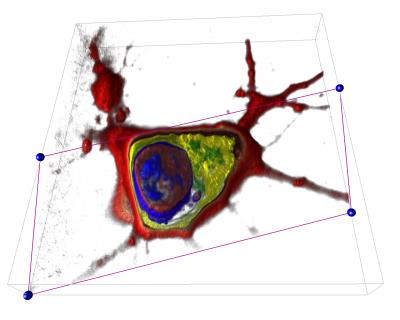
Using a holographic microscope and rotating laser beam, this image of a full living cell can be computed in minutes. The user can choose any section to see what is inside, such as the nucleus (blue) and its genetic material. (Credit: Yann Cotte & Fatih Toy/EPFL)
Two EPFL researchers have designed a device that combines holographic microscopy and computational image processing to observe living biological tissues at the nanoscale.
Going beyond conventional microscopes, they can acquire images of living cells in just a few minutes at a resolution of less than 100 nanometers — without using contrast dyes or fluorescents, to avoid distortion by the presence of foreign substances.
Being able to capture a living cell from every angle like this lays the groundwork for a whole new field of investigation. “We can observe in real time the reaction of a cell that is subjected to any kind of stimulus,” explains researcher Yann Cotte.
“This opens up all kinds of new opportunities, such as studying the effects of pharmaceutical substances at the scale of the individual cell, for example.”
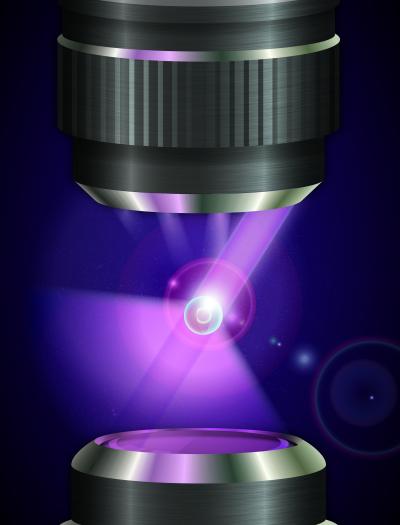
A laser beam and computer builds a 3D image of a sample, including its interior (credit: Yann Cotte and Fatih Toy, EPFL)
Watching a neuron grow
The researchers demonstrated the potential of their method by developing a movie of a growing neuron and the birth of a synapse, caught over the course of an hour at a rate of one image per minute.
“Because we used a low-intensity laser, the influence of the light or heat on the cell is minimal. Our technique thus allows us to observe a cell while still keeping it alive for a long period of time.”
As the laser scans the sample, numerous images extracted by holography are captured by a digital camera, assembled by a computer and “deconvoluted” to eliminate noise.
Finally, the assembled three-dimensional image of the cell can be virtually “sliced” to expose its internal elements, such as the nucleus, genetic material and organelles.
The researchers hope to develop a system that could deliver these kinds of observations in vivo, without the need for removing tissue, using portable devices.
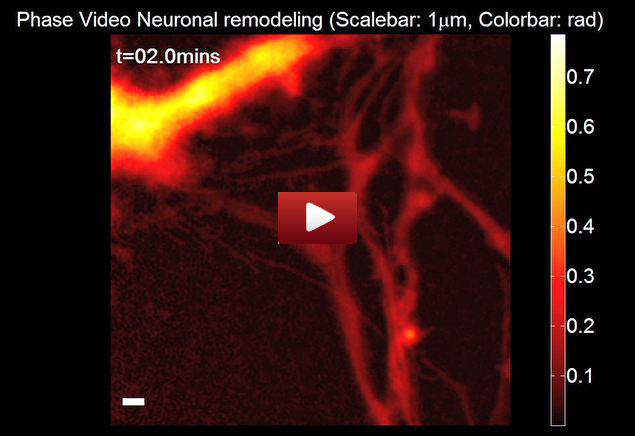
Video: Neural network in phase showing remodeling (Scale bar 1um) (credit: EPFL)
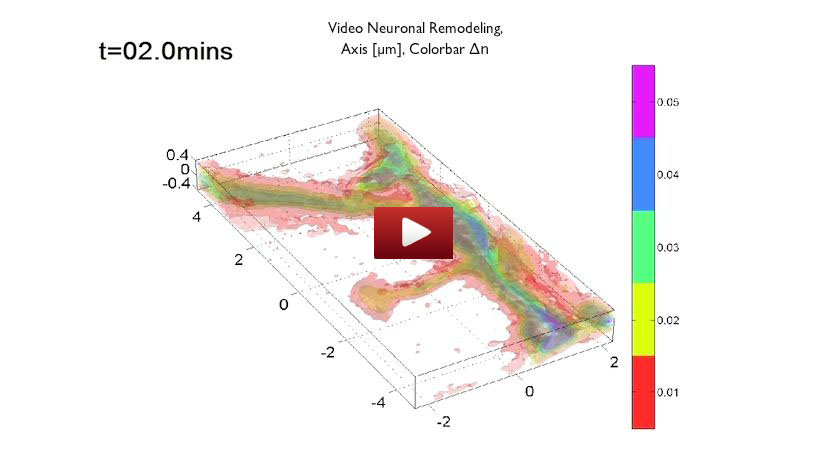
Video: A growing neuron and the birth of a synapse, caught over the course of an hour at a rate of one image per minute (perspective view, axes in um) (credit: EPFL)