Pocket test measures 50 things in a drop of blood
December 21, 2012
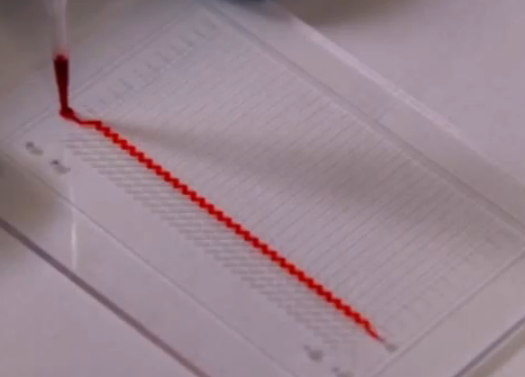
V-chip assay (credit: The Methodist Hospital Research Institute and MD Anderson Cancer Center)
A new device about the size of a business card could allow health care providers to test for insulin and other blood proteins, cholesterol, and even signs of viral or bacterial infection all at the same time — with one drop of blood.
Preliminary tests of the V-chip, created by scientists at The Methodist Hospital Research Institute and MD Anderson Cancer Center, were published by Nature Communications.
“The V-Chip could make it possible to bring tests to the bedside, remote areas, and other types of point-of-care needs,” said Nanomedicine faculty member Lidong Qin, Ph.D., the project’s principal investigator.
“V-Chip is accurate, cheap, and portable. It requires only a drop of a sample, not a vial of blood, and can do 50 different tests in one go.”
Similar assays are typically done using heavy, large, complex equipment such as mass spectrometers, or require fluoroscopy analysis, which must also be done in a lab.
How it works
The V-chip, short for “volumetric bar-chart chip,” on the other hand, can be carried around in a pocket. It is composed of two thin pieces of glass, about 3 in. by 2 in. In between are wells for four things:
- Hydrogen peroxide.
- Up to 50 different antibodies to specific proteins, DNA or RNA fragments, or lipids of interest, and the enzyme catalase.
- Serum or other sample.
- A dye — any dye will do. Initially, the wells are kept separate from each other. A shift in the glass plates brings the wells into contact, creating a contiguous, zig-zagged space from one end of the V-chip to the other.
As the substance of interest — say, insulin — binds to antibodies bound to the glass slide, catalase is made active and splits nearby hydrogen peroxide into water and oxygen gas. This approach is called ELISA, or enzyme-linked immunosorbent assay.
The oxygen pushes the dye up the column. The more present insulin is, the more oxygen is created, and the farther dye is pushed up the slide. Tests show that distance is more or less proportional to the amount of substrate present, in this example, insulin. The end result is a visual bar chart. Easy to read and accurate, Qin says, though development continues.
“The sensitivity of the V-chip can be improved if narrower and longer bar channels are used,” Qin said. “Our next steps are to make the device more user friendly and be so simple to use, it barely needs instructions.”