Preserving the self for later emulation: what brain features do we need?
October 30, 2012 by John Smart
Let me propose to you four interesting statements about the future:
1. As I argue in this video, chemical brain preservation is a technology that may soon be validated to inexpensively preserve the key features of our memories and identity at our biological death.
2. If either chemical or cryogenic brain preservation can be validated to reliably store retrievable and useful individual mental information, these medical procedures should be made available in all societies as an option at biological death.
3. If computational neuroscience, microscopy, scanning, and robotics technologies continue to improve at their historical rates, preserved memories and identity may be affordably reanimated by being “uploaded“ into computer simulations, beginning well before the end of this century.
4. In all societies where a significant minority (let’s say 100,000 people) have done brain preservation at biological death, significant positive social change will result in those societies today, regardless of how much information is eventually recovered from preserved brains.
These are all extraordinary claims, each requiring strong evidence. Many questions must be answered before we can believe any of them. Yet I provisionally believe all four of these statements, and that is why I co-founded the Brain Preservation Foundation in 2010 with the neuroscientist Ken Hayworth. BPF is a 501c3 noprofit, chartered to put the emerging science of brain preservation under the microscope. Check us out, and join our newsletter if you’d like to stay updated on our efforts.
I’ll occasionally review and report evidence and arguments relevant to the statements above, try to explain why I’m optimistic about these technologies, and to enlist your help in pushing forward their validation or falsification as fast as feasible. If validated, I’ll be pitching to you for help in getting brain preservation access and affordability to the world as fast and affordably as possible. To these ends, thank you for any frank and constructive feedback you can leave in the comments.
In this post, I’d like to try to provisionally answer a question relevant to the first three statements above:
To preserve the self for later emulation in a computer simulation, what brain features do we need?
We can distinguish three distinct information processing layers in the brain[1]:
- Electrical Activity (“Sensation, Thought, and Consciousness”)
These brain features are stored from milliseconds to seconds, in electrical circuits. - Short-term Chemical Activity (Short-and Intermediate-term Learning — “Synapse I”)
These brain features are stored from seconds to a few days in our neural synapses (synaptome), by temporary molecular changes made to preexisting neural signaling proteins and synapses. - Long-term Molecular Changes (Long-term Learning — “Nucleus and Synapse II”)
These are stored from years to a lifetime in our neuron’s connectome, nucleus (epigenome) and synaptome, by permanent molecular changes to neural DNA, the synthesis of new neural proteins and receptors in existing synapses, and the creation of new synapses.
At present, it is a reasonable assumption that only the third layer, where long-term durable molecular changes occur, must be preserved for later memory and identity reanimation. The following overview of each of these layers should help explain this assumption.
1. Electrical Activity (“Sensation, Thought, and Consciousness”)
Our electrical brain includes short-distance ionic diffusion in and between neurons and their supporting cells (i.e., calcium wave communication in astrocytes), action potentials (how neurons send signals from their dendrites to their synapses), synaptic potentials (how signals cross the gaps between neurons), circuits (loops and networks) and synchrony (neurons that fire in unison, though they are widely separated). Electrical features operate at very fast timescales, from milliseconds to a few seconds, and are variable (not exact), volatile, and easily disrupted.
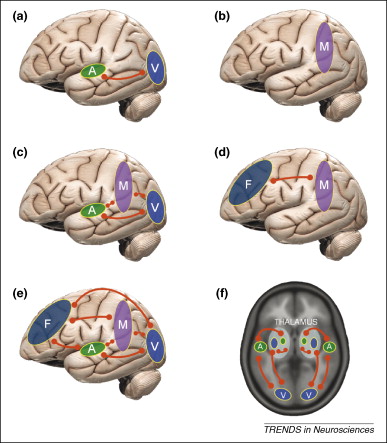
Neural synchrony — our leading model of higher perception and consciousness (credit: Daniel Senkowski et al./Trends in Neurosciences)
These features certainly feel very important to us. They include our sensations (sensory memory) and current thoughts (commonly called “short-term” memory by neuroscientists).
Recurrent loops, special electrical circuits that cycle back on themselves, hold our current thoughts (when you rehearse some information to avoid forgetting it, you are literally keeping it “in the loop”). Neural synchrony creates our conscious perceptions, and when it happens in the self-modeling areas of our brain, it gives us self-aware consciousness.
Yet electrical features are also fleeting. When you sleep, or are knocked unconscious, or are given an anesthetic, your consciousness disappears, only to be “rebooted” later, from more stable parts of your brain. Our memories aren’t even recalled with precision but are rather recreated, as volatile electrical processes, from these molecular long-term stores, in ways easily influenced by our mental state and cognitive priming (what else is on our mind). That’s why eyewitness testimony is so variable and unreliable.
The electrical features of our self are thus like the “foam” on the top of the wave of our long-term memories and personality. They make us unique for a moment, as they hold only our most immediate thinking processes[2]. Amazingly, people who undergo special surgeries that stop their heart, and some who drown in very cold water, can have no detectable EEG (electrical patterns) for more than thirty minutes, and their brains successfully reboot after rewarming them.
Essentially, these individuals are recovering from clinical brain death. Not only do they not have consciousness during this period, they have no unconscious thoughts. Yet because their deeper layers aren’t too disrupted, they can restart their electrical activities.
An excellent book about neural spikes, loops, and synchrony is Rhythms of the Brain, Gyorgy Buzsaki, 2006. It explains the emergent properties and integrative functions of these “highest order” electrical features of our brain. My late mentor at UCSD, Francis Crick, and his Caltech collaborator, Christof Koch, call this topic the search for the Neural Correlates of Consciousness.
It’s a great phrase. Consciousness is not a mystery we’ll never solve, but according to a number of neuroscientists it is a physical process of neural synchrony, in particular regions of your brain. These brief, rhythmic synchronizations share information between groups of neurons in distant regions of the brain by tightening up (“binding”) their interdependent sequences of action potentials.
The synchronizations are controlled by the inhibitory neurons in our brain, which use the GABA neurotransmitter. Disrupt gamma synch, as with anesthesia, and you take away consciousness. Give a drug like zolpidem, which activates GABA neurons and increases gamma synch, to patients who are in persistent vegetative state, and you wake 60% of them up from their comas, to varying degrees!
Wikipedia doesn’t yet have a good explanation of the gamma synchrony model of consciousness, but they will in a few more years. Laura Colgin at Kavli has found two reliable gamma synch mechanisms in rat hippocampus. She speculates that slow gamma makes stored memories available to current consciousness, and fast gamma integrates sensations to create conscious perceptions. Though neuroscientists don’t yet all agree on the details, many have found neural correlates of sensations, thoughts, emotions, and consciousness in the electrical features of our brains. These features, in conjunction with the short-term chemical changes we will describe next, represent the moment-by-moment updates to our long-term memory, self, and intelligence.
2. Short-term Chemical Activity (Short- and Intermediate-term Learning — “Synapse I”)
Short-term chemical activity is the next layer down. It involves all our short- and intermediate term learning and memory, everything beyond our sensations, current thoughts, and consciousness, but not including our long-term memories. We can call this layer “Synapse I.”
As your electrical experiences and thoughts race around the various circuits in your head, you make a number of short-term learning changes in your neural networks to capture, for the moment, what you’ve learned. These involve changes to preexisting proteins in your preexisting synapses (communication junctions), changes that last for minutes (short-term) to days (intermediate-term).
These are changes in both the mechanics of neurotransmitter release and short-term facilitation (strengthening) or depression (weakening) of synaptic effectiveness. Synapses are modified by the precise timing and frequency of electrical signals (action potentials) received by the postsynaptic neuron, a process called spike-timing dependent plasticity.
There are short-term changes in signaling molecules (neurotransmitters, cAMP, Ca++, CamKII, PKA, MAPK), and membrane receptors (NMDA). Phosphorylation states (chemical tags) are altered on some of these molecules, and a temporary equilibrium between kinases (enzymes that add phosphates to key molecules) and phosphatases (enzymes that take them away) is established in the synapse.
[Note: On Oct 15, 2012, Ye et. al. showed in Aplysia how precise spatiotemporal signaling in the synapse involving PKA holds short-term memories in synaptic electrochemical networks, and the interaction of PKA and MAPK holds intermediate-term memories in these networks, in a process called synaptic facilitation.
If the short- or intermediate-term learning or memory is to become long-term, communication with the cell nucleus must now occur, and new membrane proteins and synapses are then built, involving new or altered circuits in the connectome. If not, the new memory dies out[3].
Every night, when we sleep, our short- and intermediate-term brain writes important parts of its experiences to our long-term memory, building durable new synaptic connections, where this learning can now stay with us for years to life, in a process called memory consolidation. This process moves a subset of our recent learning and memories, apparently the most relevant parts, from temporary spatiotemporal signaling states to permanent new synaptic structures, anchored to the cytoskeleton of each neuron.
We can think of these new proteins, synapses, and circuits established in neural synapses and nuclei in a way that is very roughly like DNA, as they are long-term stable structures, encoded in a partly digital form, that will endure all the flux and variability of the biochemistry within each neuron, over a lifetime. It is these unique synaptic and epigenetic networks that we must preserve, scan, and upload in creating neural emulations, as we will discuss.
Long-term memory formation happens best when we are in slow wave (deep and dreamless) sleep, which we get in cycles during the night (and especially well if our sleeping room is dark and quiet) and also during a good nap (a great way to “lock in” what you’ve learned, after a demanding learning period that will naturally make you sleepy).
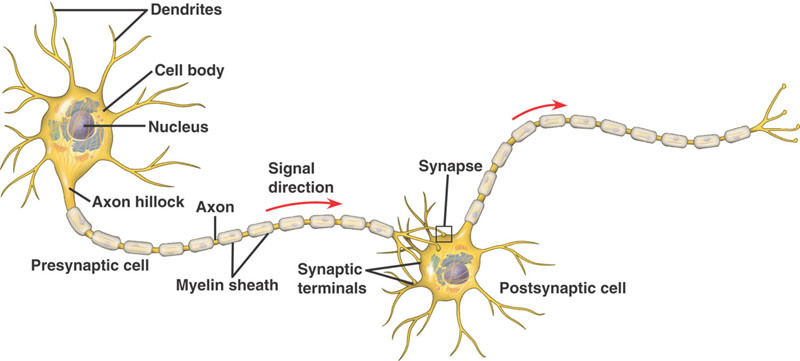
All our neurons work in circuits, and strengthen or weaken their connections based on chemical and electrical activity, in a process called Hebbian learning. Just like your muscles, which come in two sets that oppose each other around every joint, neural circuits are both excitatory and inhibitory at many decision points in the network.
Perhaps most important decision points are the cell bodies of each neuron, where the nucleus is. The electrochemical current from all the dendrites (“roots”) of each neuron flows toward its cell body, and action potentials (current waves) flow from the cell body to its synapses (“branches”), along the single axon (“trunk”) of each neuron.
Glutamate is the main neurotransmitter we use to send excitatory current from a synapse to the dendrite of the next neuron in a circuit (the postsynaptic neuron). Glutaminergic synapses are thus called “positive” in sign, and they promote electrical activity throughout the brain. GABA is the main neurotransmitter we use to let inhibitory current leak out of a postsynaptic dendrite. GABAergic synapses are thus called “negative” in sign, and they depress circuits throughout the brain.
Each neuron sums the net result of the positive and negative inputs it receives from its dendrites, over milliseconds to seconds. If the current exceeds that neuron’s threshold, it sends an action potential (depolarizing electrochemical signal) to all its synapses. As the brain learns, our synapses enlarge or shrink, giving them greater or lesser excitatory or inhibitory effect, and we may grow more or lose our synapses. With few exceptions, each neuron also uses just one type of neurotransmitter (eg., glutamate or GABA), or the same small set of neurotransmitters, at all its synapses.
The architecture of memory, thought, emotion, and consciousness may thus be reducible to a surprisingly simple set of algorithms, connections, weights, signaling molecules and electrical features in each neuron, working together in a massively parallel way to create computational networks that are far more complex than the individual parts.
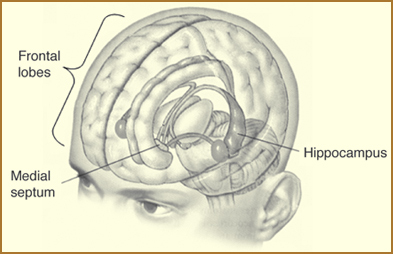
Hippocampus and frontal lobes (credit: NIH)
In higher animals, the neurons in our hippocampi (two c-shaped organs in each hemisphere of our brain), and the connections they make to the rest of our cerebral cortex (especially to our frontal cortex), store all kinds of episodic (experiential) and declarative (fact-based) information, all from our last few days of life.
At the same time, neurons in our cerebellum (a more primitive, “little brain” at the base of our skull) store procedural learning and memory (how to move our bodies in space).
Experiments with rats and primates tell us that each hippocampus makes perhaps tens of thousands of new neurons every day, from neural stem cells. Other than for repair after certain kinds of injury, no other part of the adult brain is able to use stem cells in detectable numbers, as far as we know.
The rest of our brain is postmitotic (unable to use cell division to maintain its structure), as neuroscientists learned in an elegant experiment in 2006. Our neurons must be maintained by our immune and repair systems, and as they die via natural aging, or kill themselves in apoptosis, memories start to die.
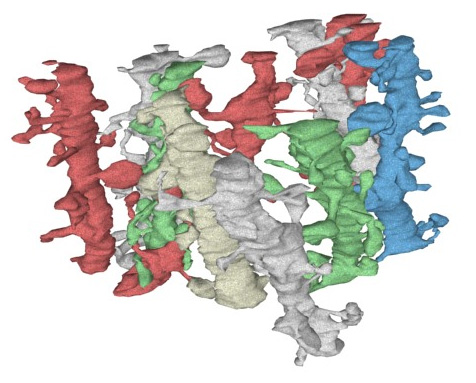
Hippocampal dendritic spines (credit: Fiala & Harris/J Am Med Inform Assoc)
Our hippocampal neurons have the very tough job of temporarily holding, in their uniquely dense synapses, and via their connections to the rest of the cortex, much of the new information we have learned over the last day or two, during our entire adult life.
Here is a picture of a computer reconstruction of a small section of ten columns of synapse-rich “spiny dendrites,” from the CA1 (input) region of the hippocampus. CA1 contains areas like place cells, imprinted genetically with detailed maps of 3D space.
Like the digestive cells lining our gut, and the skin cells at our fingertips, certain hippocampal neurons appear to get worn out on a regular basis by this demanding short-term memory holding function, and so some neuroscientists think new ones must regularly grow and mature to replace them.
People whose hippocampi are both surgically removed, like the memory disorder patient Henry Moliason, who had this done at the age of 27, can’t update their long-term episodic and declarative memories. H.M.’s long-term memory was mostly “frozen” at 27. He could occasionally add bits of new information to long-term memories of the same type he’d built before the surgery, and he could learn new procedural (spatial and muscle) memories in his cerebellum, but he had no cerebral knowledge that he’d added these memories.
H.M.’s amazing life suggests that if the brain preservation process damaged the hippocampus, but not the rest of our brain, we’d come back without our most recent experiences (retrograde amnesia), but our older memories and personality would still be intact. Ted Berger at USC managed to build a simple version of an artificial electronic hippocampus for mice in 2005, so there’s a good reason to believe that this part of our brain, though important, isn’t irreplaceable.
As long as you could install an artificial hippocampus in the computer emulation constructed from your scanned brain, you’d be back in business as a learning organism, with only some of your more recent memories and learning erased. This all helps us understand that what Daniel Dennett would call our center of narrative gravity, our most unique self, is our long-term memory.
The fact that only special areas of our hippocampus can add new cells during life exposes a harsh reality about our biological brains. We are all born with a very large but fixed long-term memory capacity, and this capacity gets increasingly used up, pruned and potentiated, the older we get. Anyone over 40, like myself, knows they are considerably less flexible at learning new things than they were at 20.
It’s far easier for older people to add more twigs to branches of knowledge we’ve previously built in our “tree of experience” than to form new branches. We can do it, but gets progressively tougher and slower the older we get.
This means, if we want to be lifelong learners in a world of accelerating technological and job change, it is critical to get an early education that is as categorically complete (global, cosmopolitan, and scientific), moral (socially good, positive sum) and evidence-based as possible.
Our children need the best mental scaffolds they can get early on, or they’ll spend the rest of their lives trying to prune away harmful and untrue thoughts and beliefs acquired in their youth. Psychologists have long known that it is much easier to add increasing specificity to a neural network than it is to unlearn (depress) any branch, once it’s built. We need to be careful about what we allow into our memory palaces.
That said, children also benefit greatly from freedom, early on in life, to study what they themselves desire to learn, and to have a good degree of control over learning outcomes and style. This freedom, and appropriate rewards for effort of any kind, induce them to build intricate mental specializations in areas they are personally passionate about.
For those who want to know how to implement a 50/50 balance of broad, state-mandated learning in future-critical STEM fields, analytical thinking, and civics (the “hilt of the sword”), and a personalized program of student-directed specialized learning, creativity, and play in the other half of the time (cutting into and mastering whatever they can convince their teachers is worth studying, or the “blade of the sword”), I strongly recommend The Finland Phenomenon, 2010 .
This film, and to a lesser extent Tony Wagner’s book Creating Innovators, 2012, demonstrate key elements of the future of learning for enlightened societies, in my opinion. It may take 20 years for the evidence to be incontrovertible and for this model to be implemented in the US, but you can give it to your child now, if you find it appealing.

MyCyberTwin – Virtual Assistants Will Be Useful for Many of Us By the Early 2020′s
It is also liberating to realize that while our biological brains are less able to learn fundamentally new things as they age, all the digital technologies we use, technologies which will bring our emulations back at an affordable price later this century, will continue to get exponentially more powerful every year.
Most of us don’t realize this, but everyone who uses a social network, email, or any other technology to capture things they say, see, and write about is also creating a digital simulation of themselves. By 2020 we’ll all be talking to and with our best search engines in complex sentences (the conversational interface), and shortly thereafter, we’ll all be able to use simple software agents, cybertwins, which will have crude maps of our interests and personality, so they can serve us better.
Computational linguists know that if you capture what a person says for just two years, we are so repetitive about what we care about that a cybertwin could whisper into our ear the word that natural language processing algorithms predict we want when we are having a senior moment, and they’ll be right most of the time.
That’s how repetitive we are, and how good web search will be by 2020. As I wrote in 2005, people who don’t run cybertwins will be much less productive, so they’ll be very popular, even though they’ll bring lots of new social problems in their first generation.
These simulations won’t be turned off by our loved ones when we die. Our children will use them to interact with a simulation of us, and to keep the best of our thoughts, experiences and personalities accessible to them. Teaching our children and ourselves to be digital natives and digital activists is thus a very important way for us to build an ever more capable cybertwin, even as our biological self naturally slows down and simplifies (prunes away branches of knowledge and memories we once had ready access to) with advancing age.
Now we arrive at our truest self, the part we care most about preserving and sharing with our loved ones and society. It is this self that I expect will later merge with the cybertwin that many of us will leave behind, as strange as that might sound.
3. Long-term Molecular Changes (Long-term Learning – “Nucleus and Synapse II”)
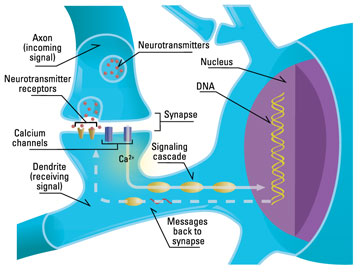
Experience-based learning (credit: Graham Paterson/Children’s Hospital Boston)
The production of long-term memory, personality, and identity requires all the short-term synaptic changes above, plus permanent molecular changes in the neuron’s Nucleus (DNA and its histones, or wrapping proteins), and the permanent creation of new cellular proteins, synapses, and circuits (Synapse II).
Here’s a brief summary of our understanding of the process[4]:
Nucleus (“Genome, Transcriptome, and Epigenome”)
1. Retrograde transport and signaling from the synapse to the nucleus
2. Activation of nuclear transcription factors and induction of gene expression
3. Chromatin alteration and epigenetic changes in gene expression (gene-protein networks)
Synapse II (“Connectome and Synaptome”)
4. Synaptic capture of new gene products, local protein synthesis, and seeding of new synaptic sites
5. Permanent synaptic changes, activation of preexisting silent synapses, formation of new synapses.
We used several “-ome” words above. Let us briefly consider each. They are very roughly ordered below in terms of their likely contribution to our unique self, from least to most important:
The Genome. These are inherited genes and gene regulatory networks that control instinctual behaviors. Our genome includes the unique alleles we received from our parents. It is easy to preserve, as it is the same in all cells. With one tissue sample we can create a clone later, either physically, or far more likely, in a computer simulation. But this clone has only our inherited uniqueness. We’ll need contributions from the next four “omes” to add our life memories and learning to the emulation.
The Transcriptome. This is the set of proteins made (transcribed) by cells. While proteomics (another “ome” word) is in its infancy, scientists estimate each of our cells has the DNA to express ~20,000 basic protein types. Each type can be further modified after creation by adding or removing chemical tags like phosphate, methyl, ubuquitin, and other small molecules, so that more than a million protein subtypes may exist in a typical human body.
Fortunately, each of our ~220 cell types only uses around 5,000 of these 20,000, and perhaps less than 2,000 of the 5,000 are unique to each cell type. Neurons and glia, the cell types we are most interested in, may use just a few hundred protein types to store our higher learning and memory in the nucleus and synapses. The other proteins are there to keep all of our cells alive, which is a critical precondition to being able to store long-term memories in a special subset of neural structures.
All this suggests the proteomics of memory and identity, and of later memory and identity reconstruction from scanned brains, are not impossibly complex, but rather highly challenging, fascinating and eventually solvable problems.
The Epigenome. These are learning-based changes in gene-protein networks that happen in the nucleus of each neuron, mostly during the life of the organism. The Dutch famine of 1944 and the Överkalix study in Sweden tell us that some epigenetic changes can be inherited in humans, so we all should seek good nutrition and avoid toxin exposure, as we may pass some of that to our children in the form of compromised and undermethylated epigenomes.
But there is a lot more to the epigenome story still to be uncovered, as this 2011 article on epigenetic regulation in learning and memory in Drosophila makes clear. Our epigenome is a gene-regulatory layer that involves chemical changes, mostly methylation, to DNA and to the histone proteins that wrap and expose DNA in the cell nucleus. These changes determine how DNA, RNA, and protein are expressed in the nucleus, and they may affect how the cell body integrates incoming electrical signals and manages its synapses.
The Connectome. This is a map of our neural cell types, and how they connect. Our connectomes and much of our dendrite structure is very similar in all of us. This shared developmental structure makes it easy for us to communicate as collectives, for ideas or “memes” to jump from brain to brain. Yet with 100 billion neurons making an average of 1,000 connections to other neurons, and most of these not being developmentally controlled, we’ve got the ability to make 100 trillion connections, the large majority of which will be unique to each individual.
The Synaptome. These are key features of the ~1,000 synapses that each neuron makes to others. They are the particular long-term molecular features that determine the strength and type of each synapse, its signaling states and electrical properties, as we’ve described them above. The synaptome is the weight and type of the 100 trillion connections described above, and this information may be the most important “recording” of our unique self.
Fortunately, because memories are stored in a highly redundant, distributed, and associative manner in our synaptic connections, our synaptome is to some degree fault tolerant to cell death. Both artificial and biological neural networks experience graceful degradation (partial recall, incremental death) of higher memories as individual neurons die.
We also know the molecular code of long term memory is fault tolerant to the noise, deformations, and chaos of wet biology. The feedback loops between the electrical and gene-protein network subsystems interact somehow to stabilize long term memories in a special subset of durable molecular changes, in spite of all the other biochemistry furiously going on to keep the cell alive.
I am sure the distinguished futurist and technologist Ray Kurzweil will have a lot more to say about these topics in his next book, How to Create a Mind, which comes out next month. You can preorder a copy here.
To understand how these subsystems interact in a living organism, let’s start in as simple a model organism as we can find, single-celled animals, organisms that don’t even have nervous systems as we know them. Wetware, Dennis Bray, 2009 is a great tour of these animals.
Single-celled eukaryotes like Stentor, Paramecium, and Amoeba do complex information processing, and hold short-term memories in their chemical networks.
In 2008, we learned that Amoeba remember and anticipate cold shocks, for example. These networks include the cell’s genome, epigenome, cellular proteins, cytoskeleton, receptors, and cell membrane. They are true computational networks, with both neural-network like and Boolean logic properties.
Genes and proteins integrate signals from other genes and proteins, and selectively switch and transmit signals, just like neurons do. The genes in each cell, via RNA, determine which proteins are made, when and where.
Most protein changes are part of the short term computation being done in a cell, but a special few will lead to lasting changes in the epigenome and the cytoskeleton and receptors in and on the surface of the cell. These long-term changes are the ones we care most about, as they store the cell’s unique memory and identity.
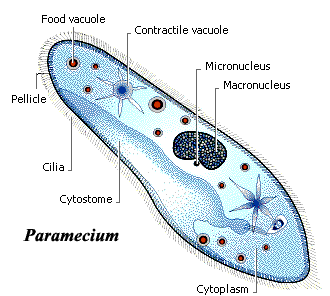
Single-celled animal (credit: Anthony Horth)
Until computational neuroscience[5] can predictively model how the gene-protein networks in a Paramecium allows these animals to evaluate options, assign priorities, regulate their moment-by-moment computational attention, continually vary strategies for chasing prey and avoiding toxins, and chemically store their representations, habituations, and memories in an intracellular environment, all without a proper nervous system, the field will be missing its Rosetta Stone.
Electrical waves exist in these single-celled animals, but with the exception of mitochondrial energy production, they are of the most primitive, diffusion-based kind. All the considerable intelligence in these animals is coursing, moment by moment, through their gene-protein networks.
In multicellular organisms with neurons, the cytoskeleton and receptors have specialized into the synaptome, the pre-and post-synaptic molecular modification of our synapses, including phosphorylation of switching proteins like calmodulin kinase II. While there are over 50 known neuromodulators and 14 neurotransmitters in our brain, only six neurotransmitters have been regularly implicated in long term learning and memory in our synaptome.
It is these and their partner molecules in the synapse and nucleus that are probably most important to understand and model to crack the long-term memory code.
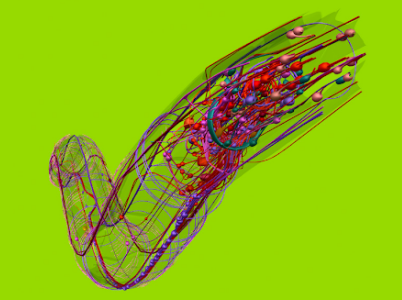
C. elegans connectome (credit: OpenWorm.org)
Fortunately, even with our very partial molecular and functional maps today we have still managed to work out some basics of neural network interaction in very small neural ensembles, like the somatogastric nervous system (~30 neurons) in lobsters.
We’ve even created early maps of very small whole-animal neural systems, like the nematode worm C. elegans, with its 302 neurons and ~6,000 synapses. We mapped the C. elegans connectome in 1986, but we still know just pieces of its synaptome and transcriptome, and even less about its epigenome.
Fabio Piano et. al. give us an overview of the state of C. elegans gene-protein network knowledge in 2006. Note their subtitle is “A Beginning.” Jeff Kaufman has recently summarized the very early status today of whole brain emulation in nematodes.
David Dalrymple in Ed Boyden’s lab at MIT is working on C. elegans simulation, and he is optimistic about new tools in neural state recording, optogenetics, and viral tagging for characterizing each neuron’s function. As Derya Unmatz reports in a blog post that sounds like science fiction, Sharad Ramanathan et. al. at Harvard can now take control of C. elegans locomotion by firing precisely targeted lasers at individual neurons in an optogenetically modified worm’s brain, controlling its chemotactic behavior and convincing it that food is nearby.
A small international collaboration exists to emulate the C. elegans nervous system, called OpenWorm. There’s even a Whole (Human) Brain Emulation Roadmap, started in 2007 by Anders Sandberg and Nick Bostrom at Oxford, and a few other visionary folks in biology, computer science, and philosophy. These important projects are quite early and extremely underfunded at present. The biggest problem today is getting more funded people working on them.
To emulate how C. elegans, Drosophila, Aplysia, Danio, Mus, and other neural networks actually work, and to begin to extract even crude and partial memories from the scanned brains of any of these and other model organisms, we’ll need a better understanding of behavioral plasticity, and the way the synapse, the nucleus, and neuromodulators bias the pattern generators in neural circuits into a particular set of behavioral patterns.
This may require not only better neural circuit maps, but better maps of several still partly-hidden intracellular systems involved in long-term memory formation: gene regulatory networks, the transcriptome, and the epigenome[6]. There are gene-protein networks controlling human neural development, neural evolution, and our long-term learning and memory. A special few of these regulatory networks, their proteins, and the epigenomic changes these networks store during a lifetime of human learning may be as important as the synapse, if not more, in determining how our brain encodes and stores useful information about the world.
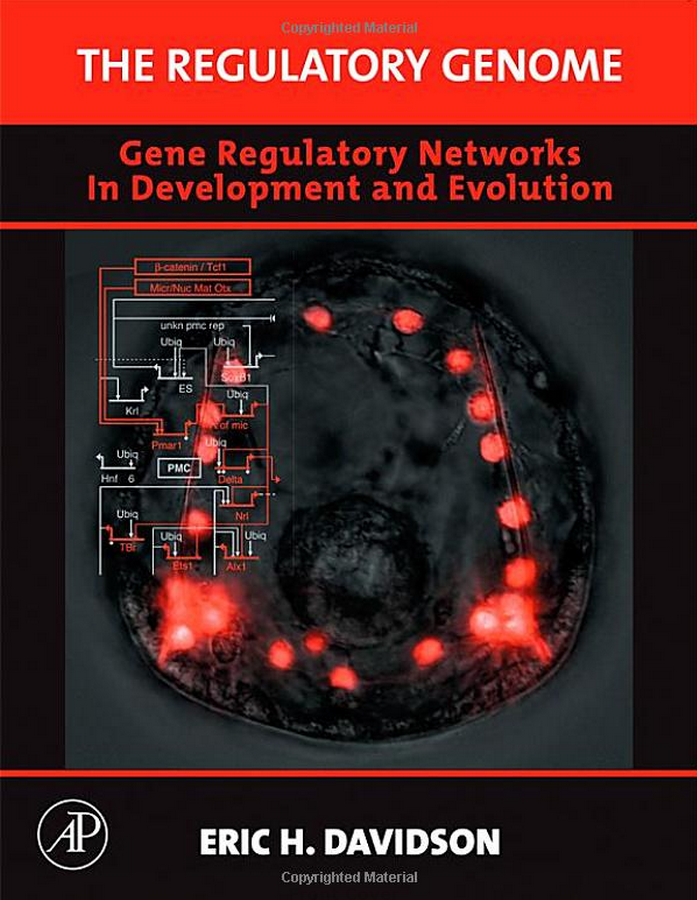
A great textbook on gene regulatory networks is The Regulatory Genome: Gene Regulatory Networks in Development and Evolution, Eric Davidson, 2006. It will amaze you how much Davidson’s group has learned about these networks, primarily by studying the evolutionary development of one simple organism, the sea-urchin, over several decades.
Last month, Isabelle Peter and others in Davidson’s group at Caltech published the first highly predictive model of how these networks control all the steps in sea urchin embryo development over the first 30 hours of its life. 50 genes are involved, and their regulatory interactions can be fully described in Boolean logic.
Now they want to model all of development, and some of the networks controlling its variational processes. Consider the magnitude of their achievement: Davidson et. al. have reduced an incredibly complex biochemical process down to a far simpler algorithm. This is what must happen in long-term memory, if we are to use scanned brains to abstract the key subsets of molecular structures that reliably encode it in our neurons.
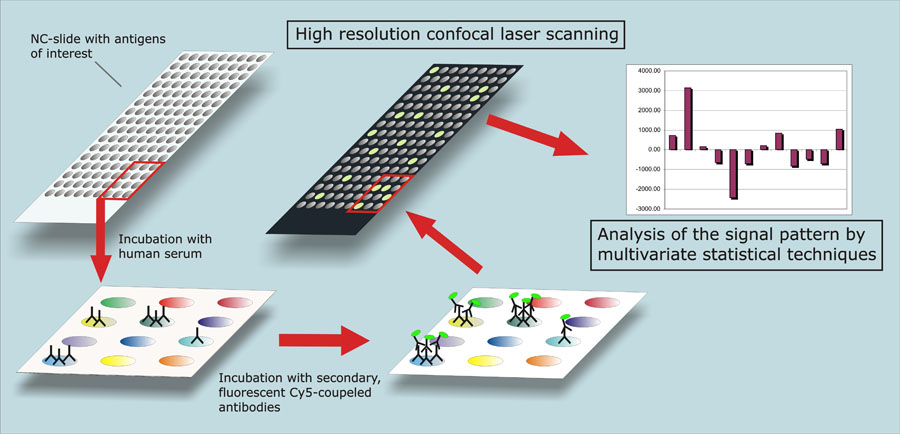
Protein microarrays — an exciting new tool (credit: Eye-Research.org)
Neural proteomics and the transcriptome are entering an exciting new phase as we use DNA and RNA microarrays, and now protein microarrays to catalog neural transcriptomes and compare them to other types of human cells, and to other primate and mammal neurons.
In August, Genevieve Konopka and colleagues published an exciting paper comparing human, chimpanzee, and rhesus monkey neural transcriptomes. We’re finding genes and proteins unique to particular areas in human brains, especially our frontal lobes. We’re building our first maps of the critical differences in the gene and protein regulatory networks that allowed us to wake up, make tools, and walk out of Africa less than two million years ago.
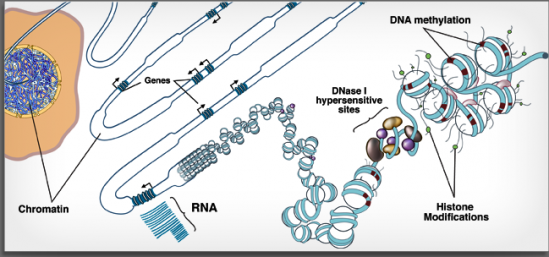
Epigenome (methylated DNA and modified histones) cartoon (credit: RoadmapEpigenomics.org)
We recently learned that what was long called “Junk” DNA, the 98% of each cell’s non-exonic DNA (DNA that doesn’t code directly for proteins), participates at various levels in gene regulatory networks, and through epigenomics these networks can change to some degree over the life of the cell. We’re learning now to map gene-protein interactions in these networks, including epigenomic changes, using tools like Chromatin ImmunoPrecipitation and sequencing (ChIP-seq).
Unfortunately, this work is also seriously underfunded. We’ve known about the importance of the epigenome for over a decade. Epigenomic changes can be inherited (watch what you do with your body, as your kids will inherit a record of some of your bad or good life habits in their epigenome!), and thus record unique learning in each cell over its lifetime, in ways we are still uncovering.
The NIH started a Roadmap Epigenomics Project for mapping the human epigenome in 2008, but the funding is a pittance, roughly $40 million a year. There is also a global collaborative research database, ENCODE, for sharing what is presently known about all the functional elements in the human genome. We give it roughly $20M/year, barely life support.
There are also various Human Proteome Projects under way, but no one seems to be funding any of these seriously, either. None of the politicians or key philanthropists who could make the Human Proteome and Epigenome into national research priorities have proposed any big initiatives, as far as I know. Even our science documentaries don’t adequately convey the promise of these fields. The scientific community is tooling along as best it can in spite of the fact that the public still hasn’t gotten the clue on how much better medicine would be in ten years if we were spending a whole lot more money on this right now.
Recall by contrast the Human Genome Project, which began with fanfare in 1990 and was rough draft completed in 2000, for $3 billion, a price gladly paid by the U.S. and four other motivated nations. The Human Genome Project was, to put it in proper perspective, our planet’s Moon Shot in the 1990’s, our species latest great leap into “inner space.”
As those who’ve read my Race to Inner Space post know, I think understanding the machinery of life and intelligence, and nanotechnology in general, is a destination far, far more valuable to us than outer and human scale (as opposed to cell and molecule-scale) space. We need an international Human Proteome and Epigenome Project race. With good funding and leadership, we might nail our first good maps of the neural gene-protein interaction layer in a decade. With business-as-usual, it will likely take much longer.
As we learn the languages of gene regulatory networks, the transcriptome, and the epigenome in coming years, we should learn how to influence these networks in many powerful ways. Do you think the trillion dollar global pharmaceutical industry is big now? Wait for the therapeutics that may start to arrive in the late 2020s, as we begin to learn how to intervene in these networks.
I think it is only when we have good maps of these gene-protein networks that we can finally expect medical advances like better learning and memory formation, elimination of a vast range of diseases including cancer and Alzheimer’s, immune system boosting, aging reduction (epigenomics repair), and perhaps even the uncovering of genetically latent skills like tissue regeneration and hibernation.
We are not talking about gene modification (inserting new genes in the germline, or in an adult), but rather about improving dysfunctional gene network regulation, and learning how to assay and minimize important parts of the network dysregulation that goes wrong in each of us as we get older and get various diseases.
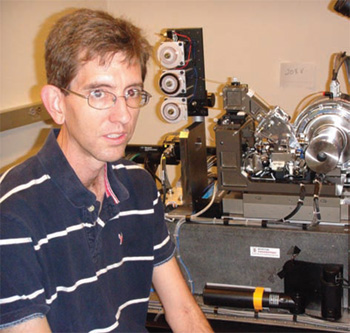
Ken Hayworth
There’s a nice analogy here, pointed out by my Brain Preservation Foundation co-founder, Ken Hayworth. The Human Genome Project gave the world affordable gene sequencing in the mid-2000’s, and ten years later, we are beginning to see the major fruits: the uncovering the previously hidden worlds of gene regulation networks, the transcriptome, and the epigenome.
Likewise, the Human Connectome Project and the still-unfunded Human Proteome and Epigenome Projects could get us affordable neural circuit tracing and functional gene regulatory network modeling in the late 2010s.
Just as the Human Genome Project showed us we had a lot fewer genes than we thought (~21,000 rather than 100,000) the Human Epigenome Project may tell us that our gene regulatory networks are simpler than we currently think, and that of the ~5,000 proteins in a typical cell, there are just a handful that matter to our long-term self.
With luck, the remaining hidden layers of the neural transcriptome and epigenome will be functionally understood in the late 2020s. In that exciting time, our ability to understand memory and learning, to read memories from the scanned brains of model organisms, and to build biologically-inspired computer models, will all be greatly enhanced.
So to answer our original question, we need to find out if both chemical preservation and cryopreservation will preserve the connectome, the synaptome, and any long-term memory-related changes in the epigenome in a living brain.
Our Brain Preservation Technology Prize, which focuses on the connectome and many but not all features of the synaptome, is an important start down this road. As we understand better what molecular features in the synaptome and epigenome need to be preserved to capture and later retrieve memories, we’ll also need to find out if either chemical or cryopreservation, or ideally both, will reliably preserve those structures at the end of our biological lives, and whether it will be possible for future scanning algorithms to repair any damage done by the preservation process.
We’re too early to answer such questions today, but it is encouraging to remember that long-term memory is a very redundant, resilient and distributed system. Extensive neural destruction can occur in brains via Alzheimer’s, stroke, and other diseases before our memories are substantially erased and cognitive reserve is no longer available.
Sixty years of histology practice tells us that good perfusion of special chemical fixatives such formaldehyde and glutaraldehyde at death will immediately preserve everything we can see by electron microscopy in neurons.
A great book on how this works is John Kiernan’s Histological and Histochemical Methods: Theory and Practice, 4th Ed., 2008. Kiernan has been publishing since 1964, and is a leader in the theory and practice of chemical fixation. There are even a few published fixation methods for whole mice brains.
Here’s a 2005 paper by Kenneth Eichenbaum et.al. demonstrating a whole brain fixation technique that claims “complete preservation of cellular ultrastructure,” “artifact-free brain fixation” and “no signs of cellular necrosis” in an entire mouse brain.
Presumably these methods also protect DNA methylation and histone modification in the epigenome, the phosphorylation of dendritic proteins like CamKII, the anchoring of AMPA receptors in the synapse, and any other elements of long-term memory formation. Presumably these molecules are protected today for years just by aldehyde fixation, if kept at low temperature (4 degrees).
Companies like Biomatrica have even developed ways to store human and bacterial DNA and RNA at room temperature for years. Long term storage of whole brain connectomes, synaptomes and epigenomes at room temperature, an ideal outcome for simplicity and affordability, may work today via additional chemical fixation steps like osmium tetroxide, a process that crosslinks fats and cell membranes, and plastination, a process that draws all the water out of a preserved brain and replaces it with resin.
But all this remains to be proven. If you know of experts who have done work in this area who would be willing to help BPF write position papers on these topics, and who can envision research projects that will answer these questions more definitively, please let me know, in the comments or by email at johnsmart{at}gmail{dot}com. Thanks.
Footnotes:
1. There is a much older layer of unique learning in each of us that is also important, the intelligent behaviors that gene networks have recorded in each of us over evolutionary time, as instinctual programs, and the unique assortment and variants of genes we each received at birth.
Such networks determine our inherited neural programs, instincts and behaviors that are executed mostly unthinkingly and robustly, and during which other forms of learning, like short-term learning, often does not even occur. To preserve this layer we just need a DNA sample of the preserved person, and that particular uniqueness can be incorporated in any future emulation, assuming future computers are up to the task.
2. Some scientists working on brain emulation, like BPF Advisor Randal Koene, suspect that measuring and modeling the brain’s electrical processes, a topic called Computational Neurophysiology, will give us powerful new insights into artificial intelligence. There are new tools emerging for in situ functional recording of electrical features of the neuron.
These may be critical to establish the “reference class” of normal electrical responses, for each type of neuron and neural architecture, the class of electrical representations of information. But if the model I’ve presented here is correct, we won’t need to record any electrical features of individual brains in order to successfully reanimate them later. We’ll see.
3. In Aplysia (sea slug), the sensory neuron neurotransmitter serotonin (5-HT) binds to postsynaptic receptors, activates adenylyl cyclase (AC) in the cell to make the second messenger cAMP, causing a short-term facilitation (STF) in strength of the sensory to motor neuron connection. More of the excitatory neurotransmitter glutamate is released by the neuron to its follower motor cells, and Aplysia pulls away harder from its shock.
The neuron is also sensitized: K+ channels are depressed, more Ca++ enters the presynaptic terminal, and the action potential spike broadens. Kinases and phosphatases (phosphate adding and removing enzymes) including cAMP-dependent PK, PKA, PKC, and CamKII control duration and strength of these changes. In facilitation, the spike broadens temporarily, as both pre- and post-synaptic Ca++ and CamKII make molecular changes that temporarily strengthen the electrical signal across the synapse.
In short-term depression (STD), the same mechanism temporarily weakens the signal. If water is gently shot at Aplysia’s gills ten times in a row, it temporarily learns not withdraw them, via synaptic depression of motor circuits. This short-term memory lasts for ten minutes, and involves a short-term reduction in the number of glutamate vesicles that are docked at presynaptic release sites in sensory neurons (undocked vesicles can’t be immediately used).
Repeat this training four times and the slug will turn this into an intermediate-term memory, making chemical and electrical changes in the synapse that now last for three weeks. Again, all this involves changes only to preexisting proteins and synaptic connections in neurons.
4. In rat and human hippocampus, the primary excitatory neurotransmitter is glutamate. This causes Ca++ influx through NMDA receptors at postsynaptic membranes, and activation of CamKII, PKC, and MAPK. Permanent synaptic changes (Early LTP) include increased insertion of AMPA receptors in the membrane, and phosphorylation of proteins to change the properties of the channel.
These receptors are anchored to the neural cytoskeleton, so they have reliable long term effects. Later LTP involves recruitment of pre- and postsynaptic molecules to create new synaptic sites. A few key gene-regulatory networks are involved, with transcriptional and translational control at both the nucleus and the synapse, and control molecules including BDNF, mTOR, CREB, and CPEB.
We’ve recently found a memory encoding master control gene, Npas4, that encodes nuclear transcription factors (the copying of other genes into messenger RNA) which interact with hippocampal neurons to encode episodic memory. When Npas4 is knocked out of mice, they can’t learn. We’ve found RNA binding proteins like Orb2, that bind to genes involved in long-term memory.
A great and reasonably current text on the molecular basis of memory and learning is Mechanisms of Memory, David Sweatt, 2009. We’re still figuring out the epigenomic regulation that occurs in long-term learning and memory, so you’ll need to go to journals for most of that story, like this 2011 PloS Biology paper on epigenetic regulation of learning and memory in Drosophila.
The full size of the memory puzzle is becoming clearer every day. Now we just need to fund the work to complete it. We sure could use this knowledge in all kinds of good ways today, if we had it. Here’s a cartoon of long-term memory formation in both Aplysia and rat hippocampus, from Mechanisms of Memory(Vol 4., David Sweatt, p. 14):
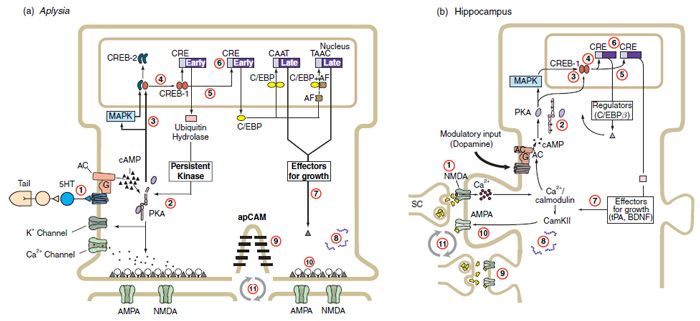
Long-term memory formation in Aplysia and rat hippocampus, from Learning and Memory, John Byrne (Ed.), 2008 (Vol 4., David Sweatt, p. 14)
5. Computational Neuroscience seeks to model brain function at multiple spatial-temporal scales. The brain uses a vast range of different schemes for representation and manipulation of information, and it passes some of this information from one system to another all the time.
Consider the way neurons integrate signals from the receptors at their dendrites, the timing and shape of their action potentials, the way synapses interact with postsynaptic dendrites from other neurons, how neurons encode and store associative memory, specialize for perceiving and storing certain types of information (edge detection, grandmother cells), do inference and other calculations, work in functional subunits like cortical columns, and organize receptive fields. It all seems formidably complex, but useful simplifications exist, as we’ve described above.
6. Most folks in the neural emulation community don’t talk much about modeling gene regulatory networks or the epigenome and its interaction with the synaptome, and I think that’s their loss. Some focus only on easier stuff to see, like electrical features, and assume that might be enough to get a predictive model.
But I think that’s like looking for your keys under the streetlights when they are in the shadows. If spikes, loops, and synchrony are a network layer that has grown on top of cell morphology and gene-protein networks, the way single-celled animals eventually grew neurons, we may learn surprisingly little by measuring and modeling electrical features.
Attempting to do so may be like trying to infer the structure of hidden layers in a very large neural network [genome, epigenome, connectome, synaptome, and electrical features] by analyzing just the input/output layer, electrical features. We need all the hidden layers if we expect to have enough computational complexity to predictively characterize learning, memory, and behavior.
Reprinted with permission from Ever Smart World


Comments (100)
by Michael Studt
We have no time left wait. Drink and be merry. The vampires are safe with the knowledge of 2046. The rest will be worm food.
by Lia Parr
Question: How would the world reproduce and increase in population if everyone had their brain preserved?
by Ironman
What if…youre wrong? there is no Self, No Person, thats the illusion that tricks the mind. There is only content. memory stored in the brain as knowledge, and knowledge is always the past and above all limited…so any action is also limited…
As is this fantasy…An identity, Person, Self pops out of thought wich again is a response of memory…etc etc…its non-existent…
by Ben Shniper
Hate to quibble, but what does “existence” mean here?
Is it existence within this universe like a physical chair? Is it existence like the idea of a chair “exists”? Or does it exist like a friendship or a family exists?
I’d argue a self (or a soul) would be the third type, and that the word “existence” is ill suited to describe it.
by Gabriel
I’ve been thinking lately on Mind-Uploading and curious on something that never seems to gain awareness. Say we managed to successfully perform this sort of operation and ‘port’ a person’s consciousness, crossing the human/machine divide, to a computer substrate, without the fear of creating a second entity and so on.
So what would happen to the body? I’m guessing the original body is essentially just a zombie now…alive, but an empty shell. Naturally, the person must not care for it too much if they decided to upload their mind, but it still makes me wonder what one would do with the body now.
by eldras
WHO’S DIED?
Excellent article.
Brain states are factors of
DNA X Environment.
Those are surely both going to be reconfigurable, and massive databases are being constructed in ever building detail.
At some point it shod be possible to give a map of anyone who has lived – ever.
That is the aim of Quantum Archaeology anyhow. It also wont matter to the dead when its done.
As with John Smart’s description what’s needed is observation and computation machines, both of which are powering on trends.
https://sites.google.com/site/quantumarchaeology/
by Gabriel
(Lia Marr: Hello Mr. X. I know it’s something that you may not be able to really understand but I have faith in knowing that God has control over life and that no human can create life.)
No human can create life? What are you talking about?
This isn’t a personal attack, but you are going to have to make what you say more sharply defined then that. No human can create life? How many people are born every single day? What about the whole field of biotechnology? Cloning?
by Mr.X
@Gabriel: I guess we both know that many religious people aren’t scientifically literate.
“… I have FAITH in KNOWING that…” – strikes me as odd.
See how she reframes it: I’m the one not understanding her.In reality, it may be vice versa.Understanding an opinion doesn’t mean one has to agree.
There is a reason it is called blind faith.
@Liar: Who created god?
by Mr.X
Sry: I meant Lia.
Shouldn’t type while being slumped over (hanging, if that’s not the right word choice) my desk after “strenous physical activity”.
Again: I apologize.It makes me look rude, although I think it funny, in some way (you know, looks like a “Freudian slip”).
by Gabriel
Not just humans, what about animals and their young? genetic engineering?
The statement that humans cannot create life is flawed….really, I don’t know know what living organism on this planet cannot create life simply due to the fact they are alive. If we are talking about the creation of an entirely new species, I feel the need to point to medicine and biotech which gives those words a run for their money…..where do you draw the line?
In any case, you’d have to be far more detailed if you want to get away with saying that humans cannot create life — as far as I can tell, we do that all the time.
by Bri
As far as I know, the closest that we have come to cresting life, is when Craig Ventore printed out new DNA for a reproductive cell of a bacterium. We don’t know hoe to make that living vessel that the DNA was inserted into. No animal or plant creates life. It’s inherent in the living reproductive cell. It’s a continuation of life. Still I believe we will figure out the last steps. We are very close to synthesizing totally independent néw life.
by Mr.X
@Bri: DNA is life.Or are viruses dead? We have no consensus on how create live.
Anyway: This argument is entirely irrelevant to the point made.
I remember having read something about creating bacteria through chemistry.
Continuation of live?Hm.To me that’s new life, not just a part of some alleged abstract “life.”
by Gabriel
Mr.X is right — while it’s good that you are getting detailed Bri, that was exactly my point…..that Lia dropped something like “no human can create life” and nothing else. Such a statement demands more clarification, otherwise it’s just plain wrong…..you can’t say something like that and just walk away with the idea you ‘proved’ anything.
Even if what you say is true Bri, how much longer will it take for, in your words, create new life from the bottom life rather then “continuing” it? How will one then rationalize the statement? That it’s not about entirely new life-forms but “life” itself in the most abstract way?
That seems to me more and more like desperation rather then patience and understanding. If an idea is pushed continously farther and farther, like the idea of omnipotence, that humans cannot create life etc etc…I’m sorry, but how plausible it is just seems to get smaller and smaller – and the only way it can somehow still be considered “plausible” is if their was no possible way to test it whatsoever…..that doesn’t prove it exists however — just that you can’t prove/disprove the idea because you can’t go any farther (e.g. agnosticism?)
You can argue, at any given point of time, it’s like that….but if, throughout history, tests have been done to prove the truth behind something and the results have continuously shown up “negative”….how can you go on with the idea that such a thing is true, if only from a practical stand-point?
Please keep in mind that I’m speaking very generally – I’m trying to express that, if only from a practical point, you have to make up your mind whether or not an idea is true or not, and if the pocket of faith is reduced farther and farther because of empirical evidence, it becomes harder and harder to believe in it. You still could, by all means….I just hope you realize there really isn’t much to say so, and you don’t hold it against others who disagree.
by Mr.X
@Gabriel:
I once read something remarkably similiar to the describtion of the life of an abstract, wished for claim that you made.
Religion regulated every aspect of human life.Then it retreated after philosophie, science etc made aviable better ways to deal with the problems that religions adressed (in the west, at least), as for example the facts about certain animals mentioned in the bible, claims about physics and so forth.Now -at last- it is trying to hold onto ethics, and providing some abstract “why” for the existance of things.
The West used to be like the middle east (who wasn’t as bad as today, back then).
Taking religious writings and honestly thinking about the Ethics therein contained will (as has already begun, especially in the eastern part of the West;)) finally push it away from it’s hold onto Ethic/ right behavior.Most people don’t follow the e.g Bible’s ethic, else they’d be barbaric.They pick and chose.
All that will be left will be: You can’t disprove/ we have some “explanations” we can’t prove.
All that will be left will be: A boundle of arguments from ignorance (argumentum ad ignorantiam).
by Damon Montano
In regards to ethics Christianity, Islam, Judaism, some groups of Hindus, as well as others certainly do not have a monopoly on ethics. Simply believing that they are ethical has nothing to do with the reality. There is a Hindu festival each year in India where the people slaughter hundreds of thousands of animals in celebration of some abstract day. Many Jews believe a cow must have its neck slit and that it must choke to death on its own blood before they will put its flesh in their mouth. They think this is “good”, “right”, even “holy”. These are very sick minded people and have no idea what ethics really means. Buddhism, Vehicle of Prodigy, and Jainism on the other hand respect all living creatures and therefore have some authority when it comes to this subject.
by Louie
Wow, A little A.D.D are we? The argument is not about God or ones belief in God. It is about the realization of having your memories live on the proverbial forever. Once we die we actually die in a physical biological term. What happens after that is based on a persons’ idea or belief. So let’s just set that aside for this issue at hand.
Preserving memories would be much like scrape booking today. It is not immoral to save pictures etc. to see our history. We should explore the possibilities of how a “tool” like this can shape mankind. Will it cause people to live different? Will humans look at their time on earth as a legacy journey? It would be much more interesting to explore the social perspective of thought saving. So can we all start over and reread the article so that when we store our memories some day we can leave a legacy of what we thought about the subject?
by oliviap48@gmail.com
Will this technology take away our humanity? The idea of immortality is found in religion. I find it ironic that as humans we are going to this idea and that a lot of scientists do not let religion invade science. Are we trying to do things without God? Are there possible consequences with that? Just putting this out there.
by Mr.X
@Oliviap: There is no god.Just putting this out there.
by Lia Parr
Hello Mr. X. This is a very interesting conversation/ question. First is there a way to prove there is no God? Or do you have faith/believe that there is no God. I think before we pursue this technology that God should be proved real or unreal. Otherwise there may be consequences with this technology.
by Bri
I don’t think there is a way to prove the existence of god. The closest that I can come to it , is like a mathematical proof. Science understands that what reality is comprised of is energy. This energy is manifesting states of information. I see those informational states as akin to spirit. True spirit is those informational states non-manifested. Whether or not we can wrap our minds around the idea of infinity it exists. It can’t be limited. That would be akin to all informational states, whether manifest or not. If you take the sum total of infinity, that would be what we refer to as god. Anyone who doesn’t believe that reality has existed for an infinite amount of time before, will exist an infinite amount of time in the future, exists in every conceivable direction, including every possible dimension, is deluding themselves. If you take this to it’s logical extention. In every single space around us is infinity, or what we refer to as god. So in my understanding of this, there is no way to know god. We are very finite.
by Vin
By definition, Omnipotence doesn’t lack demonstration even for the most lowliest, therefore lack of demonstration suggests god prefers to be non-existent and so ignored.
by Editor
Lia, an interesting question. Another way to putting that is to ask: what specific tests would be required to disprove the existence of God? That’s a challenge because the word “God” has a huge number of meanings. So one would have to spell out a specific set of attributes and properties to be tested, and define specific tests in technical detail within the realm of science; without that, the question is meaningless. Offhand, I can’t think of a definitive test, since there’s no defined method I know of for measuring the behavior or properties of “God.” So I guess I have to say the question is meaningless. I would love to be proven wrong. (As for proof, the scientific method does not attempt to prove things.)
by Bri
I’ve always disliked the semantics shell game of ” science doesn’t prove anything”. Light being bent around the sun proved Einstein right. Science ” proves” many things. It’s only when we split hairs in a debate that people hide under the statement that science doesn’t prove things. I don’t think there is any way to prove god. It’s too nebulous a term anyway. I think anyone who considers the size of the proto universe before inflation, and then asks what surrounded it, and then ponders that over time, is forced to conclude that time and space are relative. These relativities are ever changing. One has to consider that we are only seeing a infinitesimally small part of reality. If you come to the conclusion that god doesn’t or can’t exist, then you must be amazingly smart, and able to perceive things on a far grander scale than humanity will achieve in the next 100 billion years. To outright say that god can’t exist is ignorance. It ignores a vast amount of speculation by many millions of people. Given the scale of infinite time and space, I think it would be wiser to say that god does exist until proven to not exist. Otherwise you are proposing to have definitive understanding of how god couldn’t exist.
by Mr.X
Did anyone notice how the religious person shiftet the burden of proof?
In claim: I’m god.In 200 years.Now disprove.
Anyway: Checklist
-God: wishfull thinking, yes.
antropomorph, yes.
explaining things- no, who created him.If he just is, why do we need to evoke this concept at all, the universe just is.
needed for explanation- no.
-Easily competing concepts with the same viability, yes
And a standard religious god is bs; He is omnipotent.Can’t be.He can’t create a stone to heavy to lift for him.
Disprove Zeus.
Ps: It can also have consequences if we don’t develop these technologies- soon we are all “dust” and need not worry anymore.If god exists and dislikes this stuff, he can as well say so.If he threatens us, then to good claims about him are untrue and we should search for ways to get rid of him.
Have a nice day.
by Giulio Prisco
@Mr. X – Come on, the heavy stone argument has been invalidated to death by all major philosophers. A “stone too heavy for an omnipotent being to lift” is a logical contradiction in terms like a triangle with four sides. God cannot draw a triangle with four sides, because something with four sides is called a quadrilateral and not a triangle. As simple as that.
by Mr.X
And as simple as that: He is not omnipotent.Christians presuppose omnipotence- so they must be wrong.
by Giulio Prisco
Indeed, omnipotence is logically inconsistent, like Russel’s set of all sets, which is not a set. I agree that there is no omnipotent God, because the notion of omnipotence is not well defined.
This says nothing about whether extremely powerful beings, zillions of orders of magnitude more powerful than us, exist or not. I see no reason to think they cannot exist, and I guess most people have something like that in mind when they think of God.
“Infinite” means just “very big” for practical purposes. In this sense, I think there may be Gods out there, and I think we may become Gods ourselves.
by Mr.X
Giulio: Ok.I completely agree.Like I did already when I asked you wether you’re an atheist.But I remember not having said so.
I just wanted to make this clear, since there are people who take the scriptures to have certain literal meanings.I had many a conversation on this topic with christians (although mostly online, since I only know atheists and muslims- besides the priest at our local church, if you call seeing someone a few times in your life counts as knowing), and some people think their god stands above natural laws (as they are, not as we may know them) and logic.
Have a nice day:)
Ps: What would we be doing if we were god-like?My utopia would allow me to “waste” all my time with games, simulations etc;)
by Lia Parr
I see my question has started a great conversation. I have many friends who believe God is omnipotent and have a strong faith on this. What should I tell them to disprove the belief that God is omnipotent?
by Gabriel
Why should you say anything in the first place? Are you trying to “save” them?
Focus on yourself — have a philosophy that makes sense, and not just to you…have one that you are actually happy to have. Believe in something for the right reasons, and then stand behind it…until, and unless, logic and experience prove you wrong, in which case, succeed those beliefs with new ones
Whatever you choose to believe in, don’t fool yourself into thinking you know something you really don’t — don’t let “faith” be the guise for ignorance. Faith is wonderful, but self-delusion is not…don’t change your convictions “just because”, but always keep yourself open to new things — always strive to better yourself in everyway, and that includes in beliefs. It’s not easy to change your world-view especially if you’ve had it for a long time, but it’s important to recognize when it no longer holds up like you thought you did and to succeed it with something better.
by Mr.X
@Lia:
Forgive the way I express myself, I like to write my comments fast.
First: Admit you’re religious yourself.
Second, you won’t convert me or anyone here;)
Third: What do you mean by omnipotent.
And last: They should first prove there is a god.
by Mr.X
Ps: You didn’t say anything against my other points ;)
by Mr.X
“God cannot draw a triangle with four sides, because something with four sides is called a quadrilateral and not a triangle”
A mere matter of convention.But, my point wasn’t about labeling things, but doing things.
by Gabriel
Throwing this out there, but some rationalize that God is “above logic” – that he is “absolute omnipotent” in that he/she/it created what is considered logical, thus they are not bound by the rules they made, and can do, what we perceive, as contradictions. Some philosophers took this viewpoint when trying to resolve the paradox. The difficulty with this, is imagining something that supposedly cannot be imagined whatsoever, which is why, in fiction anyway, you never really see characters with this level of power. Others may further rationalize that it’s simply because we are inferior which is why we can’t.
Not that I believe in this view, or think all that much of this stuff in the first place, but throwing it out there.
by Mr.X
@ Gabriel: Thanks for your response.
I think this “we are inferior and therefore” argument is rather common.
But I think, first, people should give a reason to actively(!) believe in the existence (os opposed to the possibility, which would go for many beings once proclaimed to exist) of a god.
Not wether something can’t be disproved.
What makes this monotheistic claim special, why not ask instead wether you can get that Aphrodite godess into bed?
Where is the difference, why is one deemed more likely to exist than the other (if we are talking about probabilities, well, we could do away with gods in the monotheistic sense completely).If it is only tradition, people should grow up and get their own opinions^^
by Gabriel
Believe me Mr.X — I’m not into that masochistic rationalization in that we are inferior and that’s why we can’t logically understand; I give myself more credit then that. I was just throwing that out there ^^.
by Mr.X
@Gabriel:
I know.I perceived you to be of a similiar opinion than me^^
I thought you were providing an example for what people may say, and I think it was a good one (encountered this claim very often).
The Christian minority (not talking about paper-christs, professed christs who do nothing but say they are this or that by heritage) in our country, mostly old people, uses to say thinks like: “The ways of the lord are inexplicable.” when you ask them why certain events can still happen.
I guess that’s in a similiar vein, although it technically says something about the ways, not us, but one has to take into account that this is relative.
by Gabriel
The thing is, they very well may be true….that we can’t understand some things simply because we simply cannot, and that’s that.
The problem with that mentality is that, from my point of view, it is obviously something very masochistic and unsatisfying, and in many ways, quite dangerous — basically, it’s asking us to close our minds and trust.
Only when all other means are exhausted would I even recommend living with that kind of mentality. Others may get at me and say that I’m the one being selfish because I don’t accept blindly, but I don’t agree at all.
Hope is a good thing, faith is wonderful….but it has a place too, otherwise you are just being delusional — faith and logic are not these cartoonish mutually exclusive opposites, that’s just silly…that’s like the idea that theists are blind-believers and atheists are immoral walking brains — how babyish.
Whatever you choose to believe in, believe in it for the right reasons – see how it can be intepreted from other people. Liberty is a responsibility….don’t believe in something “just because” – you have that freedom, but even though you can believe in a Flying Sphagetti Monster, I wouldn’t recommend it nor teaching your kids about it….just because you can, doesn’t mean you should — it’s not about disrespect, it’s about not losing your sense of objective reality which is too important, faith can dull that. There is no reason why your head and your heart can’t both arrive at a decision.
I’m happy to be living in such a skeptical age – an age where people aren’t afraid to ask questions and excess of information, because it enables us to truly grow…if there was this one book that explained EVERYTHING…well, we’d know all the answers, but their wouldn’t be much growth….living in such a skeptical time with so many “truths”, enables us to slowly grow and understand what truths matter the most to us.
by Mr.X
@Gabriel:
Yes.What sometimes buggers the more sceptical people is that some religious people say you are arrogant for daring to question them.Then they say they know it because they feel it.This in fact means they take their feeling to be objectively more worth than yours.Sometimes this annoys me.
I think everyone should be able to believe and (!) question whatever he wants.
For this, I guess we are living at the best time in human history (at least till today).
by Lia Parr
Hi. Can you explain your idea a bit more for me please. Thank you.
by Mr.X
@Lia: First you explain me why how you proof your religion.
Thanks in advance:)
by Lia Parr
Hello Mr. X. I know it’s something that you may not be able to really understand but I have faith in knowing that God has control over life and that no human can create life. That is my perspective and I don’t expect anyone to share my views. I just want to share that’s all. Genesis 2:7
And the LORD God formed man of the dust of the ground, and breathed into his nostrils the breath of life; and man became a living soul. (KJV)
With this verse in mind I know who I am. My faith in God is not a religion but its a relationship with him. With this free will I can do anything, but I choose not to do certain things because I love God and I don’t want to hurt his heart. Everyone on earth too has free will and that is why technologies in brain preservation is being done. God could have stopped it from entering the minds of humans but he did not want to make manipulated beings that had no choice but listen to His commands. He wanted humans to think on their own and if they decided to love Him it would be sincere. Lastly, I think the research going into brain preservation will benefit human kind in other ways besides the main goal of reaching immortality on earth. That is my view on the subject and I hope no one thought that I was being malicious. I just want to share like everyone else. Thank you everybody!
by Editor
Lia, thanks for sharing your viewpoint, which is eloquently put. I hope you won’t feel any need to justify it. We welcome diverse (and unpopular) views here.
by Mr.X
@Lia: No problem.As long as you’re not insulted because I disagree (like Bri, who takes everything personally and then rushes his answers) I won’t ever mind.Not that this matters:)
About unpopular views: You see, they can even tolerate me (as to date) :)
by Mr.X
B: “X. I love it when you talk for me.”
How condescending from you.
“How do I take it personally. I could care less.”
You could care less means you care rather much.Thanks.Saying you have problems with logics is no insult.It’s a fact.
“You’re constantly saying thing in such a definitive manner.”
I’m not familiar enough to use the English subjunctive.
“Just because you think it or write it, doesn’t make it definitive.”
I always check wether my statements apply to myself.Do you do this, too?
“All those names that you calle are banned in the usage agreement we are supposed to follow.”
You called me names .X.Liar.Let’s talk about Amerika.See.Offensive.
“It’s speaks volumes about your character and how much I should heed your words”
Fallacy.I won’t bore you with Latin, my character says nothing about the truth of my words.Besides, nice that you know me so well.
“Call America the evil empire.”
You’re the one moralizing.I don’t think in terms of black and white, good and evil.
“I know many Germans who don’t share your views.”
“Germans” in the USA are a preselected sample.
I know many people who hate your country.Who cares.
“Google is full of opposing view points. It may bolster your arguments but it is not definitive.”
Google is a searchmachine.The content of the websites are not the contents of google.
“Saying that o take everything personally, is you trying to be insulting.”
You started altercasting me, telling me I’m full of hate.Isn’t it hypocracy to complain about this remark after such a deed?
“Your not even close to right.”
If you say so.
“I would like to understand your opinions. I hope in that way we can be friendly.”
I won’t call you a liar again, but you don’t even read my answers completly.
“I wish the best for you and your country. I look forward to reading your posts and to responding to them. Believe me, I don’t take anything you say personally.”
That’s why you so nicely imformed me about this website being AMERICAN, and that I allegedly act contrary to the rules of conduct of this site.All these contradictions.
by Lia Parr
Mr. X, how does that analogy compare to the nonexistence of God? God can’t lie in any way. He wouldn’t call a rectangle a triangle. He is holy and lying is not in his character. I also believe that for those who believe in God or not that they have faith in what they believe in. Both kinds of people do not solidly rely on scientific fact/ things they see to have their beliefs on the existence of God. I believe people put away the visual facts and believe in God or not based on what they know in their heart.
by Mr.X
I don’t believe what I want to believe.And if I don’t know something, I don’t have an opinion about it (maybe politics is an exception, but I never read any more informed post about it here, just pure opinion).Some people can’t understand that there is nothing wrong with admitting not knowing something.So they make up things.
Of course, it would be nice if one could “survive” dead because some greater entity cares.
Have a nice day:)
by Mr.X
@Lia:
Ps:Giulio brought it up (triangle thing).This wasn’t what I meant to say.I said omnipotence can’t be since someone can’t make a stone heavier so heavy that he can’t carry it anymore, and still be called omnipotent (depends on your definition).
by Bri
X. I love it when you talk for me. How do I take it personally. I could care less. You’re constantly saying thing in such a definitive manner. I find your defining the US as an evil empire, way off base. Just because you think it or write it, doesn’t make it definitive. Even your personal attacks, such as calling me a hypocrite,stupid,idiot, or liar, I don’t take personally. I think your just ranting and raving. All those names that you calle are banned in the usage agreement we are supposed to follow. Yet you do them anyway. It’s speaks volumes about your character and how much I should heed your words. Every insult you throw at me just lowers your credibility. Personally speaking, you can violate every aspect of the usage agreement and it won’t affect me. Why should it? Call America the evil empire. Should I take that personally. I know many Germans who don’t share your views. You can rat and rave all you like. How does that give you credibility? If you post a link to google, does that make it definitive? Google is full of opposing view points. It may bolster your arguments but it is not definitive.. In the end you make me frustrated in trying to be reasonable with you. You can’t stop trying to be insulting. Saying that o take everything personally, is you trying to be insulting. Your not even close to right. I find the chip on your shoulder fascinating. I would like to know more about your opinions. I would like to understand your opinions. I hope in that way we can be friendly. I wish the best for you and your country. I look forward to reading your posts and to responding to them. Believe me, I don’t take anything you say personally.
by Bri
I’m sorry of it offends you that god could be independent to your wisdom. You feel your right, and I feel your wrong. I can’t prove god ecists, and you can’t prove god can’t exist. When I try to wrap my mind around the conception of a universe, that we have now, I find it humbling. Just the shear number of galaxies, let alone stars, is incomprehensible to humans now. Many physicists propose multiverses. I tend to think that there are an endless number of them too. Thinking of all of that over time. Forward and back. Then plugging in the idea that Ray champions,of computronium and the universe “waking up”. Extend that to it’s logical extreme. You come up with an intelligence that would make you look like a bacterium, in comparrison. I think it would be hard to define your views on the topic of omniprescents in the same context as that intelligence,s thoughts on the topic. I wouldn’t expect the debate to have ended. I think god is unknowable.. It’s those darn relativities again. How does finite comprehend an infinite. I think the debate is a yin and yang. Like Schroedengers cat. All states exist. I think that all space is an illusion. That it all is a sea of infinity. Waves of holographic like information. Ideas, relationships, relativities, take their spirit and transform energy into form. That E= MC2 stuff. I mean what exactly is energy? How do you define that. It’s just ever changing quanta over time and space. I like string theory because to me the universe seems to ring like a bell. Energy just vibrating at different frequencies. An interference pattern of Yin’s and Yang’s..
by Mr.X
“You feel your right, and I feel your wrong. I can’t prove god ecists, and you can’t prove god can’t exist.”
You can’t prove that the sun will rise again tommorow.If you have a claim, it is up to you to prove.Else, you can’t expect others to take reasoning based on this claim into account.
Of course, we can take it as premise, as axiom.But why should?The axioms of logic at least have tangible results, are testable to some extent (predict things).
If you just say something like that shall explain everything, you could as well have said nothing.If it is of no consequence, you can do without it.
About feelings: Humans are a product of evolution.Therefore, it is extremely likely that our reasoning and and emotions are pretty primitive compared to what’s possible.
Your feeling of an onmipotent daddy is just based on the ape in you, who mostly organizes his societies in a strictly paternalistic, hierachical way.Combine this with some abstract thinking, and you get your god.
Therefore; your emotions are at best very weak evidence for things, since they are very, very imperfect and based on the rest of your imperfect “being”.
by Mr.X
“You can’t prove that the sun will rise again tommorow.”
Should have been it’s own paragraph.I wanted to make the point, outside of mathematics and logical systems there is no absolute proof.
Even if something happened, there is the possibility of your cognitive representation being faulty.This, to some extent, is of no practical importance (think recording, two people can still “see” a thing differently), but we are talking about your abstract reasoning.
by Lia Parr
Hello Mr.X, these are not my emotions these are based on the Word of God. I am not from a common ancestor and I am created in God’s image. Everyone is. He gave the breath of life to mankind and this therefore gives him control of life. The Creator is greater than the creation. I can give you the Bible verses that support these statements if you want . Thank you.
by Mr.X
@Lia: I was “talking” with Bri about his feelings.
Tell me, why should I as nonbeliever care about the bible?
by Bri
I don’t think you have followed my argument. I didn’t say that any material consciousness would attain gods abilities. I presented the idea that even super intelligence would probably not be able to put the debate to rest. I’ve got an idea, Mr.X. Do you believe that the universe that we see today, was the size of a proton? If so, what existed around it? What was it made of and how far did that extend? Let’s test what you do believe in!
by Mr.X
@Bri: I guess we are getting confused, because I responded to different people.
Attaining gods ability, I was talking to Giulio.
I agree with the possibility of your idea (some things won’t be settled ), so no need to argue it.
I’m also well aware of the fact that I today, can’t even imagine the reasoning ability of other possible entities.
About being humble:
First- I don’t identify with my beliefs, so you should not commit the mind-projection fallacy.
Second: I feel no need to fill in gaps of knowledge with conjuring up things.I don’t believe anything concerning your questions, since I didn’t study much on this topic.There may be ways to know what has been, very plausible ways, but without learning or thinking about it I don’t know them.
Therefore, because I don’t consider myself as having the necessary basis to form an educated opinion, I don’t have any opinion on these topics.
Just because I don’t know something does not mean I have to make up something.We have to live with temporary ambiguity, if we want to obtain truth.Everything else is immature.
In a way, this is more humble than the conduct of religious people, who despite of evolution think their faculties could automatically perceive some abstract truth better than other people, or who feel the need to succumb to social pressure on this matter, or who just are feeling bad with not knowing something or having to die.Do you fear death?
Of course, you have different premises than I, but only one of us is open to really question his presumptions.
The burden of proof lies with you, since you made the positive assertion of the existance of a God.
I’ll try tp make it easer for us to communicate:
You believe in God because of your feelings.How do you know this is a valid reason?
Ps: I was not offended by your beliefs, you can believe whatever you want (as long as this does not interfere with the lives of others in a retricting way).It seems you think I have got a problem with your beliefs?
Remember your Voltaire quote, and add to this the fact that I don’t even despise what you belief.Depending on the circumstances, each of us could be completely different than he is, each of us could have turned out like the other did.
So well, to answer your last question in some sense:
I believe in some kind of non-dualism.
I believe in the use of ockham’s razor, and other tools (!)^^
I believe in myself ;)
I believe in negotiation, not violence, concerning intersubjective communication.
I believe in Realpolitik, though, talking about nations.
I believe in studing what others said, before forming a strong opinion.
I like a certain brand of existentialism (like the writings of Camus).
I believe in Nietzsche (as in thinking sme is good at sth), because he had a good style (not talking about his translated works, I only know the original).
I believe humans are far from the best there could be.
I’m an atheist, but as open to any evidence as I can be.Of course, this means I have to constantly watch my mind.This goes for all opinions, and describes my ideal, a constant process, not a static something.
I believe in European Unity.
I believe in automatization of work, so that people can hopefully choose to hang around and do whatever they want.
In the end, I don’t believe anything the way you may do.If you ask me tommorow, or next week, I may have different opinions.
In a sense, I know nothing, and almost all our beliefs are delusions.But this would need another paragraph.
Have a nice day:)
by Bri
@X: I enjoy the discussion, but there is no doubt that we have different opinions. I thought you were getting worked up because you were talking derogatorily. I think this process of dialogue is hard to use to wade into this type of debate. As I said, I don’t think either side can “win” this debate. In terms of my questions of your belief systems, I was only referring to time and space from a physics point of view. In terms of my belief towards god, I’m unusual. I’ve had a sense of god before I could speak. My sense of time and space is very different than most peoples. If you steer your car to avoid an accident before it actually happens, it’s not a Deja vu experience. This has happened to me twice, so I tend to believe my visions of the future. On many occasions I have seen the past, present, or future, so I think of them as always existing. That is to say that for most people, they only experience the present space that they occupy. For me I see it as more of a permanent thing. The past is still there, and the future exists before we experience it. During a time when I was unable to understand language or speak to my parents, I already believed that I had lived before so I reject the idea that it was culturally inspired. I have questioned what makes me so different since I was about three or four. I’m constantly reevaluating my beliefs, but as I get older I find myself vindicated by scientific thought. Of course these are scientific theories, as Amara has pointed out. Things like the holodeck, the nature of energy, in terms of informational states, dimensionality. Just the fact that so much of the universe is unobservable. By this I refer to dark matter and energy. I know that it interreacts in limited ways, but it implies another realm that almost doesn’t have an effect on what we perceive. That there can be a whole world of things that are unseen, pass through us, yet have little to no effect. It forces you to broaden your horizons. We believe that our science has the answers yet it took a big blow with these energies, and had to admit that most of what is out there is still a mystery. The strange world of quantum physics and entanglement also warps our sensibilities. I often think of my clairivoyance as related to some form of entanglement. It’s just that as I’ve gotten older, instead of finding my experiences to be disprovable, I find more things that bolster it. Especially string theory, with it’s multidimensionality. As a person who is very musically inclined, it blows the doors wide open. So others can be incredulous toward what I say, but science keeps pushing the boundaries of what we describe as reality to overlapping multidimensional unseen paradigms.. I guess in conclusion I would say there is more to heaven and earth , than ever conceived of in our philosophies. All of these theories are nothing but belief systems and no matter what proofs science may come up with, things still come along that rock the very foundations of our beliefs. I’ll stick with mine.
by Mr.X
@Bri: You didn’t get my point :)
I guess you read into my comments what you want to, the same way you really belief because you want to belief.
Have a nice day :)
by Mr.X
Ps: Read a book on the scientific method, if you have time.You’ll see, the words theory and belief in science have entirely different usages than you might think.
Just because you interpret everything so as “to make it fit” with your view, doesn’t mean your beliefs are better.They are just much more arbitrary.I’ll take the guy who corrects himself over the one who never admits being wrong any day (science vs religion, metaphorically speaking).
And honestly, how much math do you know?
“If you think you understand quantum mechanics, you don’t understand quantum mechanics.”
You have the typically new-age outlook, spread by people who don’t understand science themselves.
Maybe you would want to get your hands on a copy of this book:
http://www.amazon.com/War-Worldviews-Where-Science-Spirituality/dp/0307886891
Have a nice day, and don’t mind my manners.I’m just a fast writing barbarian.
Pps: If you want to read something about spirituality/your experiences from the viewpoint of science:
http://www.amazon.com/Zen-Brain-Understanding-Meditation-Consciousness/dp/0262511096/ref=sr_1_1?s=books&ie=UTF8&qid=1352542876&sr=1-1&keywords=zen+and+the+brain
Anyway: Your view strikes me as pretty arrogant, willfully ignorant.
by Gabriel
Lia, that’s basically opening the door to fear — you want people to prove whether or not God is real or not before pursuing technology like this? How much longer do you want people to wait?
You cannot wait on the edge of your seat forever; it gets uncomfortable. God, or the idea of God, has been around long enough for us to question and determine the objective truth of the existence of such a being. If you are asking people to act like agnostics and wait for more evidence before making a firm decision, you are basically asking people to wait forever.
You can argue that I don’t know that for sure, but I think the thousands of years of debating has had some merit.
by Bri
@X you make me laugh! If there is anyone who is arrogant you are. You won’t answer my question if you believe in the big bang theory. I do because I understand the scientific method. Yet you tell me I should read these books to understand my own experiences. I’m very aware of current research and understanding on brain function, induced out of body experiences, etc. You should check out the TED video with the Niro anatomist that had an out of body experience. She describes the areas of the brain, how they were effected, and what she was perceiving. Try your arrogance on her. Tell her she should read up. One of the experiences that happen to me psychically speaking is telekenisi. It’s happened all through my life. When you go to do something and it physically happens before your own eyes. And you can verify it repeatedly, you tend to think that reality isn’t quite the way others portray it. I’ll stick with my new age interpretation, you can stick to yours. I have no interest in discussing my full range of experiences in this context. If you saw even a fraction of the things that I have checked the validity of, your jaw would drop to the ground.. If you want to have a real discussion on quantum mechanics or any other aspect of what I’m talking about, then let’s limit this discussion to one subject at a time.
The double slit screen experiment. Since you have read these books that you say I should read, tell me in more that a quick sentence what it is and what current scientific thought is in relation to it. Just for fun, give me a commentary on Howard Blooms take on it. He writes about particles communicating in hidden time.
Answer just those two points. Don’t obfuscate with your insults and accusations. Let’s see how much you understand. Ok? Otherwise you are just being belligerent to my views. Mine are generated from trying to understand what my psychic experiences are. They are not constructs of my mind. They also manifest in alterations of things independent of my physical body. I have been evaluated for mental aberrations numerous times at the behest of teachers and my mother. Everthing I’ve been assessed to be highly intelligent and well balanced. I have been into science since first grade. I’m fully aware of the scientific method. That’s forty six years. How many years have you understood science for..
I’ve broken this down into sections. So you’ll have an easier time understanding what I’m saying.
Only respond to the slit screen experiment. That way we can find out how much of the scientific method you understand. I don’t care if we have to recount the whole history of the debate. Science proposes theories. They make predictions of how the system will behave. These are then tested , with controlled experiments. Let’s do that with your scientific understandings. This is the topic of inquiry. The double slit screen experiment. Answer that and we will be able to test each others understanding of how science explores reality.
As you say, have a nice day!!!!
by Mr.X
Oh, are we being butthurt.
“@X you make me laugh! If there is anyone who is arrogant you are. You won’t answer my question if you believe in the big bang theory.”
Just read my comment.I neither believe nor disbelieve this, since I didn’t study the matter.Is that so hard to understand?Maybe Marcos was right about you.
“Mine are generated from trying to understand what my psychic experiences are. They are not constructs of my mind. ”
This makes absolutely no sense.If you can’t think logically, how do you want to understand science?
Btw: You are trying to altercast me all the time, it seems.Stop doing this.
“You should check out the TED video with the Niro anatomist that had an out of body experience. She describes the areas of the brain, how they were effected, and what she was perceiving. Try your arrogance on her.”
Argument by authority.Is that all?I have seen nutjobs proclaim all kinds of things.You are the one who is arrogant, since you don’t want to question your beliefs.
” That’s forty six years. How many years have you understood science for..”
You can do sth a million times the wrong way.Just because you are older than me, doesn’t mean you know what you are speaking about.
I saw what you were saying about evolution for example.If you call that understanding, than militant islamists understand science too.
Ps: If we want to talk about physics, give me the math.If you can’t do that, you really don’t understand it.Thanks.
by Giulio Prisco
@oliviap48 – technology cannot take away our humanity, because technology is one of the things that humans do, so it is part of our humanity. I am wearing glasses to write this, but this doesn’t make me non-human, just human with glasses. Similarly, when our children will have brain implants, they will be… humans with brain implants, and I am sure they will get used to it just like we got used to smartphones.
God: yes, we are trying to do things without God. But perhaps God is an emergent property of the universe. If so, by doing things without God, we are helping God to come into being.
by oliviap48@gmail.com
Soul and Spirit=Nervous System? I want to put this question out there. Also if anyone has ever read Frankenstein, I would like to compare the monster to the uploaded human. Dr. Frankenstein wanted to create something awesome, however it ended up being an uncontrollable creature that terrorized human kind. Will that happen with this technology? Also what are the benefits coming from studying this technology that is benefiting human kind right now? (Not in the sense of the future idea of immortality)
by Lia Parr
We need a soul and spirit to live. Scientists have forgotten about that. Copying the brain and the rest of the nervous system is not enough.
by Editor
An alternative to “soul and spirit” (which have no meaning in science that I’m aware of) would be “dynamics” (the actual operations and behavior of the nervous system, rather than the morphology).
by Bri
Science doesn’t recognize soul and spirit. They are words derived from religious experiences. Science can’t find any correlates. Even though dark matter is an unknown, soul and spirit don’t leave tangible effects. If telekinesis were proven, then it would have a measurable effect, like dark matter. Soul and spirit are often used interchangeably. They are distinctly different, depending on which religious perspective describes them. Generally, the spirit is thought of as changing. The soul as the essence behind the spirit. Most of these thought are derived from personal experiences, compiled and correlated. Over the eons of time, many people have had near death experiences. Also, many people have mystic or psychic experiences. These often correlate well together, with some cultural biases. From this, many cultures speak of a life after death. In many cultures, this is viewed as the world of spirit. In many cultures there is a belief in reincarnation. The accumulated different lives are often thought of as a clothing for the soul. From my own personal experiences I find this to be truth. Even though science can’t find the spirit or soul, it can’t find dark matter yet either. For me the spirit and soul are inescapable. I wish other people had at least some of the experiences that I have. Then it would be more credible and easier to relate. Time and space is an illusion created by spirit. It’s all just energy with different states of information or spirit affecting it’s manifestation. All of that is orchestrTed by all our souls. All souls, spirits and energy, taken as a whole is what we refer to as god. It is not biased toward anything. It creates all things. Time and space are a tiny part of the sum total of what is. Contemplating infinity in all it’s manifestations can give a general sense of what god is. As described in most religions, god is unknowable. A finite can’t contain an infinite. A soul can’t be perceived in full, because it is an infinite. A spirit can be perceived, because it is just a flicker of a soul. Just as your thoughts and appearance changes.. I apologize for being preachy. It’s just frustrating to me to see such confusion. As I’ve said, for me this is unescabale. It is just a part of my daily experiences.
by Mr.X
@Bri:
Well, I think you don’t need the concept of a soul to explain certain experiences.There are eastern traditions that emphasize this point, being non-dualistic (by which they mean body and mind etc are one).
One simple test: Read some historical accounts of such experiences, some modern from other cultures, and you’ll see they’re colored by their heritage, indicating they happen in your brain- are body based.
Another thing is that people don’t know what the wirring of their brain can do, since they think they themselves perceive reality “as is.”
This isn’t true, imagination and seeing are done by the same part of our brain (simplistically speaking).Our brain constructs our world, and filters sense experience.Everything we perceive is not directly perceived, since the atoms of our bodies don’t touch anything directly (at least not the things they aren’t reacting with).
Every incoming stimulus is already in the past (e.g the time it needs to reach us), and the parsing and constructing of your world-view is done before it reaches consciousness, meaning we perceive a filtered memory of the past as present.This can, in some instances, alter our perception of cause and effect.
A study I read about claimed that more people have had mystical experiences than not.But not everyone judges them the same way in retrospective.
Have a nice day:)
by Bri
I understand your point, and have considered it at great length. One of my earliest experiences, I was about two years old. My mother was teaching me to drink from a cup, not a bottle. I was inside my chest, looking up at my throat. It was clearly above, and I was detached from my body, even though I was inside. It was as if I were watching someone else. I didn’t have words, but my responds was indignation at having to learn how to do this yet again. My parents are relatively agnostic. They are like Ray. They concede that there may be a god, but they don’t think so. So where did my perspective come from? Nobody in my local community ever expressed thoughts of that nature. I wasn’t exposed to eastern thought till I was a teenager. From my inner thoughts, there has never been a time when I was not aware that I had not lived before. This thought is foreign to my community. Many of my psychic experiences are centered around this phenomenon. I don’t relate them because there is no way to validate them. I often see that people reincarnate with other people that they have k own on previous lives. I sometimes see flashes of their shared experiences. More often their shared relationships. Father, son, mother,daughter etc. Where does that come from? It’s not the belief system of anyone in my community. I have thousands upon thousands of these type experiences. I don’t ask for them. It’s a knowing that has been an integral part of my life for as far back as I can remember. It is alien to everyone I’ve meet until I was in my high school years. I really don’t talk about even a small fraction of what I have seen or experienced. One of the hardest things I can relate to you is that I have always felt gods presence. When I was about eight years old, I started reading about ancient Egypt. It’s principal god is the god Amun. I built a small shrine and would worship there. It’s not like a Judeo, Christian, muslem, or eastern service. I would stand there and just feel love for god. No words, no actions, just a sense of adoration. I pretty much do that everywhere. I don’t feel that god isn’t everywhere, and I feel that sense of adoration, even in adversity. It is still to this day, shocking to me, that others don’t feel this. Many times in my life I have had a strong sense of alienation. That I am a foreigner in foreign lands. I have never come across anyone that has had similiar experiences. As I have said, for me it is inescapable. It’s impossible to divorce myself from these experiences.. All of who I am and how I relate to the world is derived from this. I became aware that it was unnatural at about three to four years old, and for the most part, have kept it hidden since then.. As I’ve said, I’ve told only a small fraction of what I’ve experienced. Most would not be understandable or believable to people. For me it’s just my life.
by Mr.X
@Bri
Thanks for sharing.Well, there is something about Egypt- I remember reading about Mr.Crowly and that he -too- felt something about some Egyptian god.
http://en.wikipedia.org/wiki/Aleister_Crowley – in case you want to read about him.
Have a nice day :)
by Bri
I think Crowley was on the cover of the St peppers album. I see his work as babble. Amun is described as the hidden one, he who is in the shadows, unknowable, the one upon whom all things are dependent, creator of everything. When I read those things as an eight year old child, they fit the feelings that I had had. I’ve just always felt a presence, and those words fit my feelings. Very different from Crowley.
by oliviap48@gmail.com
Then would it just be a copy of the human and not the actual person? This stuff really interests me and I would love to hear more about your point of view. Thank you!
by Editor
Statements 1 and 2 (at the top of the blog post) refer to the actual person; statement 3 refers to a copy.
by Bri
From my personal experiences, everything has a soul and spirit. In the fullness of infinite time. Take your personal computer as an example. I know this will sound illogical, but over infinite time, going in infinite directions, it will repeat an infinite number of times. That is it’s spirit, or essence repeating. Take all personal computers, in all there possible manifestations over an equal infinity, and that would be the soul of personal computers. Your question relates more to if they can become self aware. The answer to that is yes. Can you put your consciousness, not a facsimile into a computational substrate. I know it can be done, it’s just not going to be easily achieved. Just because you put all the information of your physical state, into a machine, whether mechanical or biological, doesn’t mean you’ll have a continuity of consciousness. If you make absolutely perfect biological copies of your self. With no information missing. It doesn’t matter if you make one or a thousand. You will not experience what they experience. Uploading may appear identical to an observer, but the original I is bound to it’s vessel. It can be induced to change vessels., but this won’t happen automatically. I am at odds with most people who believe that a facsimile will intrinsically be them, but my own personal experiences make me feel that what I’m saying will be proven the reality. I don’t mean to dash the hopes of people, but your I AM is yours, and the facsimiles I AM is theirs. They occupy different space. All of everything is alive with it’s own spirit of I AM THIS. Time and space is an illusion created by all of everything or infinity. What we refer to as god.
by Mr.X
@Lia: Can you prove this!?Can you prove I have a soul, or the contrary?
by Darren
Just don’t do it all at once.
by Christian Gehman
It’s worth noting, also, that we already have people who can not only recreate human experience, emotion and mathematical functioning but also transfer those things to other minds — we call them artists: poets, novelists, painters, musicians, composers, mathematicians and teachers: high priests of the temple of information.
by Christian Gehman
I say, let this team design a more appropriate and more accurate type of informational “Turing test” to gauge the degree of “human-ness” …. At last we are beginning to get a clear picture of what it means to be human – as opposed to being a machine. Of course, this is all beside the point because, as we all know, a human being is only a gamete’s way of making another gamete.
by Erik
If it’s possible to transfer consciousness (A) from an organic substrate to an electronic one (B) – neuron by neuron to transistor by transistor- then why shouldn’t you be able to split B into two or more consciousnesses?
Maybe bit by bit, so we have C,D and E?
I see two alternatives:
1) A,B,C, D and E are all the same mind. How that would work is beyond me. Will you be able to look with ten eyes??
2) Or they are all different and if so, then it’s not possible to make the initial transfer. A and B would be different.
by qraal
One thing not regenerated at the molecular level is our neocortical neurons – as made clear by radiocarbon dating of different parts of cadavers of post open-air nuclear testing deaths. Everyone living after the Cold War bomb tests has a unique spike in C-14 which is slowly, predictably declining, givinga time stamp to each part of the body. Two parts are almost as old as “you” – the neocortex and the crystallins in the lenses of your eyes.
by Dave Mitchell
What if there’s reincarnation and this all overkill?
by Editor
What if future scientists recognize brain emulation as how the ancient myth of reincarnation was finally actualized?
by Christian Gehman
ah, yes, just install the new “brain” in a “vacant” android body …
by Mr.X
@Dave: What is if nihilism is the right way to think!?
You see, this leads to nothing.Where I’m from we have a saying: “Trust is good, controling (in the meaning of checking, not forcing- before cliches surface) is better.”
Or an English one: Better safe than sorry (although technically you wouldn’t even be sorry, you just wouldn’t be).
Maybe some of us (like Hindus) don’t want to reincarnate, they can freeze their “living” body and live in some kind of nirvana that way.Or they can choose virtual nirvana.Others would still want to live with their contemporary identity.
Well, and to people like me all these beliefs are unlikely, and I won’t guide my decisions by meta-physical playground “arguments”.
by James Vaughn
Watain, I think your comment is exceptionally keen and relevant here. What we are today, looks, feels, and behaves differently years from now. We are quite literally dying, being reborn, and transforming on a cellular level from moment to moment. Death, as we medically define it, is the cessation of all vital functions of the body including the heartbeat, brain activity (including the brain stem), and breathing. But if the mind can be transferred to a system that isn’t susceptible to decay, and remain active without the body, and even be reinserted in a body for continued physical experiences, then “we” don’t die just because the vessel of our mind has changed. Likewise, though our body remains, in whatever form, do we die as a “soul” when memories fade and are replaced by new ones? I would hesitate to say that. But then, I would hesitate to say that we are our memories. Although our memories color our intentions and responses to the world, we have to look at what we are in our essence. If all your memories were wiped out this very moment, you would still be alive. You would still be considered a person. You would still have an innate impetus to experience the world, create relations, and find something meaningful to do with your life.
When some asks “Who are you?” Our typical response is to give a name, right? But your name isn’t who you really are. It’s just what you go by. It’s something for the government and social community to identify you by.
Following “Who are you?” the typical next question is “What are you?” or “What do you do?” We don’t tell people that we’re a lung, or that “what we do” is breathing -even though that is literally something we do as an organism to exist in the world. This question is essentially concerned with the relevance of one individual to another. Many people define themselves by what they do -and ascribe their value to their function in society. This is perfectly natural considering that biology essentially does the same thing. Our immune system determines what is “belongs” in the organism and what does not. Each cell in our body has a specific function. They can be destroyed, reduced to their components, and recycled according to the needs of the body. Today a cell may be a liver cell. Tomorrow its components may be a heart cell. In one moment a cell belongs to a potato. The next moment, it’s a human cell.
Long ago, in my exploration of the potential for perpetual life through regenerative medicine, I got the notion that perhaps the reason our bodies don’t regenerate indefinitely is because we don’t regenerate our psyche in tandem. What good would it be to start life again with a new body if your personality remained that of a bitter, cynical, stubborn, and crotchety? That would be no way to live one’s childhood. So it occurred to me that perhaps the renewal of the mind, heart, and spirit may go hand in hand with the renewal of the body. So, in effect, perhaps in order to live in perpetual youth, we have to recondition our mind and heart to that of our youthful state. But how can we do this? And if we can do this, will we lose the wisdom and intelligence we’ve developed through experiences that may have made us more cautious, guarded, and rife with defense mechanisms born of emotional wounds. Perhaps aging is the result of not healing and returning to emotional and mental homeostasis?
That being said, I have conceived that one of the reasons -perhaps THE reason- that we age and die is because we ultimately crave novelty and new experiences. Albeit, I would love to live indefinitely to explore all the things that fascinate and interest me, and I could certainly fill hundreds of years with endless engagements, but at some point, we may want a completely new experience that only a different body -and a different mind- could provide us. How many people wonder what it’s like to be the opposite sex? How many people wonder what it’s like to be one kind of animal or another? How many people wonder why some people seem to be happier, more carefree, better able at making friends, more inventive, more successful, etc? Are such thoughts the very impulse of our spirit yearning to break free of the body and mind that does not provide these experiences?
Romertl, you bring up another key point. It’s one thing to transfer the mind from one vessel to another, but something very different to duplicate the body AND mind of an individual. I too saw “The Prestige” and it brings up a potent philosophical conundrum. Once you’ve been duplicated, if you’re killed, although the other “you” continues to live, the “you” that died seems to have necessarily been deleted. Perhaps it’s not the best analogy, but let’s say you have 2 CDs of a certain album. If you give one away, whatever happens to that CD will be unknown to you. You can only experience what happens to the CD you keep. I think this is similar to how once you’ve created a duplicate of yourself, you’re still “you” and if you die, that will be your experience. Whatever happens to the other “you” will be unknown to you -granted that once we die, we are removed from all physical and conscious experience.
by Jim Mooney
It’s a knotty philosophical question. If my consciousness is perfectly duplicated, I die, and it’s inserted into a clone – did I die or was I reborn? The answer isn’t as simple as thought. And of course, if trick people and stay alive, then the clone also comes alive, who owns the house ;’)
by tim333
I think point 4 that societies that preserve 100k brains will then see positive social change is a bit dubious. You argue in the link that societies would have to be pro science and progressive to do that but I think cause and effect may be the other way around – that society would have to be pro science to preserve brains rather than will become pro science because they have brains in the freezer.
by Christian Gehman
When funded by the military, science does not necessarily lead to progressive advances in human thought or culture.
by Christian Gehman
Rather than being pro science and progressive, isn’t it far more likely, given the scope of human history, that the societies which preserve 100k brains would be clan-closed aristocracies that generate extreme disparities in wealth and use most of their excess production to make war on their neighbors? Brain/personality preservation will be (a) very expensive and (b) reserved for the few, whether they be “worthy” or just very, very rich. Tell me, do you believe Mozart’s brain would have been preserved? Or Bach’s brain? to name just two of the higher peaks of musical accomplishment …. Would our hypothetical society preserve Van Gogh’s brain? Picasso’s brain? or would it choose to preserve, say — Ronald Reagan’s brain? Are some people, ultimately, more human than others? What kind of test could be devised to validate a successful transfer of “hujmanity” …. ?
by Gary Salter
The problem is that people can think that they will magically appear “in the cloud” when their brain is scanned (uploaded)……no, it won’t, when you die, that’s it, you are dead…..a copy of you will exist in the clod, buy you will die.
It’s better to keep yourself alive by Aubrey de Grey’s SENS project and the Mprize projects and reverse your aging to make yourself younger because then you still exist…..advanced brain scanning would be usefull if and when we have advanced nanotech and if you had part of your brain damaged, it could be restored by application of nanotech.
I think that part of the problem here is that a lot of people belong to various religions that predate science and that have defined the body as two seperate entitites, your body and your soul, but science shows the exact opposit, we have one body-mind configuration and that’s it, if you want to preserve it, then aubrey’s SENS and the Mprize are the only ways to succefully reach that goal.
by RomertL
I do think about this a lot, ever since I watched the movie “the prestige”. And even more after getting into the Singularity thing. There’s definitely no easy answer. Maybe there not even a hard answer. The perfect copy will be convinced he is the original, have all his memories and attributes etc. And so will everybody else (unless they know). The problem comes when, like in the movie, the original is preserved. Then two individuals will claim they are the same person, surely one has to be wrong. Or has he? Maybe they are one individual until the copy is made, and then split to two, neither more “original” then the other. To say one is more original than would be to say that the self is in the matter rather then the pattern. But, as Kurzweil likes to point out, we’re not the same cells and molecules walking around today as we we yesterday… That’s not to say I don’t agree that the SENS approach is a safer bet. But pretty sure most people think about cryo or chemical preservation as a last resort if everything else fails. Or like someone said (don’t remember who): better alive than frozen, but better frozen than rotten
by Vin
I would say one still remains ‘the original’ because it will always be impossible to make a ‘perfect’ duplicate.
by Watain
As i age, i lose memories, change my opinions etc. etc. Every atom in my body is also changed relatively often. Every couple of years i go through the process of being “copied and killed”, as the building blocks in my body changes. Even if i could reverse aging i would still lose memories etc, due to inherent limits of the human brain.
If you dont believe in a soul, then there should be no argument about uploading. Your body is the atoms it consists of, if you can make an 100% accurate simulation, that IS you. If it is not you, then that would hint at the existence of a soul that can not be copied.
I am 24 years now, in 20 years this version of me will be gone and dead, and a middle aged man with my dim memories will have taken his place. If i was uploaded tomorrow, i would be able to keep my 24 year old self alive a lot better.
Just my thoughts on the matter, sorry for the bad english ^^
by Christian Gehman
:”A copy of you will exist in the clod” … ashes to ashes, dust to dust?
by GAUSS
A very thorough article indeed.
by Khannea Suntzu
AS MUCH AS POSSIBLE. “I” (note the paranthesis) don’t want to turn out some horrific mentally disfigured freak shadow of my former self after I miss on the necessary resolution.
by tesla111
Well goodbye then! You take the worms, I’ll take the Future!
by Gorden Russell
That’s right, tesla111. Ya know the dice are loaded, but it’s the only game in town. But by 2046 the game will be fair. Just keep good care of your health until then.
by Christian Gehman
Alas, most of the people alive today will be dead by 2046. Youth for the young! Forever!
by Bruce Bowen
Don’t worry. Missing detail will be filled in by prosthenic info as needed. :)