Printable houses are coming
April 11, 2012
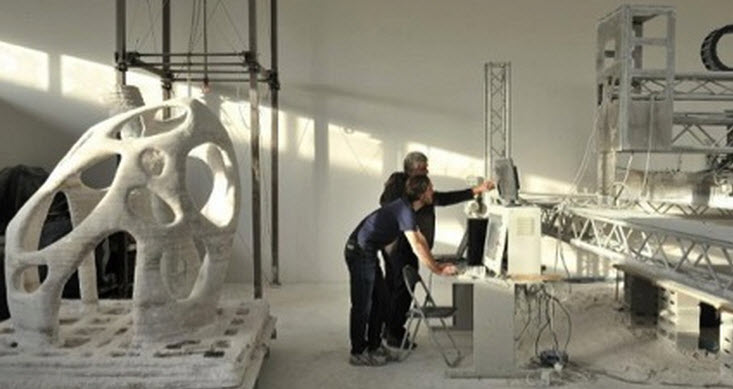
Italian inventor Enrico Dini has developed a huge 3D printer called D-Shape that can print entire buildings out of sand, The printer sprays a thin layer of sand followed by a layer of magnesium-based binder from hundreds of nozzles on its underside. The glue turns the sand to solid stone, which is built up layer-by-layer from the bottom up to form anything from a sculpture to a sandstone building. (Credit: Monolite UK Ltd.)
The first “printed homes” will be coming soon, says World Future Society blogger Thomas Frey.
One construction technology that has great potential for low-cost, customized buildings is “contour crafting — a form of 3D printing that uses robotic arms and nozzles to squeeze out layers of concrete or other materials, moving back and forth over a set path to fabricate a large component.
Structures would be quicker to make, reducing energy and emissions. Using a quick-setting, concrete-like material, contour crafting forms the house’s walls layer by layer until topped off by floors and ceilings that are set into place by the crane.
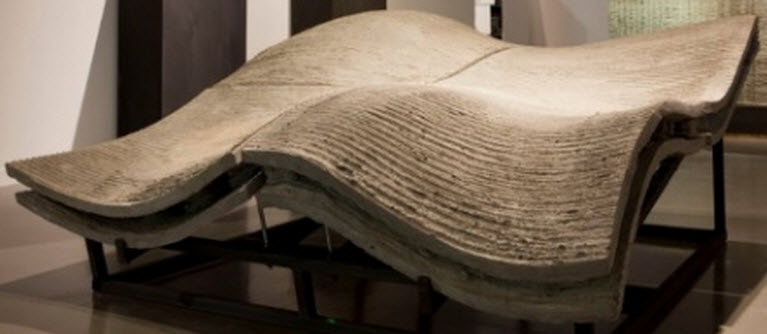
Printed houses can take advantage of nonlinear but sturdy forms made from concrete (credit: Loughborough University)
Other far-reaching opportunities include constructing rapid shelters after natural disasters, operational structures on the moon out of moon dust, and cheap houses for people in impoverished countries.
A natural extension of printing new buildings will be devices that recycle the old ones. Ideally, the old material will be ground up and reformulated into new composites that can be re-printed into whatever is needed.
By replacing our traditional techniques for pouring concrete, 3D printers could be used to print driveways, sidewalks, benches, fences, foundations, and much more.
Small bots will be used to create seamless coatings on the tops of houses. The small army of people needed to reroof a house today will be replaced with a single person who’s job is to place the bot at its initial starting point and make sure there is a consistent supply of material to coat the entire roof.
Walls will no longer need to be flat surfaces. Every wall can be designed with textures, protrusions, and artistic designs to put an end to the dreadful uniformity in our homes today.
Comments (16)
by Dan Dascalescu
Contour Crafting has actually been out for a while: http://www.contourcrafting.org/
by Carl
You wouldn’t download a house, would you?
by James
Large scale additive (3D) manufacturing will be a quantum leap forward. Imagine being able to construct complete airplanes or a ship. This also lends itself to precision distributed manufacturing of subassemblies (may as well spread the wealth) and later integration.
by GatorALLin
3d printers are so cool, but I never thought to make them giant and print a house… That would be so cool if they just could print an entire house and just fill up the giant ink like cartridges with the raw chemicals needed. I just spent the last 5 days redoing a bathroom and shower (all new tile walls and floor). It was amazing how perfect the liner for the shower floor had to be and how much extra work was needed to keep it sealed. A 3d printer could just make it one solid piece to avoid leaks. Anyhow… Love the idea. I just saw a video on 20 mini robots that fly, proving they could help build future skyscrapers if the parts were prebuilt on the ground first…. Now I can guess how the rooms on the ground will be made first… Big thinking.
by Huw
It is perfect for making buildings designed by the artist Roger Dean.
http://www.rogerdean.com/home-for-life/image-gallery/
by Bill
What would be even better is as the building material is improved, it could possess insulating qualities that preclude the need for wall or roof insulation. It could also incorporate ready made cavities for wiring and plumbing or lay down the wiring and plumbing as part of the same continuous process.
by Chrispium
This will be really good at replacing some or all of the cheap houses made from flammable wood now.
by As Best
caution, they should first make sure that this charming “magnesium-based binder” is safe. With time it could produce dangerous dust just like asbesto fibers do.
by melajara
@As Best
Good point.
by peter g
housing is not an information technology yet…
i still see challenges like conforming to the building codes for residential
don’t expect this for at least 10-15 years
by craison
20-30 yrs will suffice .
by Bob V
I want a house built like a shoe.
by GamerFromJump
I just hope it doesn’t wind up being just a fast way to make cheap gray boxes.
by Marcos Marin
So finally humans will start to move away from their shoe boxes? =)
by Michael Tefsfaye
So is housing an Information Technology now?
by Editor
Bingo