Prospective Alzheimer’s drug builds new brain-cell connections
October 12, 2012
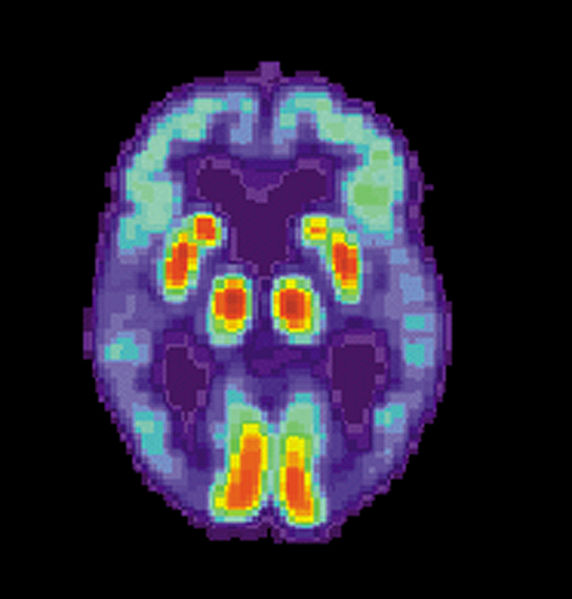
PET scan of a human brain with Alzheimer’s disease (credit: US National Institute on Aging, Alzheimer’s Disease Education and Referral Center/Wikimedia Commons)
Washington State University researchers have developed a new drug candidate that dramatically improves the cognitive function of rats with Alzheimer’s-like mental impairment.
Their compound, which is intended to repair brain damage that has already occurred, is a significant departure from current Alzheimer’s treatments, which either slow the process of cell death or inhibit cholinesterase, an enzyme believed to break down a key neurotransmitter involved in learning and memory development.
Such drugs, says Joe Harding, a professor in WSU’s College of Veterinary Medicine, are not designed to restore lost brain function, which can be done by rebuilding connections between nerve cells.
“This is about recovering function,” he says. “That’s what makes these things totally unique. They’re not designed necessarily to stop anything. They’re designed to fix what’s broken. As far as we can see, they work.”
Harding, College of Arts and Sciences Professor Jay Wright and other WSU colleagues report their findings in the online “Fast Forward” section of the Journal of Pharmacology and Experimental Therapeutics.
Their drug comes as the pharmacological industry is struggling to find an effective Alzheimer’s treatment. Last month, the Pharmaceutical Research and Manufacturers of America, or PhRMA, reported that only three of 104 possible treatments have been approved in the past 13 years.
“This 34 to one ratio of setbacks to successes underlines the difficulty of developing new medicines for Alzheimer’s,” the trade group said in a news release.
Development of the WSU drug is only starting. Harding and Wright must first satisfy the U.S. Food and Drug Administration that it is safe. Only then would clinical trials begin to see if a drug that works in a rat will work in a human.
Safety testing alone could cost more than $1 million, says Harding, who is looking to fund the drug’s development through his and Wright’s company, M3 Biotechnology Inc., the WSU Research Foundation, and ultimately large pharmaceutical company partners.
Harding, a medicinal chemist, and Wright, a neuroscientist, have been working on their compound since 1992, when they started looking at the impact of the peptide angiotensin IV on the hippocampus, a brain region involved in spatial learning and short-term memory. Typically, angiotensins have been linked to blood pressure regulation, but Harding and Wright noticed that angiotensin IV, or early drug candidates based on it, were capable of reversing learning deficits seen in many models of dementia.
The practical utility of these early drug candidates, however, was severely limited because they were very quickly broken down by the body and couldn’t get across the blood-brain barrier, a cellular barrier that prevents drugs and other molecules from entering the brain. The only way the drug could be delivered was by direct brain application.
Says Harding: “We said, ‘That’s useless. I mean, who wants to drill holes in people’s heads? It’s not going to work. It’s certainly not going to work for the big population.’”
Five years ago, Harding designed a smaller version of the molecule that he and Wright called Dihexa. Not only is it stable but it can cross the blood-brain barrier. An added bonus is it can move from the gut into the blood, so it can be taken in pill form.
The researchers tested the drug on several dozen rats treated with scopolamine, a chemical that interferes with a neurotransmitter critical to learning and memory. Typically, a rat treated with scopolamine will never learn the location of a submerged platform in a water tank, orienting with cues outside the tank. After receiving the WSU drug, however, all of the rats did, whether they received the drug directly in the brain, orally or through an injection.
“Same result, every time,” says Harding.
Harding and Wright also reported similar but less dramatic results in a smaller group of old rats. In this study the old rats, which often have difficulty with the task, performed like young rats. While the results were statistically valid, additional studies with larger test groups will be necessary to fully confirm the finding.
The “gold standard” compound for creating neuronal connections is brain-derived neurotrophic factor, or BDNF, a growth-promoting protein associated with normal brain development and learning. Autopsies of Alzheimer’s patients have found lower levels of BDNF in the brain.
In bench assays using living nerve cells to monitor new neuronal connections, Harding, Wright and their colleagues found Dihexa to be seven orders of magnitude more powerful than BDNF, which has yet to be effectively developed for therapeutic use. In other words, it would take 10 million times as much BDNF to get as much new synapse formation as Dihexa.
“We quickly found out that this molecule was absolutely, insanely active,” says Harding. These results further suggest that Dihexa or molecules like it may have applications in other neurodegenerative diseases or brain traumas where neuronal connections are lost.
Funding was provided by the Edward E. and Lucille I. Lainge Endowment for Alzheimer’s Research, the State of Washington Initiative Measure No. 171, the National Institutes of Health and the Hope for Depression Research Foundation.
Comments (20)
by Phil Osborn
There are currently companies offering to clone your stem cells and reinject them to rebuild whatever is worn out, and a hundred other amazing claims, if you have the money to pay for them. Some of them might actually work, but don’t expect any FDA sign-offs on them. SF has often speculated about a future in which you live as long as you can pay for, with significant class divisions between the ageless and the general population – e.g., Ira Levin’s “This Perfect Day.” It may be happening, for real. Maybe you’ll get an “invite” some day, a free pass back to youth if only you do some simple task, like passing on corporate secrets…
That’s the potential cost of a dysfunctional system as other posters have noted, in which the only incentive – at the FDA or other regulatory bodies – is to cover one’s butt, avoid or cover every possible risk, many times over, while the new drug lords offer immortality for immorality. Will you sign on to be a neo-gangbanger in return for LIFE?
by djk
Sadly we have so many cures out there all ready and the FDA has killed thousands of people by not letting these drugs through. It has been said that the FDA will let 100,000 people die by not approving a drug rather then suffer the consequence of allowing that same drug to kill 5 people through some side effect. They are about CYA, politics, career protection, and legal protection. They recieve no flack for holding back the drugs. They simply blame the disease while they tie up the drugs in endless and expensive testing. Meanwhile our loved ones die while they fiddle. It will take many beurocrats families to die before these drugs start getting passed
by Lois Toevs
I have Alzheimer’s Disease. My only way to benefit from this new discovery is to grow a tail, a longer nose and apply to the researchers as a test rat volunteer. Too bad there is nothing NOW for me as I daily lose cognition and memory. But good article and hope for others is comforting.
by Eric
Hi. Check out this link. It talks about eye drops that can increase BDNF.
http://www.architalbiol.org/aib/article/view/149205
by Klaatu
If there is anything to this you can believe that some rich
guy is going to jump the peer review process and get the
thing to human testing.
Different topic: a bunch of corporate types just figured out
how to jumpstart the various state bureaucracies to
house homeless veterans nationally. It was beyond
complicated but it was done. The same can be done
with the big A IF ISN’T JUST BID FOR FUNDING.
by melajara
Good, I suggest the following little experiment.
Let’s take a pair of homozygous twins in good shape and at least eighty years old with NO musical training. Both will be “incarcerated” to prevent any different influence on them for the 3 months experiment.
Twin A will take Dihexa, twin B a placebo regularly for, say 3 months. The main activity will be for them to attend daily piano lessons delivered by the same teacher but not simultaneously as the twins will be prevented to communicate.
At the end of the experiment, the efficacy of Dihexa on their piano training will be assessed by professional judges listening to a piano recital where both will be required to play the same opus ;-)
by JC
The PDF in the link is readable for free. This is hugely exciting. There are so many people on death’s doorstep with neurodegenerative diseases I imagine volunteers for safety testing will be easy to find. The older rats got big performance gains and fast, within days! “Figure 5 indicate that dihexa significantly improved performance (p<.05) on most of the test days. It should be noted that because these aged rats were not pre-screened for cognitive deficits the results substantially underestimate the effect of dihexa." from link.
by someday69
Sure’yea’I'll drink’some’of’that’Tea,,but,,just wait’for the digital’version…I’know ah’guy::,,,who’gets’ it’off”big’Pharma’s'own,oringal’soft’ware’app.template- You get an’absoute’pure’fix’,,,,In’ah’hard’disk’..once’open’,,it’s good’for six..You’in..were on’for it.in two’hrs?? Yea’Neo’that’s'im….you know’em too??Maybe’between’the two of us babe’mabye we can’get’em ‘OUT..he’sz such’ah’re’clues…
by Bri
Wooooow!!!!!
by Carl Brooks
Who’s AI is this?? Ramona? is that you?
by Mark
If we were benefiting from every breakthrough these rats seem to be, I figure would be living at least 150 years of perfect health and be cured of any possible disease I may get in the meantime. It seems I have been hearing about a new alzheimers breakthrough miracle treatment every couple of weeks for at least the last decade. However, my grandmother developed dementia several years ago and doesn’t even remember who I am. Why is this when I keep hearing about all these wonderful breakthroughs? Same with cancer, I seem to hear every other week or so about how we are on the verge of being able to zap cancer with a bunch of gold nanoparticles or whatever that can directly target tumor cells. Yet my aunt died of cancer last year and to my knowledge all she got was old fashioned chemo therapy, no miracle nano particles that I keep hearing about. I will believe this one when I see it.
by Aaron
I hope James Franco doesn’t give any of this new prospective Alzheimer’s drug to any errant monkeys…
by JC
I am very pro pro-cognitive agents. This one sounds like the first version of the drug from the movie Limitless. I can hear the South Korean labs gearing up at top speed to make this from here (San Francisco). Perhaps a free sample will be schwag at next years Singularity Summit!
by Marcos Marin
yeah, from alzheimer to autism at top speed! within days right? hmm…
by thomas
Interesting idea — what makes you think of autism?
by JFH
That was my first thought…”what if a healthy brain was exposed to this drug???” Enhancement? Poison? Or no change?
Interesting stuff.
by Steven Wright
Limitless was an interesting movie, wasn’t it? When you mentioned South Korea, that made me wonder if there’s more hope of seeking this type of medicine in Europe, too. India came to mind, also. It seems ridiculous that we would need to look to a recent 3rd world country to find the best medicine. America is so worried that someone might sue, that we can’t get things done anymore.
by Gorden Russell
When rats can find a hidden platform, then we can find our keys.
by GatorALLin
especially if our keys are underwater…
by Klaatu
like some mortgages…