Ray Kurzweil’s How to Create a Mind published
November 13, 2012
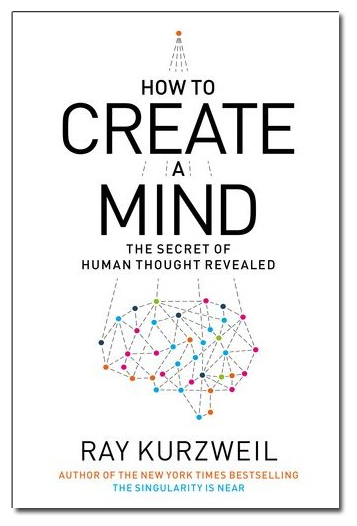
Ray Kurzweil’s new book — How to Create a Mind: The Secret of Human Thought Revealed* — was published today, Nov. 13, Viking has announced.
The book opened on Monday as #1 among all books on the Barnes & Noble bestseller list. It is now available from the book website or from all major booksellers, and available in all popular e-book formats.
In the book, Kurzweil explores the most important science project since the human genome: reverse-engineering the brain to understand precisely how it works, then applying that knowledge to create vastly intelligent machines.
Drawing on the most recent neuroscience research, compelling thought experiments, and his own research and inventions in artificial intelligence, he describes his new theory of how the neocortex (the thinking part of the brain) works: as a self-organizing hierarchical system of pattern recognizers.
A roadmap to superintelligence
Kurzweil shows how these insights will enable us to vastly extend the powers of our own mind, and provides a roadmap for the ultimate creation of superintelligence — humankind’s most exciting next venture.
“We are now at the dawn of an era of radical possibilities in which merging with our technology will enable us to effectively address the world’s grand challenges,” he says. “We are already seeing artificial intelligence go mainstream with the recent innovations of IBM’s Watson, the iPhone’s Siri, Google Now, and Google’s self-driving cars.
“The inevitable next step is that our brains will soon be merged with the intelligent technology we are creating. By around the 2030s, nanobots in our bloodstream and brains will keep us healthier and smarter, most of our thinking will be in the cloud — unhindered by the natural limits of our biological brain and easy to back up like a hard drive, and we will vastly speed up the learning process.”
How to Create a Mind is Ray Kurzweil’s seventh book, joining The Age of Intelligent Machines, The 10% Solution for a Healthy Life, The Age of Spiritual Machines, Fantastic Voyage: Live Long Enough to Live Forever, The Singularity Is Near, and Transcend: Nine Steps to Living Well Forever.
“One of the eminent AI pioneers, Ray Kurzweil, has created a new book to explain the true nature of intelligence, both biological and non-biological,” said AI pioneer Raj Reddy. “The book describes the human brain as a machine that can understand hierarchical concepts ranging from the form of a chair to the nature of humor. His important insights emphasize the key role of learning both in the brain and AI. He provides a credible roadmap for achieving the goal of superhuman intelligence, which will be necessary to solve the grand challenges of humanity.”
How to Create a Mind book website
Ray Kurzweil and Time book critic Lev Grossman at 92Y in NYC Nov. 20
Ray Kurzweil at TEDx Silicon Alley in NYC Dec. 3
* Ray Kurzweil, How to Create a Mind: The Secret of Human Thought Revealed, Viking; November 13, 2012; ISBN: 9780670025299; 336 pages
Comments (38)
by Editor
All questions about purchasing the book and offers should be referred to the book website: http://howtocreateamind.com/contact.php.
by Cybernettr
Yaaayyyy! I live in Indiana and I got my book yesterday and my tee shirt and bookplate today!
by jjbjb1701
Weren’t these preorders supposed to be autographed?
by Some1
Aren’t they ??
The pre-order page clearly said:
What you’ll receive with your pre-order
Reduced pricing (34% off)
Individually signed by Ray Kurzweil
How to Create a Mind T-shirt
Free download of Transcendent Man, The Life and Ideas of Ray Kurzweil
by Admin
Books began shipping on Monday, November 12. You will receive a separate package with t-shirt and bookplate signed by Ray Kurzweil. Please contact Sarah Reed at sreed@kurzweiltech.com for more info on individual orders.
by David S. Bunin
I received my t-shirt and bookplate today! I love the t-shirt, but was just wondering; is the bookplate really individually signed by Ray, or is the signature machine printed along with the rest of the print on the bookplate?
by Editor
Questions about book purchase and offers and should be addressed to sreed@kurzweiltech.com
by DCWhatthe
So far so good. Kurzweil is able to ‘talk’ to the reader, not as a superior genius but as just a guy who figured out a few things. So far, the read is enjoyable & relaxing.
by GAUSS
Can’t wait to read this.
by MarkOates
Bought it. Readin’ it. :)
by Jordan Henrichs
I have pre-orderd the book and was wondering if the books have shipped? I have contacted the recommended email address and I received an automatic reply. I also have sent an email to sreed@kurzweiltech.com per the recommendation below. Looking for in reading Ray’s new book! Thanks!
by David S. Bunin
I pre-ordered the book as well and have not heard a thing. Meanwhile anyone can go to Barnes and Noble and buy the book today!
I will never make the mistake or pre-ordering ANYTHING from Kurzweil again!
by Admin
Hi David and Jordan,
You both should have heard from sreed@kurzweiltech by now. If you have any additional questions, please feel free to follow up with her directly.
by Jesse
I have not heard anything either..
by Simon
You Can’t buy the book as an ebook via Amazon in Australia?
I think we need science to come up with some kind of international networky type thing and some technology to ‘digitalize’ the paper book.
Once you can solve those challenges we could easily tackle creating a brain – don’t ya think?-
by Ian Clarke
Same in the UK too. Baffling! Maybe we have to wait until enough copies have been made??
I also find it frustrating at how many books in general still have no ebook version. We should be being encouraged to adopt this format, not left to feel like second class customers.
by Jerry
Great, another one!
I tried to buy another neuroscience related book as an ebook down under and had to give up and buy a paperbook after many attempts. An extra $10 and a 2 week delay over the preferred ebook, or I could have avoided the wait by purchasing locally with a hyper-inflated price…
by Murray
Or New Zealand.
I can buy other Kindle books from Amazon.
Why can’t someone as progressive as Kurtzweil and his company promote the modern book formats and support the global sales model.
The outlets being used only seem to be supporting ebook sales to the US and Canada.
by Murray
Won’t be buying this until I can read it on my phone and tablet.
by Cynic
I got around this by setting up a US Amazon account. Just put in any address. I buy myself gift vouchers from NZ account and redeem them on the US one, so there is no credit card and address associated with it.
by Dave Pook
Can’t wait to get my pre-ordered copy! Interested to see how Ray addresses the issue of machine conciousness: how can we build a machine that develops the quality of self-reflexive awareness, that is aware of it’s own awareness, that “wakes up” and realizes its own existence. This would signal the birth of true artificial intelligence. Would it occur suddenly, or gradually unfold over time through experience as it does in developing human brains? But once it does occur, could’t we at that point “clone” that machine state as many times as we wish, to as many different hardware substrates as we wish?
by Reader
I sent you 2 emails about the book ordering that I did (I sent it to “admin@howtocreateamind.net”) why can’t I get your reply?
by admin
Hi Reader,
Please send an email to sreed@kurzweiltech.com. She will help you with your request.
Thanks.
by John
If you can create a mind, why wouldn’t you create it in the first place, instead of writing a mere book?
And if you can’t create a mind, why would you call the book this way?
Nevertheless i’m very curious about what’s inside, although HMM usage doesn’t sound promising. It’s that “Singularity is near” was that good of a book.
by Chris P. Kareem
We don’t have the processing power to do it yet.
Also I don’t think we have all of the algorithms we need yet, but we will have them within a decade or two.
by John
Cmon, man. I can say the same, “here is my great invention, the box in which you put your talking computer… which will be invented somehow in 20 years”.
So, if you don’t know to details – you don’t know it, since details are often the hardest part.
by Alex
I’m tempted to feed the trolls here…
Instead I’ll just congratulate Ray on what is sure to be another exemplary book. Mr. Kurzweil is nothing short of a visionary and a leader in his field and I’m always in a state of optimism when I’m enjoying his work.
by MrFriendly
I don’t think John is really trolling. He brings up an excellent point.
The “Singularity” has become almost a religion in itself, so anyone who challenges or casts doubt on the concept is a heretic or a troll.
This book will be an interesting read, mainly because I’m sure it’ll have a lot of optimism, a little science, and a little bit of fantasy. I’m ordering my copy.
by GAUSS
We don’t have the processing power yet, necessarily, but we do have opportunities to increase our awareness of the principles that will be necessary to make such a thing. My understanding is that that’s part of what this book is about – building up a knowledge base for experiments and research so that when we do get the right hardware, we already have a good idea of how to approach something like this.
That said, I’ll certainly advocate what Michio Kaku calls a “constructivist approach”: build it, then see how you can improve it. With artificial intelligence, the trouble is that we lack unified understanding. No one theory about intelligence or cognition is confirmed correct, and so we have to approximate results based on what limited knowledge we have. Until superintelligence becomes a feasible result, it is good to build the theories and explore what is possible in the now.
by Chris P. Kareem
It’s not that abstract, though. All we have to do is model all of the functions of neurons programmatically and simulate it on a supercomputer. There are already systems derived from neuroscience such as Hierarchical Temporal Memory (I believe). And Google and Microsoft are already using deep neural networks for progress in language translation and speech synthesis. Just imagine what we’ll be able to do in a decade when the technology matures.
by GAUSS
I do like the elegance of RBMs, but in practice they are deathly slow. Even Dr. Hinton himself admits this. HTM has a few opportunities for optimization, and is fairly clean since it doesn’t muck about with energy functions and all of that. Microsoft will probably find ways to optimize RBMs, but my money is on a more pure associative scheme, a la HTM or something new along those lines.
by Chris P. Kareem
The point is, we’re moving toward neural networks and AI. I’ve had a few ideas myself that would use that kind of computation that would be pretty successful if they were done right.
by GAUSS
That’s awesome! The great thing is, if it doesn’t work in software you can also try hardware prototyping, like FPGAs or even your own circuit design. The possibilities are endless. When the interaction between components corresponds to associative neural networks as opposed to logic values, the value could be huge. IBM has a lot of research going in neuromorphic architectures, as do some other interesting players on the field. Exciting times!
by Jerry
A similar titled book that I found enjoying and you might dislike the title of is: “How to build a time machine”. The book (from my understanding) is aimed at educating the reader in the latest advancements in the GAI field.
This isn’t a book for those that are capable of working in the field, it’s a pop science book. It’s meant for the layman, the armchair scientist, letting us know how reality is progressing in an easily digestible format.
by Gabriel
That’s always been the nice thing about Kurzweil in general…it’s difficult to get new things out about him, but in general, especially for the layperson, he explains things very easily for the average person to understand. I’m not surprised his latest book follows this format.
by Gabriel
“If you can create a mind, why wouldn’t you create it in the first place, instead of writing a mere book? And if you can’t create a mind, why would you call the book this way?”
Oh brother >_>
by RobinSongs
I get the feeling that I’d rather have my own cloud.
by David Nollmeyer
The rational skill and logic of when to intervene in emergencies I believe will be a decisive factor in whether AI can function empirical ly in the social setting. Most rationality training appears centered on for profit optimization and minimizing damage. The challenge is whether the programs can develop crystal or non linear quantification based on legal moral principles and make the right call.