Reflections on Avatar by Ray Kurzweil
March 7, 2010 by Ray Kurzweil
I recently watched James Cameron’s Avatar in 3D. It was an enjoyable experience in some ways, but overall I left dismayed on a number of levels.
It was enjoyable to watch the lush three-dimensional animation and motion capture controlled graphics. I’m not sure that 3D will take over – as many now expect – until we get rid of the glasses (and there are emerging technologies to do that albeit, the 3D effect is not yet quite as good), but it was visually pleasing.
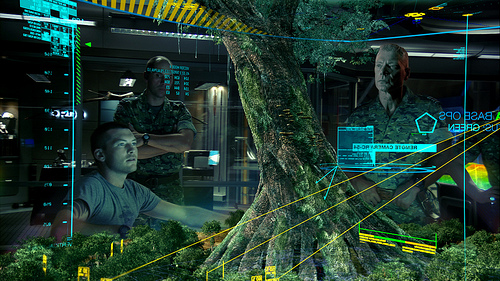
3D information visualization displays and interactive multi-touch screens as featured in this scene from "Avatar" already exist and are in use today. (20th Century Fox)
While I’m being positive, I was pleased to see Cameron’s positive view of science in that the scientists are “good” guys (or at least one good gal) with noble intentions on learning the wisdom of the Na’vi natives and on negotiating a diplomatic solution.
The Na’vi were not completely technology-free. They basically used the type of technology that Native Americans used hundreds of years ago – same clothing, domesticated animals, natural medicine, and bows and arrows.
They were in fact exactly like Native Americans. How likely is that? Life on this distant moon in another star system has evolved creatures that look essentially the same as earthly creatures, with very minor differences (dogs, horses, birds, rhinoceros-like animals, and so on), not to mention humanoids that are virtually the same as humans here on Earth. That’s quite a coincidence.
Cameron’s conception of technology a hundred years from now was incredibly unimaginative, even by Hollywood standards. For example, the munitions that were supposed to blow up the tree of life looked like they were used in World War II (maybe even World War I). Most of the technology looked primitive, even by today’s standards. The wearable exoskeleton robotic devices were supposed to be futuristic, but these already exist, and are beginning to be deployed. The one advanced technology was the avatar technology itself.
But in that sense, Avatar is like the world of the movie A.I., where they had human-level cyborgs, but nothing else had changed: A.I. featured 1980′s cars and coffee makers. As for Avatar, are people still going to use computer screens in a hundred years? Are they going to drive vehicles?
I thought the story and script was unimaginative, one-dimensional, and derivative. The basic theme was “evil corporation rapes noble natives.” And while that is a valid theme, it was done without the least bit of subtlety, complexity, or human ambiguity.

From the movie "Dances with Wolves" (MGM)
The basic story was taken right from Dances with Wolves. And how many (thousands of) times have we seen a final battle scene that comes down to a battle between the hero and the anti-hero that goes through various incredible stages — fighting on a flying airplane, in the trees, on the ground, etc? And (spoiler alert) how predictable was it that the heroine would pull herself free at the last second and save the day?
None of the creatures were especially creative. The flying battles were like Harry Potter’s Quidditch, and the flying birds were derivative of Potter creatures, including mastering flying on the back of big bird creatures. There was some concept of networked intelligence but it was not especially coherent. The philosophy was the basic Hollywood religion about the noble cycle of life.
The movie was fundamentally anti-technology. Yes, it is true, as I pointed out above, that the natives use tools, but these are not the tools we associate with modern technology. And it is true that the Sigourney Weaver character and her band of scientists intend to help the Na’vi with their human technology (much like international aid workers might do today in developing nations), but we never actually see that happen. I got the sense that Cameron was loath to show modern technology doing anything useful. So even when Weaver’s scientist becomes ill, the Na’vi attempt to heal her only with the magical life force of the tree of life.
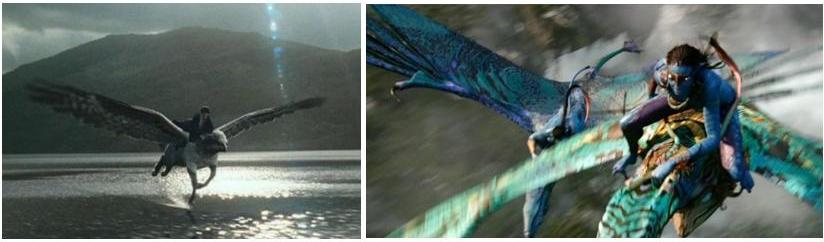
Harry Potter rides Buckbeak the Hippogriff (Warner Bros.) while Jake Sully rides a Mountain Banshee / aka Ikran (20th Century Fox)
In Cameron’s world, Nature is always wise and noble, which indeed it can be, but he fails to show its brutal side. The only thing that was brutal, crude, and immoral in the movie was the “advanced” technology. Of course, one could say that it was the user of the technology that was immoral (the evil corporation), but that is the only role for technology in the world of Avatar.
In addition to being evil, the technology of the Avatar world of over 100 years from now is also weaker than nature, so the rhinoceros-like creatures are able to defeat the tanks circa 2100. It was perhaps a satisfying spectacle to watch, but how realistic is that? The movie shows the natural creatures communicating with each other with some kind of inter-species messaging and also showed the tree of life able to remember voices. But it is actually real-world technology that can do those things right now. In the Luddite world of this movie, the natural world should and does conquer the brutish world of technology.
In my view, there is indeed a crudeness to first-industrial-revolution technology. The technology that will emerge in the decades ahead will be altogether different. It will enhance the natural world while it transcends its limitations. Indeed, it is only through the powers of exponentially growing info, bio, and nano technologies that we will be able to overcome the problems created by first-industrial-revolution technologies such as fossil fuels. This idea of technology transcending natural limitations was entirely lost in Cameron’s vision. Technology was just something crude and immoral, something to be overcome, something that Nature does succeed in overcoming.

Unimaginative, non-futurist props in the supposed future world of the movie A.I. (Warner Bros.). Most sci-fi films depict a few truly clever technologies representing a probable human future, while leaving the rest too ordinary and undeveloped to be believable. The entire world of human technology will evolve in step, affecting all aspects of the way we work, live, play, heal, create, learn or defend. Advanced technology will be embedded everywhere, in even our most mundane objects, interconnected and always-on. In a future world capable of strong A.I. and inter-stellar travel, the landscape of technology merged with our daily activities will actually be far more advanced, and far more interesting than in the film depictions we see today.
It was visually pleasing; although even here I thought it could have been better. Some of the movement of the blue natives was not quite right and looked like the unrealistic movement one sees of characters in video games, with jumps that show poor modeling of gravity.
The ending (spoiler alert) was a complete throwaway. The Na’vi defeat the immoral machines and their masters in a big battle, but if this mineral the evil corporation was mining is indeed worth a fortune per ounce, they would presumably come back with a more capable commander. Yet we hear Jake’s voice at the end saying that the mineral is no longer needed. If that’s true, then what was the point of the entire battle?
The Na’vi are presented as the ideal society, but consider how they treat their women. The men get to “pick” their women, and Jake is offered to take his choice once he earns his place in the society. Jake makes the heroine his wife, knowing full well that his life as a Na’vi could be cut off at any moment. And what kind of child would they have? Well, perhaps these complications are too subtle for the simplistic Avatar plot.
See also:
REUTERS | Human exoskeleton suit helps paralyzed people walk
DISCOVERY NEWS | New exoskeleton gives soldiers super strength

CURRENT TECHNOLOGY | Lockheed Martin's HULC: hydraulic-powered, un-tethered, anthropomorphic exoskeleton (Lockheed Martin)
LOCKHEED MARTIN | The HULC: Dismounted Soldiers often carry heavy combat loads that increase the stress on the body leading to potential injuries. With a HULC exoskeleton, these loads are transferred to the ground through powered titanium legs without loss of mobility.
The HULC is a completely un-tethered, hydraulic-powered anthropomorphic exoskeleton that provides users with the ability to carry loads of up to 200 lbs for extended periods of time and over all terrains. Its flexible design allows for deep squats, crawls and upper-body lifting. There is no joystick or other control mechanism. The exoskeleton senses what users want to do and where they want to go. It augments their ability, strength and endurance. An onboard micro-computer ensures the exoskeleton moves in concert with the individual. Its modularity allows for major components to be swapped out in the field. Additionally, its unique power-saving design allows the user to operate on battery power for extended missions. The HULC’s load-carrying ability works even when power is not available.
Lockheed Martin is a leading provider of advanced technology solutions for the Warfighter including ground Soldier systems such as wearable situational awareness equipment and mobility assistance systems. Future advancements in exoskeleton technologies will focus on specific user communities, shifting energy and performance requirements. Lockheed Martin is also exploring exoskeleton designs to support industrial and medical applications.
Comments (14)
by brux
I agree that it is easy to be critical of “Avatar” … and at least for me 3D is just a distraction that adds little value but annoyance.
The scenes of reality and on the planet did not really mesh well, and I was constantly aware of the cartoonlike quality of life on the planet, and the motions are still not quite really lifelike.
The historic reality of imperialism was glossed over with video-game-like wonder and 2D movie characterizations … after all the whole point of the movie is the violence and spectacle, even if the excuse is to try to deliver some kind of new age techno-philosophy. It doesn’t work and the void of the lie is too big in the human mind not to see it.
I’m no fan of Harry Potter, so no comment there. “AI” is a different issue. When I first saw “AI” I really hated it, and my reaction was so strong that I left a little before the end. At some point I thought I should go back and watch a movie that gave me such a strong reaction, and I think the message of “AI” is very hard to take … I think it is a movie about the myth of our own humanity, something that everything in our culture pushes to distract away from and sweep under the rug.
I did not like the constant juvenile attitude of the Jake character in “Avatar” and the reality of his personality I think would have not led him towards being humanistic, but the reverse, the movie did not add up characterwise.
I was not worried about the likeness of the flora and fawna to Earth’s because I think there are some universal forces at work in the workings of life that will cause most life in the universe to follow a similar pattern, distorted by physics or chemistry.
While nature in the movie overcomes technology, anyone can see that is done to comfort the audience because in our world it is very likely in the battles coming up that nature will be the loser.
The biggest problem I see with the futurist orgasmic obsession with technology is the lack of introspection or critical thinking and the acceptance of everything that can be done as something that should be done … the biggest example is the Monsanto Corporation’s idea of modern agriculture which I see as far more evil and anti-life than anything depicted in “Avatar”.
by Be Afraid
I did not see the Na’vi as being post-singularity at all. I saw them as having a naturally occurring form of inter-species communication, and a stored memories of those who had died and been connected to the “Tree of Life”.
But, this Tree of Life could do nothing more than simple storage and communication. There did not appear to be a greater than human recursively improving mind within that networked connection on Pandora.
I, like Ray, was terribly disappointed by the human technology, which showed very little progress from today, and a horrible misapplication of technologies that were present.
As for the modeling of gravity that Ray complained of, Pandora was a world with gravity than was closer to that of the moon than of the Earth. They mention this, very briefly, at the beginning of the movie. I thought the bigger problem with their modeling of gravity was that they did not show this effect in the normal motions of the characters, but ONLY showed it through the use of those huge “heroic” leaps made by the characters.
I notice in the comments that someone mentioned Caprica. I met one of the producers of Caprica (then just BSG) at an event at Berkeley, and mentioned Ray’s work to him. He had said that he would love to discuss tech applications of a society approaching their own Singularity with Ray…
Maybe you should give them a call, Ray?
MB
by Dave Baldwin
Ray is right about the movie. The television show Caprica (caught a little of prequil) was more in line with progression of future steps than Avatar by a mile.
It is not healthy to always presume the avg human is an idiot, so we need to feed the same story line. Doing that creates the scenario where something that truly isn’t what is claimed will be accepted as real, and then become the definition affecting development of a product that truly is.
Good review.
by Caseyd314
Just a correction here (unless the version of Avatar released in the UK had a slightly different ending to the version released in North America):
Quote from Ray: “The ending (spoiler alert) was a complete throwaway. The Na’vi defeat the immoral machines and their masters in a big battle, but if this mineral the evil corporation was mining is indeed worth a fortune per ounce, they would presumably come back with a more capable commander. Yet we hear Jake’s voice at the end saying that the mineral is no longer needed. If that’s true, then what was the point of the entire battle?”
Jake did not say at the end of the film that the mineral was no longer required. He said that Toruk Makto, the rider of Last Shadow, was no longer needed. This leaves the story of a return by the corporation/human race open as a sequel, which James Cameron stated he wished to do if the first film was a financial success.
by iPan
Finally saw this last night. What a total disappointment. I’m glad I waited for video and didn’t waste $20 at the theatre.
by futurist
interesting position
by TomC
I think Ray missed a few points. The Na’vi are post-singularity, taken care of by a global mind that has control of the planet. They are “primitive” because that was determined to be what the Na’vi were best adapted to – since they evolved to that level and not to the fast paced high tech society that gave birth to the singularity. However, they were substantially modified, along with all life on the planet – e.g. giving them the neural interface gene-tech that lets them commune with their beasts and planet mind.
And the high-tech corporation has limited tech because that’s what they can reproduce in the limited time with the limited resources they can haul over the light-years. The really high tech is inside the station, used to manufacture the rather lower tech stuff outside. Sure, we could posit that they COULD have produced higher tech stuff outside – but we don’t know the nature and limits of their tech.
by doojie
Ray’s comments remind me of something i read in McLuhan’s “Understanding media”. Old technology is not a continuation of the new, any more than a “horseless carriage” is a continuation of horses. The new technology will seek to replace and alter the old technology until it makes the old fit completely integrated with the new. This, of course, is consistent with the genre of “Terminator” movies and perhaps the Transformers.
by jabelar
I agree with Ray’s assessment. I was very disappointed in Avatar. It only had two positives — it was visually appealing and the action was directed well (not all shaky camera technique as is becoming a common cop-out in action sequences). However, the acting, writing, theme, etc. were all poor or simplistic. There was not one single surprise or twist in the whole movie! The movie was entirely un-creative. I think people who think it is amazing haven’t really been exposed to sci-fi, because everything (flying dinosaurs, living forest, blue “elfs”, floating mountains) has been done so many times before by fantasy artists that they are all cliche. Another major deficiency is they didn’t explore the morality of having a biological avatar — I mean they grew a creature that could open its own eyes and move but they had no qualms about just taking it over mentally and controlling it as a tool — was the avatar alive in its own right? The question wasn’t even asked …
by funkervogt
Hello Ray,
I agree with you on almost all points, but I have to take issue with your belief that films like “A.I.” and “Avatar” are unrealistic because they don’t show absolutely every piece of technology being different. For example, your inclusion of the pill bottle picture seems to indicate your belief that it is unrealistic to assume such objects will still be in use in, say, 50 years. Really? Is there some kind of better way to contain pills?
Just look around your house and you’ll see all kinds of manufactured goods that have been essentially unchanged over the last 100 years or more, like furniture, clothing, and many eating and cooking utensils. Sure, I understand that styles and manufacturing processes change, but the form of the end product is always dictated by functional need, and that doesn’t change.
So no, I don’t think its unrealistic at all to see people in futuristic sci-fi films wearing normal-looking clothes, drinking their morning coffee out of ceramic mugs, keeping their pills in little orange plastic bottles, or driving around in four-wheeled land vehicles.
by Extropia DaSilva
On the audio commentary for ‘Surrogates’, the director (Jonathan Mostow) explained why they chose to depict cars, phones, houses and workplaces as essentially unchanged, despite the obvious technological advances implied by the Surrogates themselves.
The director felt that showing too much technological change would cause future shock in the audience, draw their eye from one weird and wonderful tech to another, and distract from the storyline. It was decided to focus on the one Big Idea of surrogate tech, and build a plot around that one ‘what if’?
I would imagine most directors filming science fiction come to a similar conclusion, which is why we typically see future worlds where one thing changes dramatically, while everything else would not look out of place in a contemporary setting.
by SkipErnst
I don’t think any movie set in a future more than 35 years distant will ever stack up to what the law of accelerating returns predicts. The reason is the singularity itself. Audiences are not prepared for that kind of radical change and wouldn’t be able to fully understand or appreciate it (let alone follow the actual movie plot as you mention). They may never be prepared for it because as the years pass the changes 35 years hence will only increase. From this point on we are probably stuck with Hollywood visions of a mostly-underpowered future.
I had to read several books and ponder the singularity for some time before really coming to understand it and its implications. Two hours just isn’t enough time to do it.
by eldras
:) Dances with Avatar :)
I wont go and see it after this review.
I walked out and got my money back on Speilberg’s AI because it lacked imagination and just walked out of Harry Potter because it looked like it had been scripted to a point system & also was unimaginative (JK Rowling is being sued fro nicking her ideas from the presently dead Adrian Jacobs’ work. they had the same agent, but I dismissed it as unlikely until I saw his work & was amazed at their similarity: wizard schools etc – which you can see online).
There are 7 great plots in literature
rites of passage
fatal flaw
Cinderella
winning the prize
defeating the enemy
battling nature
tragedy/comedy
etc
There doesn’t seem universal agreement on how to tabulate them & they’re not exclusive but thrashed out by the Greeks before gunpowder..
Hollywood could be urged to bring better sci-fi .
by Oceans With-In
Go see it eldras.
http://www.youtube.com/watch?v=O4jYr4502M0&playnext_from=TL&videos=gdS-Sq-vH-Q