Resurrecting extinct proteins shows how a machine evolves
January 10, 2012
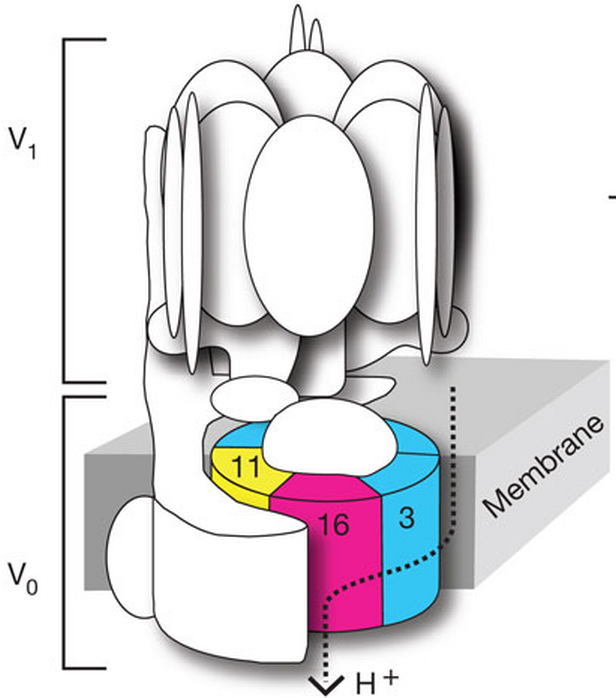
Structure and evolution of the V-ATPase complex (credit: Gregory C. Finnigan et al.)
By bringing long-dead proteins back to life, researchers have worked out the process by which evolution added a component to a cellular machine, Nature News Blog reports. The result, they say, is a challenge to proponents of intelligent design who maintain that complex biological systems can only have been created by a divine force.
Cells rely on “machines” made of multiple different protein components to carry out many vital functions in the cell, and molecular and evolutionary biologists have puzzled about how they evolved.
Joe Thornton at the University of Oregon in Eugene chose to study a particular machine called the V-ATPase proton pump, which channels protons across membranes and is vital for keeping cell compartments at the right acidity. Part of this machine is a ring of six proteins that threads through the membrane.
In animals and most other eukaryotes, this ring is composed of two types of protein. Thornton wanted to know how the machine evolved from the simple to the more complex form.
The team first scoured databases and pulled out 139 genetic sequences that encode the ring’s component proteins in a range of eukaryotic organisms. They then used computational methods to work backwards and find the most likely sequences of these proteins hundreds of millions of years ago, at key branching points on the evolutionary tree: just before and just after the ring increased in complexity. The team synthesized DNA that encoded these “ancestral” proteins and put it into yeast, which had had parts of its own proton pump deleted. The technique allowed Thornton’s team to test in yeast whether various combinations of ancestral proteins produced a working, proton-pumping machine.
The work reveals the pathway by which the two-component ancestral protein became a three-component one. The result challenges the assumption in biology that increased biological complexity evolves because it offers some kind of selective advantage. In this case, the more complex version doesn’t seem to work better or have any other obvious advantage compared with the simpler one; it is more likely that the two proteins were just corrupted by random mutation.
And to intelligent-design proponents, Thornton adds, the results say that “complexity can appear through a very simple stepwise process — there is no supernatural process required to create them.” Still, evolution of a three-protein machine is unlikely to silence those proponents — there are many far more complicated biological machines with far more protein parts and intricate internal mechanisms. Thornton says that his and other groups will now probably use the same tools to dissect the evolution of more complex molecular machines.
Ref.: Gregory C. Finnigan et al., Evolution of increased complexity in a molecular machine, Nature, 2012 [doi: 10.1038/nature10724]