Robot learns ‘self-awareness’
August 24, 2012
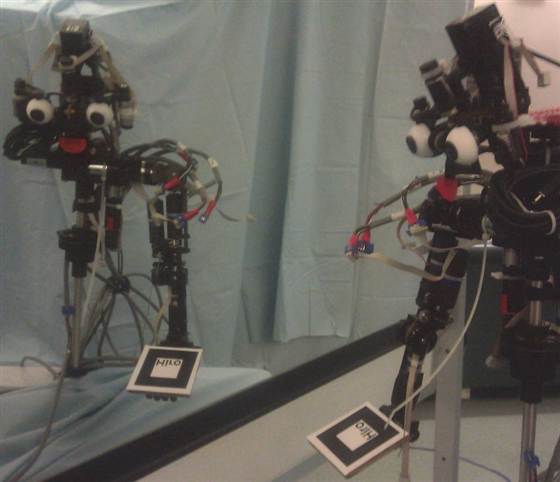
Who’s that good-looking guy? Nico examines itself and its surroundings in the mirror. (Credit: Justin Hart / Yale University )
“Only humans can be self-aware.”
Another myth bites the dust. Yale roboticists have programmed Nico, a robot, to be able to recognize itself in a mirror.
Why is this important? Because robots will need to learn about themselves and how they affect the world around them — especially people.
Using knowledge that it has learned about itself, Nico is able to use a mirror as an instrument for spatial reasoning, allowing it to accurately determine where objects are located in space based on their reflections, rather than naively believing them to exist behind the mirror.
Nico’s programmer, roboticist Justin Hart, a member of the Social Robotics Lab, focuses his thesis research primarily on “robots autonomously learning about their bodies and senses,” but he also explores human-robot interaction, “including projects on social presence, attributions of intentionality, and people’s perception of robots.”
Recently, the lab (along with MIT, Stanford, and USC) won a $10 million grant from the National Science Foundation to create “socially assistive” robots that can serve as companions for children with special needs. These robots will help with everything from cognitive skills to getting the right amount of exercise.
Hart’s specific goal in this program: enable Nico to interact with its environment by learning about itself, and using this self-model, to reason about tasks — mainly ones for humans.
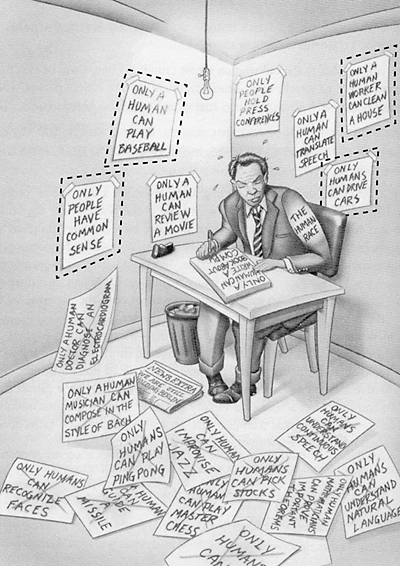
“Only humans can be self-aware” joins “Only humans can recognize faces” and other disgarded myths. Quiz: which of the posters on the wall in this 2005 cartoon (from The Singularity Is Near) should now be removed?
Previous researchers have built robots that acquire knowledge of the external world through experience, but Nico is different from those that have preceded it. “Knowledge about the robot itself has generally been built in by the designer,” Hart says. “None of these representations offer the flexibility, robustness, and functionality that are present in people.”
For example, Nico is learning the relationship of its end-effectors (grippers, for example) and sensors (stereoscopic cameras) to each other and the environment. It combines models of its perceptual and motor capabilities, to learn where its body parts exist with respect to each other and will soon learn how those body parts are able to cause changes by interacting with objects in the environment.
Nico in the looking glass
An object reflected in a mirror is “a reflection of what actually exists in space,” Hart says. “If one were to naively reach towards these reflections, one’s hand would hit the glass of the mirror, rather than the object being reached for.
“By understanding this reflection, however, one is able to use the mirror as an instrument to make accurate inferences about the positions of objects in space based on their reflected appearances. When we check the rearview mirror on our car for approaching vehicles or use a bathroom mirror to aim a hairbrush, we make such instrumental use of these mirrors.”
The classic mirror test has previously been done with animals to determine whether they understand that their reflections are actually images of themselves. The subject animals are allowed to familiarize themselves with a mirror. They are then sedated and a spot of dye is put on their faces. When they awaken, if they notice the new spot of color in their reflection and then touch the place on their face where the dye was put, they “pass” the mirror test.
“To our knowledge, this is the first robotic system to attempt to use a mirror in this way, representing a significant step towards a cohesive architecture that allows robots to learn about their bodies and appearances through self-observation, and an important capability required in order to pass the Mirror Test,” says Hart.
So far, no robot has successfully met this challenge. Jason and the Social Robotics Lab are working on it.
Reference (open access): Rajala AZ, Reininger KR, Lancaster KM, Populin LC (2010) Rhesus Monkeys (Macaca mulatta) Do Recognize Themselves in the Mirror: Implications for the Evolution of Self-Recognition. PLoS ONE 5(9): e12865. doi:10.1371/journal.pone.0012865
References:
- Justin W. Hart, Brian Scassellati, Mirror Perspective-Taking with a Humanoid Robot, Proceedings of the Twenty-Sixth AAAI Conference on Artificial Intelligence, 2012
Comments (58)
by | gad_E |
I really can’t even believe that anyone is trying to bash this type of innovation. Are some of you really that obtuse or do you just like to argue for the hell of it? I know it’s not from a lack of intellect. You wouldn’t even be reading this article & making a comment if you weren’t fairly intelligent. Although, some of the straw man arguments I’ve browsed over tend to point more toward a lot of book smarts accompanied by zero common sense & just a hint of bitter envy. You people DO realize that this is just a bunch of wires, processors, diodes, capacitors, etc., don’t you? This is absolutely incredible. Well, I say, “Bravo!!” to the inventor. Job well done, my friend. Some people just struggle with assimilating new ideas.
by dan walsh
i say bravo too. just one problem here. if you do make the bunch of wires diodes etc act the same as a human than you can expect them to think the same way .therefore if the free thinking object should happen to go nuts and decide to kill you it will. good luck commanding it to stop because “you made it” and therefore you are the boss .it is after all thinking on its own, no input from you.
by Munphs
Why do they always give these robots those creepy eyes….
by anthrobotic
There is zero reason to believe in the exceptionalism of human intelligence, or that it’s the shiny prize trophy culmination of evolution’s efforts toward self-awareness, reflection, and creativity in the universe. Machine self-awareness and/or consciousness may or may not happen, but dismissing the possibility out of hand is ferociously arrogant and irresponsible – and leads only toward a logical cul de sac and/or god which is kinda the same thing I guess.
We don’t truly understand intelligence and self-awareness or consciousness, and AI/NBI critics regularly point to this as the reason why we’ll never create it. So, let’s see – I guess that means we’re completely qualified to dismiss the emergence of something we ourselves cannot even clearly define? Wow. Do we really love ourselves that much?
Apologies for sharing a year-old piece, but it remains relevant:
“Can a computer be as intelligent as a human? Or, Asking the Wrong Dumb Question. Get it?” http://goo.gl/rmzkn
by Michael Zeldich
The concept
The essence of my concept for designing of an artificial system capable to demonstrate a reasonable behavior is in implementation of the feature of the subjectivity in an artificial system.
Incorporating of the feature of subjectivity in an artificial system will make the architecture of the resulting systems (A control unit and the connected to it hardware) non task specific.
“Non task specific” have the same meaning as for a human been and all other live creature.
The feature of subjectivity will remove the necessity in programming of the functionality in such systems and let them performing like a live creature. Profiling of the systems and its performance will depend on the hardware connected to the control unit, accessible resources, education, training and a past subjective experience, no programming will be required.
Some test questions are included below. You are lucky if able to find the correct answers on them.
For the beginning I would like to invite interested parties in a discussion with purpose to build an understanding how to approach to the problem in the right way. We could discuss some sides of the problem before we are will be able to decide if it is reasonable to reach the business agreements.
So, why, so far, no one was able to do the same?
Let’s start with some history.
Behaviorism was rejected due to the problem with study of the inner functionality of the live creature, which behavior was the subject of that science.
So called cognition has surfaced as the alternative and the basis for the future progress. However, that science does not have sufficient and relevant factual basis. Moreover, it basis has more problem than the rejected “Behaviorism “.
In the book “Artificial intelligence”, the 3rd edition, by Stuart Russell, professor of computer science, director of the center for intelligent systems, and holder or the Smith—Zaden Chair in Engineering, and Peter Norvig, director of Research at Google: inc., page vii, they state that: “The main unifying theme, the idea of AI, is intelligent agent. We define AI as the study or agents that receive percepts from the environment and perform actions. Each such agent implements a function that maps percept sequences to actions, and we cover different ways to represent these functions such as reactive agents, real-time planners, and decision-theoretic systems.”
We cannot see there the references to the inner functionality as well.
John Tyndall was stating in 1871: “The passage from the physics of the brain to the corresponding facts of consciousness is unthinkable.”
In that strong statement we could see the two problems: The brain is set apart of a body, and up to present we did not have “the corresponding facts of consciousness”.
The first problem is making the functioning of a live creature a mystery, and blind believes in existence of so-called mental function is turning the so- called “Cognitive science” in a kind of religious faith.
Today science did not develop any approach which is built on the factual basis for solving the task of designing of an artificial system capable to be self-guided.
To be successful in the attempts to develop of an artificial system capable to behave in a reasonable manner one have find the concise answers to the following questions:
• How can a control unit (brain) isolated from direct access to an environment manage the behavior of a system (body) in the relation to that environment?
• Why live creatures don’t require programming, at least external, for staying alive in the ever changing environment?
• What does it mean: gaining experience?
• Why the live creatures did not facing the “combinatorial explosion” problem?
These questions are not isolated from each other. The answer to one should not contradict with an answer to the rest.
I could offer the general concept for the development of the artificial subjective systems capable to determine its own behavior and would like to assembly a team of people, or establish the partnership with an existing entity for the purpose of building a real system. The general concept should be converted by the team to detailed, and on that basis it will be possible to build a control unit for the existing android (for example), which will convert that android in the artificial subjective system capable to demonstrate a reasonable behavior.
(NDA and normal business agreements are mandatory.)
That task could be accomplished in 6-8 month within an established company. Further details can be discussed after we are will reach an agreement about further development.
What is your opinion about that, tell me, please.
Best regards, Michael Zeldich, Independent inventor
Cell: (917) 816-447
Skype: Subjective1
E-mail: szeldich@netzero.net
by Logic
I love these comments. It’s a rorschach test of personal beliefs and preconceived ideas. It all boils down to one incendiary phrase: “self-awareness”. If a robot can recognize its reflection, it is “aware” of itself, ie, “self-aware”. No, not on a human level, not aware of all that “self” implies. But it DOES meet the basic definition of the phrase.
So it’s a great time to ask, then, what IS “self” and why does the concept matter in the first place? When we see the differences between the current level of robotics and AI and ourselves, we see how and why WE evolved, and it is easier (and less threatening) to see how our machines will evolve, too, and how that can only be a good thing for us.
by Peter Kinnon
In general t is a mistake to conflate mirror self-recognition with self-awareness. This particular test merely identifies an aspect which natural selection has optimized within particular environmental niches.
But there is no reason that this task, or any other aspect of self-awareness, consciousness, call it what you will cannot be implemented in a robot.
After all it is a feature of most, if not all, biological organisms as a very necessary adaptation for the fitness to their various ecological niches.
And, a particularly highly developed phenomenon in the case of humans. Of course, if our species is used as a benchmark, matching this level of ability in an individual robot will be no mean feat. After all, it has taken around five million years for this particular level of sophistication to evolve.
But the construction of an entity that can be expected to surpass our own level of cognition, sentience and self-awareness is alreadyy well under way!
As I have pointed out before, the construction of a “brain” that will soon equal and then surpass that typical of our species has for long been a work in progress. Not as a result of any deliberate human “design” but rather as the result of an autonomous evolutionary process that can be seen to have run its exponential course since humankind acquired the ability to share imagination, which we know as language.
Very real evidence indicates the rather imminent implementation of the next, (non-biological) phase of the on-going evolutionary “life” process from what we at present call the Internet.It is effectively evolving by a process of self-assembly. You may have noticed that we are increasingly, in a sense, “enslaved” by our PCs, mobile phones, their apps and many other trappings of the net.
We are already largely dependent upon it for our commerce and industry and there is no turning back. What we perceive as a tool is well on its way to becoming an agent.
Consider this:
There are at present an estimated 2 Billion Internet users. There are an estimated 13 Billion neurons in the human brain. On this basis for approximation the Internet is even now only one order of magnitude below the human brain and its growth is exponential.
That is a simplification, of course. For example: Not all users have their own computer. So perhaps we could reduce that, say, tenfold. The number of switching units, transistors, if you wish, contained by all the computers connecting to the internet and which are more analogous to individual neurons is many orders of magnitude greater than 2 Billion. Then again, this is compensated for to some extent by the fact that neurons do not appear to be binary switching devices but can adopt multiple states.
Without even crunching the numbers, we see that we must take seriously the possibility that even the present internet may well be comparable to a human brain in processing power.
And, of course, the degree of interconnection and cross-linking of networks within networks is also growing rapidly.The culmination of this exponential growth corresponds to the event that transhumanists inappropriately call “The Singularity” but is more properly regarded as a phase transition of the on-going “life” process.
An evolutionary continuum that can be traced back at least as far as the formation of the chemical elements in stars.
The broad evolutionary model that supports this contention is outlined very informally in “The Goldilocks Effect: What Has Serendipity Ever Done For Us?” , a free download in e-book formats from the “Unusual Perspectives” website.
by Bri
Well said, particularly in reference to the web. We are developing information centers that loosely corespondent to some brain centers. The Internet is more like multiple personalities. There isn’t one operator, but it is increasingly self reflective. I think of it like a child. When we are younger than four years old, we don’t have a sense of direction or purpose. We have lots of neurons, but they haven’t formed the relationships necessary to create organized actions. The Internet is in a similar phase.
by cosmowrench
You mistakenly compare humans using the internet to neurons in a brain. Humans put information on the internet, they provide input. So that would make humans more like the senses of the internet.
by Uh-oh
I hate to say it but algorithms cannot be aware. The only hope for AI are neural networks inspired by the brain.
by rob falgiano
I’m not sure this will actually prove to be true. What if the universe is just one big computer? Music travels through the air, but can be ‘captured’ and reduced to a long string of binaries. Why not thoughts or perhaps even biological matter?
by patnap
The ultimate self awareness test is survival instinct. Humans have it and so do animals. It seems robots do not.
by Logic
Yet.
by Sean Brazell
Wait, you mean to tell me that that annoying bastard who mimics everything that I do whenever I’m in front of a window IS ME?!
Damn.
;-)
by Bri
I sat down with my Yoga teachers dog once in front of a mirror. I kept pointing to me and saying my name then pointing to him and saying his name , for a good fifteen minutes and then he figured it out. He clearly looked at the reflections and let out a cry, and buried his head between his paws. He though he was a human too. One of the pack. He didn’t like seeing he was a dog. In my view everything has a sense of “I Am” , even atoms.
You don’t need a brain to have life. The brain is a means to process sensory information. Your “I Am” is in every cell, every molecule. Your brain doesn’t have any direct way to link to that, but it all gets orchestrated by your spirit. People do many things, like sleep walk to make a sandwich, without being conscious. That’s a reflective brain circuit.
Nico is self aware, he just needs a whole lot of other brain circuits. Add things like a Watsoneque informational circuit that he would assimilate it’s relativity to everything else in the Nico paradigm. To make him more human we would have to add a lot of other circuits, including the dopamine feed back system( do this in small steps, we don’t need a robot going through the terrible twos, or mad at the world because it’s not accepted in the troop, then go off a shoot a crowd of people from the pains of withdrawal in those dopamine circuits.).
Needs drive us. Masloffs hierarchy of needs. Heroin short circuits that circuit. Like a strung out heroin addict, these mass murderers( columbine, the batman joker killings,etc) aren’t deriving a proper sense of self in relation to the group. They begin to self identify with characters like the joker. They identify with the mania of joker characters, and lash out at the troop, to try and inflict a similar pain. Like a terrible twos temper tantrum, just with far better weapons than throwing a spoon.
Nico is learning self awareness. It just lacks all the other circuits that we identify with, as being human.
by Glyn Taylor
far far far far far from self aware, don’t be silly
by Ian Clarke
Well, you don’t want them too self-aware, or you’ll end up with Marvin the Paranoid Android. :-)
by Spikosauropod
I agree in part with pdm. I don’t think this experiment in toto is merely intended as a publicity stunt, but the reference to self-awareness is clearly a grab for topicality.
First of all, the experiments done with animals have no relation to self-awareness. Dogs don’t recognize themselves in mirrors because the abstract construct of a “reflection” is meaningless to them. It does not occur to dogs that they could be “there” when they are “here”, so they never consider the idea that they are somehow looking at themselves.
The robot is not self-aware, It is not aware at all. It is merely following an algorithm that says to output the result that the image in the mirror is itself.
by Peter Simmons
You speak as if you know, but you are wrong. I have had dogs who recognised themselves in shop windows, have tried it with mirrors and they are again perfectly aware it is them reflected. I agree the robot is not self aware, merely programmed to match patterns, but don’t assume other sentient species don’t have self awareness. Corvids also are clearly self aware, as are many other species. Human arrogance is often a bar to realising we are just another species; one that got lucky with an opposed thumb but is essentially not so different to other mammals.
by Editor
Right. See Monkeys recognize themselves in the mirror, indicating self-awareness, especially the video.
by Lang
It could be said that all you’re doing is following an algorithm that says to output the result that the image in the mirror is yourself….
So many people threatened by the possibility that someday there could be self-aware robots like that somehow takes away from our humanity.
Not saying this is it here but come on man all your brain is is a computer processing information it’s gathered albeit much more efficiently than our robots do now but that’s the point of experiments like this, to close that gap.
by C
“So far, no robot has successfully met this challenge. Jason and the Social Robotics Lab are working on it.”
Does this mean that Nico hasn’t passed the mirror test? Is that just the goal?
by Bob Vasquez
There are a lot of people that look at themselves in the mirror and don’t recognize who they “really” are so, here’s to Nico.
by Dr.Pratt
Baloney! The self awareness of humans only never existed in the first place. My Dog is self awar and he figured out the relfection in the mirror is his. This nico thing is crap science and crap reporting on the crap science.
by Lint
This is NOT self-awareness because there is no experience. Experience is still magic.
by Ian Clarke
Would programming a duplicate Nico to mimic the other Nico’s actions fool the ‘self-aware’ robot into believing he was looking at his own reflection, I wonder?
by GatorALLin
Yeah, I bet it would confuse the current pattern recognition algorithm they have in there now, but I bet if it was taught to search for a clone and then figure out what version it was, then it could differentiate. If they can get the progress of these algorithms to double every year, or faster, then they will have something. (phone rings….) I have to go now, SkyNet is calling…
by Ian Clarke
I imagine a more advanced Nico to suspect he was being duped, and then try to catch the other robot out (perhaps by making sudden and unusual movements) to confirm his hypothesis. :-)
by Lukas
It could also differentiate as we do. If the mirror image wasn’t doing exactly what Nico expected then it would know something had run amok. When we look in a mirror we expect the image to reflect exactly what we are doing.
If Nico saw a picture or video of himself…. that would be more interesting. Nico would have to recognize that experience and be able to tie it back to the recognition triggered in the image. If there was no memory of that event (location + time) then Nico would have to conclude that it was not him!
by Bri
What about putting sensors in the fingers. Then Nico could tell if it was another Nico or it’s self.
by melajara
No, if they were clever enough to incorporate a time delay measure comparing the robot’s own moves with the effect on the image as any faithful mimicry ( a feat by itself) would involve some delay. Now if the robots were prescribed to execute the same moves with perfect synchronicity and of course reversed symmetry, this could be different.
by Vin
No, they won’t move in synchronicity since they are not ‘prescriptively programmed’ , but they are using an adaptive learning algorithm.
by Vin
No it wouldn’t because Nico would realise this other’s motor activities will not match the commands it is giving to its own motors.
by Smita
Age old question , is this good or bad? Is the question relevant if the singularity is inevitable? Frightening if they go out of control…
by GatorALLin
..age old answer….. Yes…… because…
by Marv Brilliant Ph.D
This is just the beginning of a brave new world. In, say 10 to 20 years from now, robots will be commonplace
by joe
Millions of unemployed Humans that can do this kind of Work and yet the
PhD’s want to make Robots.
Give it up, Sub-sub!
J.
by dfc
The Singularity movement is a kind of ultimate “revenge of the nerds” effort. Some people in it seem to be sociopaths who delight in the thought of putting the jocks who bullied them in high school and cheerleaders who spurned them out of work. The joke is, however, that some kid now in elementary school will put these PhD students out of work by inventing the bot that designs all future bots. They really just need a hug.
by Bri
Both affects are driven by profits. Home Depot put so many mom and pop hardware stores out of business. They and all there employies had to retrain for another skill. The robots are being built by profits focused into education and corporations. If you want your children to succeed in life send the to the best schools. Best schools do the most cutting edge research. Success is measured on how much profits you can make. As you lose your trade or job, you’ll retrain for another. Corporations have to be competitive so they’ll definitely want robots, shedding more workers. Those are some of the warm waters feeding this hurricane, or as I like to say spinning ice skater(it doesn’t sound as calamitous). Robots will end capitalism. They will out compete us at every job. It’s just a matter of time. Not so bad in the long run. We won’t have to work. We will need a new economic system.
by Logic
People fear robots because they will put people “out of work”, but work as we know it is an extremely recent development. Robots (and technology in general) will free us from the mundane busy-work, so that we may reach our greater potential. Just as life today is markedly different to 100 (or even 50) years ago, the future will be markedly different to today. When you fear this progress, you are clinging to a moment in time. But our world is in a constant state of change. There is no need to fear any of it.
by Gorden Russell
We can say that a robot is self-aware when it goes online on its own time to read this newsletter and make comments on this message board.
by Editor
KLAATU BARADA NIKTO
by Mark Harrison
I hope you’re channelling Michael Rennie, and not Keanu Reeves there…
by Editor
yes of course! Just make sure you tell that to Gort. There’s no limit to what he can do. He could destroy the Singularity!
by Carl Brooks
awesome Evil Dead reference
by Mark Harrison
Quiz: which of the posters on the wall in this 2005 cartoon (from The Singularity Is Near) should now be removed?
- Only a human worker clean a house.
— Remove, please – Roomba and Scooba might not do it was well as a human, but they do it well enough for me.
- Only humans can drive cars.
— Remove please, Google may be winning the marketing battle, but BMW’s approach is happily cruising at autobahn speeds.
- Only a human can translate speech.
— Remove please – there are a bunch of different apps on my iPhone that do that. Maybe not as well as a ‘good’ translator, but better than I do (and I spent several years working for an Anglo-French company and could debug a firewall in either language, so I’m not your average Brit.)
- Only a human can review a movie
— Not sure – I’d trust an algorithm, like Amazon’s, to provide a better overall review, by taking a bunch of human experiences, and comparing what those reviewers have said about things in the past to what I’ve said, and therefore providing a customised recommendation FOR ME. This isn’t ‘the same’, but it’s a great example of mixing things biological brains are good at with things that silicon ones are to give something that’s better than either.
- Only a human can play baseball.
— Remove please. I’m willing to believe that there is no current robot as good as DeMaggio out there, but only because no-one’s bothered – it’s hard to believe that the different bits don’t exist that would make ‘BaseballBot 1.0′ outplay anyone if only someone were willing to spend ‘chess-winning’ money on the project.
- Only people have common sense.
— Not sure. There are algorithms in specific domains that outperform ‘human intuition’ in things as diverse as hedge fund trading to interpreting medical scans. Whether or not you agree with this one seems to me to hinge on a subjective definition of ‘common sense’ that can constantly be redefined to exclude non-humans for another few years.
- Only humans hold press conferences.
— I’m willing to believe that, at the moment, only humans CALL press conferences, but cloud-based services do all the ‘holding’ of them that I need.
by Bri
Like I said, looks like human level thinking is just around the corner. Nico could perform like my tree spiders. If it ocntinues to map relationships of it’s appendages and what they can achieve, it will really be able to perform autonimously in our world. Take down all the posters on the wall except common sense.
by pdm
Come on, this is a publicity stunt imho. recognising an image in the mirror is not self awareness, and ca be achieved with simple pattern matching algorithm. human level self awareness is another thing
by Editor
How do they differ?
by Peter Simmons
To recognise self, there has to be a self to recognise as well as a self doing the recognising. A robot is a collection of mechanical/electrical/electronic parts, there CAN be no self, nor, therefore, self awareness. All there is and can ever be is a machine capable of mimicry as a programmed response. An earthworm is more complex and more capable of ‘selfhood’ that any inanimate machine ever could be, whether the machine is given a human name or not.
This is predicated on a category mistake or category error, which is a semantic or ontological error in which things of one kind are presented as if they belonged to another. Anyone studied philosophy?
by Tame
Mirror-self recognition demonstrates bodily self-awareness. It is one thing to have bodily-awareness, but true self-awareness, self consciousness, is another matter. For that one needs a concept of self, to engage in what cognitive scientists call higher order thinking. That is to have “I” thoughts. Mirror self-recognition does not show us that that is what going on here.
by Logic
What if self-recognition in a mirror is the start of self. How would self-awareness begin naturally? Wouldn’t you first make the connection that the reflection “moves just like I do”? Then, wouldn’t that arouse curiosity about what “I” is?
I think the naysayers here are mistaking a profound step forward. No, this robot is not self-aware. It may not become self-aware for many iterations yet. But this is a key step toward that inevitable end.
If you think it’s far-fetched, you’re not paying attention to either robotics OR neuroscience.
by Tame
We’re in agreement; this is an important step forward, but it does not yet demonstrate self-awareness.
by Mark Harrison
pdm,
If Nico’s behaviour had been implemented by a simple pattern-matching algorithm, then I’d agree that it was a publicity stunt.
Nico, on the other hand, seems to be doing something conceptually different – learning!
I don’t think that anyone is claiming that (he / she / it?) is exhibiting self-awareness in the same way that a human does – but progress is a bunch of developments building on top of each other at a faster and faster rate.
So, whether this is a ‘milestone’ or not, it’s a step forward.
by omran al-kandari
I do agree with you , he might be self aware he might be not but even by understanding the mirror reflections throw a pattern still he did achieve that by learning .
so this step could lead to the next step which is self awareness
by Lint
Right, pdm. There is no actual *experience*, so no true self-awareness. Just pattern matching and behavior simulating self-awareness. Experience is a pre-requisite for self-awareness, consciousness, and any true AI. And we’ve made zero progress on creating experience in an artifact. Experience is still very much magic — maybe forever.
by cosmowrench
Just pattern matching? Thats exactly the same thing your brain does.
by mrd
Well, it seems we have an individual who has successfully built a robot that is now truly self aware… congratulations! and your name is… oh excuse me, by the way you were talking I thought that you had already built one. I’m sorry. My mistake. I figured that if you already had it figured out, and it was all that easy, I assumed that the proof was forthcoming. My bad.