Robot swarms aim to bring buildings to life
July 19, 2012
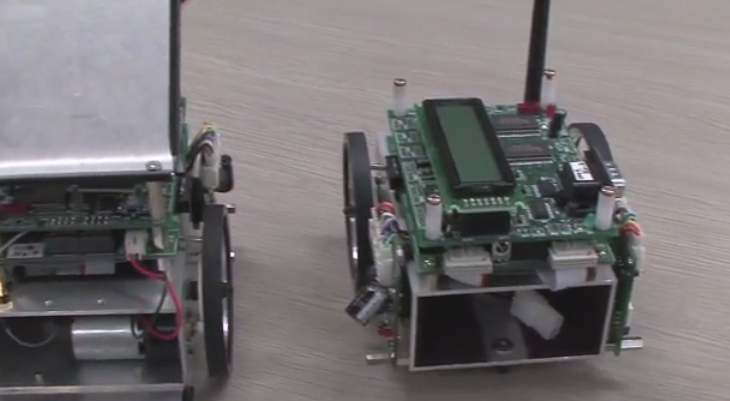
Robot swarms (credit: Mita Laboratory)
Compared to the living buildings proposed by Akira Mita, today’s smart buildings are the architectural equivalent of single-celled organisms, BBC Future reports.
Using swarms of robotic sensors that “chase” a structure’s human occupants, he wants buildings to understand everything about us, down to our emotional state.
These robot sensors will learn from their mistakes, self-regulate using digital “hormones”, and record information over the course of years, building up a record of experiences to be used as “DNA” to program future versions of themselves, or even other buildings.
Early prototypes, called the “e-bio,” are about as big as the Roomba robotic vacuum cleaners. They’re equipped with a pair of bat-like ears that can determine the precise location of sounds. They also have an “eye” that sweeps a laser beam around the robot, allowing it build a complete, three-dimensional picture of its surroundings ten times a second.
Mita’s team is concentrating on making his robots hyper-attuned to signals given off by the human beings in a building.
Take the body language or words we use to express the discomfort we feel with the temperature in a building. In cases like this, the attendant robots would communicate via a “hormonal” signal.
Smart swarms
Borrowing ideas from “swarm robotics” — the study of robots that make decisions in the same distributed way that ants and other insects do — Mita wants his robots to make consensus decisions about how to alter a building’s environment.
Mita’s team figured out how to program a building’s ambient music to shape the mood of its human occupants. The system has pre-set goals — in this case, keeping people productive during the day — and accomplishes them by experimentally adjusting both the familiarity and the tempo of the music piped through a building. By integrating observations of all the humans present, the system used a relatively unsophisticated but “swarm intelligent” algorithm to increase productivity by 69% versus a no-music control.
Another characteristic of living things that Mita is copying is a concept called “homeostasis.” For example, rather than simply being programmed with simple instructions like “if a person walks into a room, turn the light on,” Mita’s “e-bio” sensors might learn how much light a user likes. Equipped with their own light sensors, they can adjust ambient light levels to fit a user’s demonstrated preferences.
This way, the system automatically takes into account time of day, clouds, even whether or not the blinds are drawn, all without actually knowing the state of any of those variables. (This sort of thing makes even more sense with next-generation LED lighting systems, which are dimmable and can be formed into almost any shape, not just that of a lightbulb.)