Russia 2045: will the Singularity be launched in Russia?
March 29, 2012 by Ben Goertzel
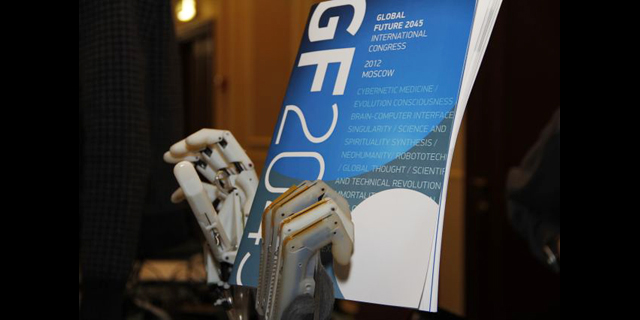
(Credit: Global Future 2045 Congress)
For 3 days in late February, Russian businessman Dmitry Itskov gathered 500+ futurists in Moscow for a “Global Future 2045 Congress” — the latest manifestation of his “Russia 2045” movement.
The Congress featured an impressive roster of Russian scientists, engineers and visionaries, along with American and West European futurist leaders like Ray Kurzweil, Randal Koene, and John Smart.
As Kurzweil noted when I asked him about the conference, “The reference to ‘2045’ comes from my date for the Singularity. The conference was forward looking and was based on my ideas. “
The occurrence of a conference like this in Russia is no big shock, of course. Russia has a huge contingent of great scientists in multiple, directly Singularity-relevant areas; and it also has an impressively long history of advanced technological thinking . My dear departed friend Valentin Turchin wrote a book with singularitarian themes in the late 1960s, and the Russian Cosmists of the early 1900s discussed technological immortality, space colonization, and other futurist themes long before they became popular in the West.
On the other hand, the overall social atmosphere in Russia is not so optimistic these days. In fact Russia is seeing a brain drain of sorts — around 1.25 million Russians have left the country in the last decade, including a large number of educated individuals. This is fairly dramatic for a country of 142 million with a death rate significantly higher than its birthrate. The global economic crisis of 2008 reduced Russia’s GDP to a persistent 3% or so per year, compared to 7–8% beforehand. Russian polling agencies estimate that 20% of Russians are thinking of leaving, with the figure nearly 40% in the 18–25 age bracket.
So on the one hand there’s a struggling economy and brain drain; and on the other hand, a massive brain trust of brilliant scientists and a long tradition of visionary futurist thinking. Taken together, quite an interesting backdrop for Itskov’s event….
And, like the Russian Cosmists before him, Itskov has no lack of grand ambitions. As he told Sander Olsen in an interview last year,
[T]he most important thing is that we want to eliminate death and disease for all — to overcome the limitations of our protein-based body; to find a way out of the chain of various crises our civilization is facing.
As regards the Avatar project … this is a project to create a robot copy of a human that can be operated through the brain-computer interface.
We just talked about the Body B project, which is to create a brain life support system in order to extend human life by 100–200 years.
The Re-Brain project is a purely Russian project to create a computer brain model and a model of the human psyche using the method of reverse engineering, and to develop a way to transfer personality to an artificial carrier.
And Body D is our vision of the evolution of a personality carrier: a body that is like a hologram. This technology is not yet able to be made, but that is how we envision future human bodies.
Exciting visions indeed!
I’m splitting my time between Hong Kong and DC these days, so I’m fairly aware of singularitarian happenings in the U.S. and China (see, e.g., my 2010 article, The Chinese Singularity, and followup comments in this interview). But Russia is largely unknown territory for me — so the Global Future 2045 conference piqued my interest particularly, and I regret I was too busy with work to attend. But I did my best to keep up to speed on the proceedings from a distance.
It’s unclear from the online conference abstracts and other Russia 2045 materials just how much actual work is going in Russia on right now, explicitly oriented toward realizing the exciting visions Itskov describes; and it’s also unclear to what extent Itskov’s “Russia 2045” movement serves an active R&D role, versus a visionary and publicity role.
It appears that most of the concrete science and engineering work at the conference was presented by scientists who had made their breakthroughs outside the context of the “Russia 2045” project; whereas Itskov and the other Russia 2045 staff were largely oriented toward high-level visioning. But of course, Russia 2045 is a new initiative, and may potentially draw more researchers into its fold as time progresses.
To get a better sense of the event and the underlying movement, I asked a few friends who spoke at the Russia 2045 Congress to give me their impressions.
Ray Kurzweil gave a fairly glowing report, noting “It was a well funded conference, funded by a number of major corporations in Russia….. There was significant representation from the mainstream press. The ideas were taken seriously. There were people from companies, from academe, from government…. The comparison to Humanity+ or the Singularity Summit is reasonable…. The people at the conference (about 500–600) were pretty sophisticated about all the issues you and I talk and write about.”
Dutch neuroscientist, geneticist and mind uploading visionary Randal Koene gave a similar report. “I was quite positively surprised by GF2045, because it demonstrated an honest dedication and willingness to put effort and resources in. It is much harder for me to judge the quality of project work that is going on in Russia, partly because I had to rely on the translated version of talks given in Russian, and partly because those talks were of course also aimed at the general public attending and not very full of concrete details.
“The conference content seemed evenly split between an emphasis on seeing the big picture (by inviting many speakers from the “Big History” teaching movement) and scientific/technical/ transhumanist topics. From the latter, the types of subjects that were presented were similar in scope and ambition to those that would be presented at the Singularity Summit, H+ Conferences or AGI (although AI was really not the focus of this particular congress).
“I think that the general arc of thinking is similar to that which we find the US and Europe, though I noted quite a few instances where Russian notables had apparently invented or come up with theories or ideas that were in many ways similar to those found elsewhere, but arrived at somewhat differently.”
Randal also made an acute and perhaps important observation about the relative openness of Russian government officials to listen to singularitarian ideas: “I think there is a place where Russia may be ahead of the U.S. and certainly Europe: There appears to be in governing circles of Russia a greater willingness/readiness to talk about and contemplate as serious possibilities some of the goals and topics that still do not really reach the upper echelons in the U.S. or Europe. That doesn’t mean that the majority of those with governing clout are in favor, but there are at least some who dare to be seen considering the topics.
“I don’t think that there is any official positive position in Russian government about transhumanist memes. But it seems more discussable. By contrast, look at the U.S., where much of the debate is dominated by religious issues.”
Finally, to get a Russian view of the event, I talked to Danila Medvedev, a Russian futurologist specializing in the science and future of Russia. I knew Danila as a leader of the Russian transhumanist movement, and a founder and director of KrioRus, the first cryonics company outside of the United States. I asked Danila what he thought about Randal Koene’s take on the Russian government’s openness to transhumanist themes, and he replied that, in his view, “The power structure includes a few people who are aware, but in general they are anti-progress and there is no actual support whatsoever. Russia-2045 is not a mainstream group, but neither it is a fringe group. “
About the Congress itself, Danila was a bit less enthusiastic than Kurzweil and Koene, noting that “I didn’t see anything impressive at the congress … nothing groundbreaking…. “ However, he went on to note that, in Russia, “transhumanist thinking is relatively widespread. Many people are aware of these ideas and openly support them, including Members of Parliament, such as Mitrofanov, Pligin, etc. The Russian Transhumanist Movement is quite well organized, has an office in the center of Moscow, a number of large interesting projects, such as KrioRus and others.
The organization has good standing, some supporters and has attracted significant media attention. Tech and science are poorly developed for a number of reasons (but there is a number of pioneering projects). For instance, thanks to our projects, such as the Diagram of Human Aging project and other projects, science and technology for dealing with aging is quite advanced (world leading in some respects).”
What’s the overall take-away? As often, it’s apropos to quote Churchill on Russia: “It is a riddle, wrapped in a mystery, inside an enigma.” Clearly there are many smart scientists and engineers in Russia doing directly Singularity-relevant things; and Itskov’s Russia 2045 organization seems to be doing a good job of attracting public and political attention to this work. What amount of concrete work is actually going on toward Itskov’s list of grand goals is unclear to me at present, but certainly seems something to keep an eye on.
And it’s also worth remembering the full Churchill quote: “I cannot forecast to you the action of Russia. It is a riddle, wrapped in a mystery, inside an enigma; but perhaps there is a key. That key is Russian national interest.” The relative openness of the Russian political establishment to Singularitarian ideas is an interesting fact to keep in mind. If this establishment decides that putting a lot of money into the development of highly advanced technologies is in Russia’s national interest, we could see some very interesting things happen in that part of the world.
There is as yet no clear evidence that such a decision will be made; but the relatively high level of acceptance given by various government higher-ups to the ideas at the Russia 2045 conference, is at least mildly suggestive in this direction. While the U.S., Japan and Europe still play a dominant role in most directly Singularity-relevant technologies, and the 21st century is widely perceived to be shaping up as a Pacific century, Russia may prove a major actor on the Singularity stage as well.
Reprinted with permission from H+ Magazine