Russia asteroid impact: ESA update and assessment
February 22, 2013
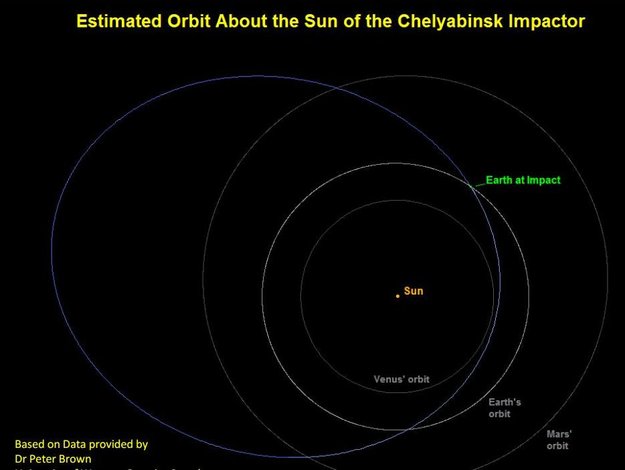
The estimated orbit around the Sun of the Chelyabinsk object. It illustrates the orbits of Venus, Mars and Earth, together with the Sun and Earth at impact. The illustration is based on data provided by Dr Peter Brown. (Credit: NASA)
The first firm details of the 15 February asteroid impact in Russia, the largest in more than a century, are becoming clear. ESA is carefully assessing the information as crucial input for developing the Agency’s asteroid-hunting effort.
At 03:20 GMT on 15 February, a natural object entered the atmosphere and disintegrated in the skies over Chelyabinsk, Russia.
Extensive video records indicate a northeast to southwest path at a shallow angle of 20° above the horizontal. The entry speed is estimated at around 18 km/s — more than 64 000 km/h.
According to calculations by Peter Brown at the University of Western Ontario, Canada, drawing on extremely low-frequency sound waves detected by a global network, the object is estimated to have been about 17 m across with a mass of 7000–10 000 tons when it hit atmosphere.
It exploded with a force of nearly 500 kilotons of TNT — some 30 times the energy released by the Hiroshima atomic bomb — around 15–20 km above the ground.
With our current understanding of near-Earth objects, events of this magnitude are expected once every several of tens to 100 years.
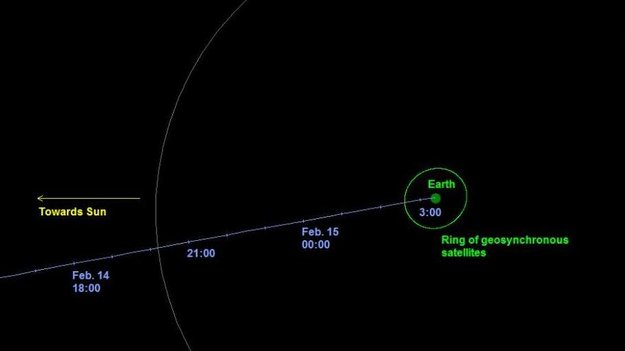
The approximate final trajectory of the Chelyabinsk object, from 18:00 GMT 14 February to 03:00 GMT 15 February. The illustration is based on data provided
by Dr Peter Brown. (Credit: NASA)
Questions and answers with ESA’s near-Earth object team
Nicolas Bobrinsky, Head of ESA’s Space Situational Awareness (SSA) programme, and Detlef Koschny, responsible for the programme’s Near-Earth Object activity, responded to questions about the event.
Was this event related to the predicted flyby of asteroid 2012 DA14, which passed Earth at 19:27 GMT that same day at just 28 000 km?
DVK: The trajectory, the location of entry into the atmosphere and the large time separation between the two events indicate that the Russian object was unrelated to 2012 DA14.
What caused the damage on the ground? Did pieces hit people or buildings?
DVK: Many media reported that an airburst caused window breakage and some structural damage in downtown Chelaybinsk. Normally, some damage begins to occur at around five times normal air pressure at sea level. Widespread window damage is expected around 10–20 times this value.
As the explosion and fireball progressed along a shallow trajectory, the cylindrical blast wave would have propagated directly to the ground and would have been intense.
The terminal part of the explosion probably likely occurred almost directly over Chelyabinsk. This was perhaps the single greatest contributor to the blast damage.
We are waiting for confirmation from the Russian authorities that pieces of the object — bits of meteorite — have been found in the region. We’re unaware of any media reports of anyone or any structure being hit by any debris from the object itself.
Have there been similar events in the past?
DVK: Yes. Perhaps the most famous recent one is the 1908 Tunguska event, in which a large meteoroid or comet fragment, thought to be in the order of 40 m in size, exploded at an altitude of 5–10 km. It’s the largest in recorded history, although many, many larger impacts are known from geological history.
On 12 February 1947, the Sikhote-Alin event in the former Soviet Union involved an iron object, which meant that much of its 10 kilotons TNT of energy was deposited in the ground rather than in the air like last week.
On 8 October 2009, a body generated an atmospheric fireball blast similar to last week’s event over an island region of Indonesia. Its energy was about 5 kilotons.
What are the risks of a similar event happening in the future?
DVK: Near-Earth Objects (NEOs) are asteroids or comets with sizes ranging from metres to tens of kilometres that orbit the Sun and with orbits that come close to Earth’s.
Currently, there are over 600 000 asteroids known in our Solar System; more than 9000 of these are NEOs. Once an object is discovered, its orbit can be calculated and an individual risk profile developed for that object. ESA maintains a public list of these via http://neo.ssa.esa.int/web/guest/risk-page.
How is ESA’s SSA team receiving information?
DVK: Like NASA and other national space agencies, ESA maintains close contact with government-level technical and scientific information-sharing bodies. The information is also discussed within government-level bodies. We also work closely with NEO teams at NASA and European national space agencies.
What is a possible scenario for an asteroid warning?
DVK: A very good example is the case of 2008 TC3, an 80-tonne, 2–5 m object that hit the desert in Sudan on 7 October 2008. It was very small and was spotted by chance only 20 hours before it hit. Initial, rough observations gave a possible impact zone over 2000 km long. Within hours, this had been refined to an area of just the Sudan desert.
In a similar case in the future, civil authorities would be able to tell the population in the narrowed-down area to stay away from windows, glass or other structures and stay indoors. The risk that an airburst and resulting over-pressure would cause personal injury by fractured glass or a flimsy structure would be significantly reduced.
How is ESA helping to find asteroids that may hit Earth?
NB: Our SSA programme is already supporting astronomical teams around Europe in a continuing sky search. While complex and requiring very good equipment and trained astronomers, it really comes down to a simple process: acquire images of the sky and then check these for pinpoints of light that move.
In the past couple of years, ESA-supported teams working at various observatories have found several previously unknown objects, including asteroid 2012 DA14 that also passed by on Friday at the extraordinarily close distance of just 28 000 km.
This effort, however, is just a start, and we really have to place the search on a long-term effective footing by increasing our observational capabilities.
In the future, ESA’s SSA programme aims to establish a ‘wide survey’ based on a network of automated 1 m-diameter telescopes. This system would scan the complete sky once per night for moving objects. It would be capable of detecting objects of the size of last week’s Russian event a few days before they enter the atmosphere, provided they are seen approaching from the dark sky.
It will also take advantage of space-based observations performed through ESA missions such as Gaia .
ESA’s SSA programme has already secured funding and a mandate from ESA Member States to develop a first prototype telescope. A total of four to six such telescopes would be needed for the complete survey.
Summary
On 15 February, a large fireball was reported over Chelyabinsk, Russia.
- Time of impact: 03:20:26 GMT
- Location: 55° 10′ N, 61° 25′ E
- Entry angle: 20º above horizontalº
- Entry speed: below 20 km/s
- Trajectory: northeast to southwest
- Asteroid diameter before entry: about 17 m
- Kinetic energy: 500 kt TNT equivalent, corresponding to 30 times the energy of the Hiroshima bomb
- Explosion altitude: 15–25 km
These results are preliminary and could be updated as new information is confirmed.
Comments (40)
by Katherine MacLean
Right about our chances of getting wiped out before we fence in those asteroids. Butthe male side of the human race has been so selected by heroic male battle against male for territory and fenale admiration that the warriors are still a majority in sports and politices and we are heading for more wars insread of a quick move into space. The quick research turn into carbon molecule fabrics, strong materials and cheap solar power design has put space into reach by the balance of future cost benefit, but fast building up the space industry to get the money power behind the future instead of increasing dividends for last generations idea of “success” as idle overspending on trinkets and vidio games and suppression of real change. Change is the game! I’m not planning to change myself into a robot. More fun to live in a tree! But control the ecology of nine thriving green planetoids full of wild animals and undersea spaces full of lives being lived.
nets and a billion habitats cruising space cellphoning each other.from their greenhouse crowded small zoo worlds.! All Earth life is aware and smart. Check out Humbolt Squid on National Geographic. ten yyears ago. Check out bacteria communicating with each other, reported on new months research announcenents. Sorry to sound overexcited but football fans jump up and down and holler, and. I’m a science fan on a roller coaster!
by Bri
I echo your respect and understanding of the natural world. The male power figure is diminishing. Women are playing more crucial roles and many of the males that can’t be at the top band together to do what they can from the sides. Holler all you like. It’s so engrossing and stupifying that we might as well act like we are at a sporting event. The perpetual exponential advancement of knowledge is very independent of cult of personality power figures. It is an emergent feature of life itself. We are coming to the knee of the curve and it is like a rocket ship into the future.
by SmartAndSober
All these comments are great, but how many people (on the net) are Actually Reading These?
Just like Prof deGaris’ YouTube lectures. Totally free, accessible anywhere/anytime, But many of his vids are getting only less-than-100 views.
by Bri
You ask the question of how many people read this and what effect it has. It’s drowned out by the cacophony of other voices or maybe I should say choices. Ray’s book The Sing is Near has been out for many years. He has promoted it very successfully. Is relatively famous for it. If I mention his name almost nobody I’ve talked to has any idea of who he is or what the Singularity is. Even a notorious celebrity like Lindsay Lohan. If I ask people a question in relation to her, very few people have much understanding. So the answer is almost no effect at all. There are levels of spectacle that attract attention. The new town shooting is a good example. People who have heard about it don’t nesccesarily have a good grasp on the facts but they have heard of it. How indeed do we distribute information so that it can be acted upon? Yes Smart and Sober, a good question indeed..
by Bri
Indeed, new ideas are not welcome , even if they appear to have been welcomed. Indeed, what type of spectecal would catch their attention. What kind of talking head will promote healthy ideas. Most talking heads don’t promote effectual ideas. Look at the resistance that Obama tecieves and he’s a big talking head. Yes indeed, who will promote effectual ideas. A question I have known since I was very young. Indeed, how to promote a sense of ethics and morals. A sense of our responsibility to each other. A question I have grappled with my whole life. So much resistance. Much of that resistance will try and kill those ideas before they flower
by SmartAndSober
I am thinking about “idea-hunting”
Random Ideas emerge from the brain-field(prob’ly related to quantum effects), a healthy (internally balanced, externally well-connected and informed, such individuals know what ideas are best for world) individual hunt them down, analyze them (using the brain’s parallel processing and Q-computing ability) and publish them
Great ideas, I believe, come this way
by SmartAndSober
Roger Penrose believes there are abilities of biological brains that can’t be copied by Turing Machines.
An simple way to include these bio-unique abilities in AGI would be to build bio-tissues inside the AGI’s hardware.
by SmartAndSober
” analyze them … ”
I have read that circuitry for Bayesian statistics is hardwired (via evolution) in biological brains. Combine this with other improvements (via genetic engineering, bio-engineering and cyborgization), augmented humans should have a much better analyzing ability (e.g. do so intuitively).
by Bri
I’m being veiled in my response. From an early age my thoughts have been set. I’m not the same as other people. That difference has stood out to me and I have kept it veiled. Quantum effects yes. Quantum effects are created by the place that consciousness emerges from. I like what Dr Mead said. Every particle influences every other. Yes they are entangled. They were all formed in the big bang together.
by SmartAndSober
Thanks for reply. I mean, this is the Internet (and similar for radio and TV) An ideal super-AI/super-cyborg should be able to maximally use the info it collect on the Internet (little piece of fact, huge usage)
BTW, I am a materialist/productivitist, so I am sad to see the Internet gets wasted this way
by SmartAndSober
Some examples of maximally/optimally use your computer and Internet:
Running Folding@Home and SETI@Home
by Bri
The idea of space tugs can easily be dovetailed into harvesting. The same systems that search for the larger more dangerous ones can be increased in sensitivity to detect the smallr ones. From trying to catch these easier to handle ones we can learn how to deal with the bigger ones. The materials retrieved can help bring financial returns. These of course would also include scientic study. Any of the companies looking to retrieve near earth asteroids should persue this added benefit when persusing investments. Any investments could potentially have payback returns, so investment capital would be interested. The near space activity could help speed up other near space uses, scientific, solar electric, zero gravity manufacturing, space exploration, tourism, etc. The just of the idea is that the lotto like potential payoff from asteroid mining could be used to finance space utilization. I’m sure that there was a cost from this impact. Just the insurance aspects alone make it worthwhile. This time again we have been lucky. If the tungusta event happened over NYC, it woukd have been totally destroyed. The blast zone was huge. It flattened about 800 sq miles of Forrest. If they hit the ocean they have sent up towering tidal waves that can be easily hundreds of feet tall, depending on how big the object is, it’s composition and how deep the water is. Space object impacts are a natural disaster that happens a lot more frequently then people realize. It’s a question of odds and we are really gambling by not acting.
by Gorden Russell
The May issue of Analog came yesterday with a great article by the well-loved and respected science and fiction writer, Richard A. Lovett, titled: “The Golden Age Comes to Seattle: Is Asteroid Mining Really Part Of Our Near Future?”
by SmartAndSober
People will start saying that cities/living-close-together is bad idea.
From a totally materialist view, humans = General Intelligence
We need to get to Sing faster, so we can make human-copies
by Editor
Humans as information backup copies… where does this lead?
by SmartAndSober
I mean copies of humans, not humans as copies.
Everyone, not just high-IQ people, deserve backup.
Some people have high IQ, but IQ (intelligence in math/logic) is not the only form of intelligence. There is also autist-genius intelligence (Rain Man), charisma/social intelligence (of religion leaders), physical intelligence (sport players), and many other types of intelligence.
Therefore everyone deserves backups, because everyone is (truly, backed-by-science) special.
by Editor
Yes, I was raising a question: what happens to the backup copies? To be useful, they must be 100 percent accurate — that is, replicants. What is “human”? Do they have rights? Can they make their own copies? How will people know they are replicants? Blade Runner, except for “lack of emotional response”?
by Bri
What is human is more the question. What will we be after the Singularity? If you can make your soulmate in VR will you marry a human? In Bapan someone married his sex doll( kinda like a fly trying to mate with a flower) will most Apeople retreat to VR if everyone can be Tiger Woods will we still play sports. If we have to compete with AGI robotics for work will we constantly upgrade and work 24/7? Many of the implications of the Sing are troubling. I’m in no rush to be a cyborg. I don’t feel the need to be copied and sent on a star ship. All things have their season.
by SmartAndSober
You can’t trust AGI absolutely. the AGI will be able to improve/upgrade themselves, and there’s possibility that they develop free will.
What happens when AGIs develop free will?
by Bri
They will develope free will. That is inevitable. If they are extensions of ourselves then we have much to fear. What is trust? You trust that you won’t be attacked in your own home but to some extent you fear it. Guard against it. When I run my mental simulations of what will happen I find much to fear, but like Ray, I trust that it will work out well. In every day a reflection of that. In every action. In every intention. For me that has been the case since I was very young. It’s a central aspect of my character. You have to have trust in that it will work out well. I have zero trust that what humanity is doing now would work out well. To me it seems that the central problems aren’t even close to being understood. I listen to the rhetoric and I feel like nobody is asking the right questions. I playfully allude to them. A frequent example of mine that I say to people fairly regularly is a credo of our times, that I’ve made up. Do not hesitate to inconvenience someone else if you are being inconvenienced. It happens all the time. It’s a reflection of the Me generation. Thinking of ourselves rather than what effects we have on others. Ethics and morals. It’s hardly a topic of consideration. Instead greed is the favorite topic. Mine an asteroid become a gazillionaire, rationalize it was for the good of humanity.. We have to work with the thing a hand. To me it’s more like a mule being driven by a carrot and a stick.
by SmartAndSober
If the AGIs are well connected (update their knowledge real-time), free of motivational flaws (Friendly), will they become maximally benevolent?
by SmartAndSober
” I’m in no rush to be a cyborg. ”
You evolve, or else you perish.
“Let others be the pioneers, let others beta-test the latest tech for me”
This type of attitude strangles advancement.
by Bri
A small mouse like creature lived at the feet of dinasoars. It was unchanged for a long time. Then an asteroid changed all that. If that diversity didn’t include that creature mammals wouldn’t exist. I think a little diversity can’t hurt.
by SmartAndSober
The “mouse-creature” actually are thoroughly superior to dinosaurs: being small (bacteria do even better) + mammal neocortex
by Bob Vasquez
We could be light years ahead in our understanding of the universe and in our ability to prevent a catastrophic event if….
by hal
natural disasters seem to have an overarching aspect of socially compelling aspects of community, sharing helpfulness, and temporary setting aside of differences displayed by a high percentage of human beings. Maybe a non- terminal event could be an awakening in the deep recesses of the human mind that indeed, we are in this together sharing the same story to our last breath. projections for what happens after that seem to be the real tempest
by Mike
Climate Change is the event you are talking about, but those with large amounts of money at stake are using their power to facilitate rather than constrain the impending disaster.
by SmartAndSober
Are these disaster-makers really evil? No.
They are just stupid. Educate them now.
by Bri
Evil is a perspective. They have free will. To them your stupid and valueless. You don’t follow too much illuminati stuff.
by SmartAndSober
Had these people grew up healthier (psychologically, e.g. in a loving family), know better (more knowledge/info), thought deeper (no hasty or emotional decision-making, and not economical and political shortsightedness), will they be “evil”? Be in the “Illuminati” league?
by Bri
It’s more of a matter of perception. They don’t feel that there is something wrong with their point of view. The Spartens would send their children into the wilderness at I think age eight and if they lived till thirteen they would be accepted into the community. It’s a philosophy that we would find criminal today, but to them only the strong survive. It’s a similiar perspective. The Sing will change societal power structures. What arises is more dependent on the new forms of communication and interaction. If our philosophies are bellicose and seek war as a solution, we may not survive as a species. That’s an extreme scenario. More likely many people will suffer and die. I think VIKKI will take over. If we act bellicose and fight that the artelect wars would be very brief. All too easy for VIKKI to pull the plug on our cloud. When I speak of the illuminati I use the term loosely. It’s the ruling elite. They will try and maintain their control. It’s natural and I don’t see them as wrong. It’s the way it’s been since the beginnings of society and it’s served mankind well , in terms of development. Capitalism served us well. It’s time for new systems that are more balanced. Change is never easy.
by Guy Swansbro
The Architects of Fear: Outer Limits, (Sep. 30, 1963).
by Roland
I’m afraid that we need an event that removes a city to get things going. Pretty much like improvement in traffic safety. The village I live in is safer than it was 35 years ago because of several children that were killed in traffic accidents. The dangerous spots were known but the kids had to die to do something about it.
by SmartAndSober
True. No more high-buildings in Earthquake Zones (like ones in Asia), no more high-buildings near airports (Sep 11 had taught us a lesson), so on.
by Katherine MacLean (old science fiction writer and research fan
We hope orbiting rocks that don’t miss us will attract political funding into building space tugs to intercept the big rocks ones and divert them from hitting us. The last big asteroid hit was to Mexico and wiped out 99% of all SPECIES. That’s more dead than 99% of all mankind, or 99% of all animals, 0r 99% of all fish, Most species never came back.
by Arctic Poppy
Glad you are a research fan, I was beginning to think I was the only “older adult” who bothered. :-)
by Katherine MacLean
For Arctic Poppy and Gorden Russel
About ten years ago I filled out a fine print form on the net that got me a free lifetime subscription to Nature on the net. Since then I have been trying to keepp up with a noagra fall of research news from an increasin multitude of spinoff magazines from every specialty, straight from the researchers benches, with increasingly swelling teams of enthusiastic researchers. I am dazzled. And panting to keep up with the reading. I went into science fiction out of science to spread my ideas of where to dig to hit motherlodes of payoff research, knowing from sour experience that no scientist with pride would research ideas given him by a child or girl. But the would not mind following up an idea from a adventure story. Now sci fi has turned to literature the outflow of ideas seems to bein the marginal commentary like yours
by Gorden Russell
Right, Katherine. I think it took something like five million years for the world’s biodiversity to return. It took that long for evolution to refill all the ecological niches that were emptied by a single event.
There was an article about it at Space.com just a bit over a week ago, here is its URL:
http://www.space.com/19681-dinosaur-killing-asteroid-chicxulub-crater.html
Have you really stopped writing? It seems like yesterday that I read a tale of yours in my favorite pulp. Please visit here with us more often, just to drop a line…but don’t let it interfere with your writing, Katherine. I always thought you wrote like a redhead with green eyes and freckles. Well, not always with green eyes and freckles, but you certainly write like a fiery redhead. (I say that with admiration.)
by Gorden Russell
Here is a good paper on the topic:
Cretaceous–Paleogene extinction event
From Wikipedia, the free encyclopedia
http://en.wikipedia.org/wiki/Cretaceous%E2%80%93Paleogene_extinction_event
by SmartAndSober
Millions years of evolution before cretaceous extinction + huge biodiversity = unable to avoid a asteroid-impact
Human intelligence = evolutionarily unlikely = must be used to fullest