Science in three dimensions: the print revolution
July 5, 2012 | Source: Nature News
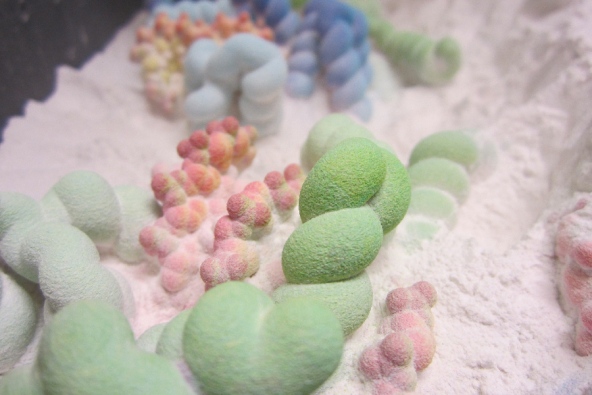
Research labs use many types of 3D printers to construct everything from fossil replicas to tissues of beating heart cells. Arthur Olson’s team at the Scripps Research Institute in La Jolla, California, produces models of molecules; some are shown here partway through the printing process (credit: Adam Gardner, Molecular Graphics Lab at TSRI)
Three-dimensional printers are opening up new worlds to research.
Christoph Zollikofer witnessed the first birth of a Neanderthal in the modern age. In his anthropology lab at the University of Zurich, Switzerland, in 2007, the skull of a baby Homo neanderthalensis emerged from a photocopier-sized machine after a 20-hour noisy but painless delivery of whirring motors and spitting plastic.
These days, personal kits go for as little as $500, says Terry Wohlers, a consultant and market analyst based in Fort Collins, Colorado — although industrial systems cost an average of $73,000. Last year, he says, nearly 30,000 printers were sold worldwide, with academic institutions buying one-third of those in the $15,000–30,000 price range.
Early adopters are using the technology to investigate complex molecules, fashion custom lab tools, share rare artefacts and even print cardiac tissue that beats like a heart. At palaeontology and anthropology conferences, more and more people are carrying printouts of their favourite fossils or bones. “Anyone who thinks of themselves as an anthropologist needs the right computer graphics and a 3D printer. Otherwise it’s like being a geneticist without a sequencer,” says Zollikofer.
The printouts are yielding insights that are not possible with more conventional methods. Neanderthal neonate fossils, for example, are extremely rare, so Zollikofer did not want to risk copying his fragile specimen with the usual plaster-casting methods. With the printout, however, Zollikofer could explore the logistics of Neanderthal births.
Molecular playground
These days, 3D printing is being used to mock up complex molecular systems, says Arthur Olson, who founded the molecular graphics lab at the Scripps Research Institute in La Jolla, California, 30 years ago. These include molecular environments made up of thousands of interacting proteins, which would be onerous-to-impossible to make any other way. With 3D printers, Olson says, “anybody can make a custom model.”
Yet Olson says that these models can bring important insights. When he printed out one protein for a colleague, they found a curvy ‘tunnel’ of empty space running right through it. The conduit couldn’t be seen clearly on the computer screen, but a puff of air blown into one side of the model emerged from the other. Determining the length of such tunnels can help researchers to work out whether, and how, those channels transport molecules. Doing that on the computer would have required some new code; with a model, a bit of string did the trick.
The cellular matrix
Printer ‘inks’ aren’t limited to plastic. Biologists have been experimenting with printing human cells — either individually or in multi-cell blobs — that fuse together naturally. These techniques have successfully produced blood vessels and beating heart tissue. The ultimate dream of printing out working organs is still a long way off — if it proves possible at all. But in the short term, researchers see potential for printing out 3D cell structures far more life-like than the typical flat ones that grow in a Petri dish.
For example, Organovo, a company based in San Diego, California, has developed a printer to build 3D tissue structures that could be used to test pharmaceuticals. The most advanced model it has created so far is for fibrosis: an excess of hard fibrous tissue and scarring that arises from interactions between an organ’s internal cells and its outer layer. The company’s next step will be to test drugs on this system.
Other groups are using 3D printing of plastic or collagen to construct scaffolds on which cells can grow. Carl Simon, a biologist with the biomaterials group at the US National Institute of Standards and Technology in Gaithersburg, Maryland, says that the intricacies of scaffold shape can help to determine how cells grow, or how stem cells differentiate into different cell types. With 3D printing, researchers have a very controlled way to play with different scaffold configurations to see which work best. One problem, however, is that most 3D printers can produce details on the scale of only tens to hundreds of micrometres, whereas cells sense differences at the single-micrometre level. Top-quality printers can currently achieve 100-nanometre resolutions by using very short laser bursts to cure plastics, says Neil Hopkinson, an engineer who works with 3D printing at the University of Sheffield, UK, but this is “still very much in the lab”.
Custom tools
In the meantime, basic plastic 3D printers are starting to allow researchers to knock out customized tools. Leroy Cronin, a chemist at the University of Glasgow, UK, grabbed headlines this year with his invention of ‘reactionware’ — printed plastic vessels for small-scale chemistry (M. D. Symes et al. Nature Chem. 4, 349–354; 2012).
Researchers in other fields have found a more immediate use for the technology. Philippe Baveye, an environmental engineer at Rensselaer Polytechnic Institute in Troy, New York, uses 3D printing to make custom parts for a permeameter — a device used to measure the flow of water through soils. Although commercially available devices are fine for routine work, he has often had to design his own for more precise research — a task that previously required many hours on a lathe. Printing, he says, is much easier.
Others agree that the real power of 3D printing lies in its ability to put science into the hands of the many. Cronin wants to enable anyone — whether in the far corners of Africa or in outer space — to print their own tiny drug factory. Museums can already distribute exact copies of rare or delicate fossils as widely as they wish. And students can print out whatever molecule they’re trying to come to grips with. “Through 3D printing,’ says Olson, “the ability to make physical models has become democratized.”