Sequencing the Connectome
October 25, 2012
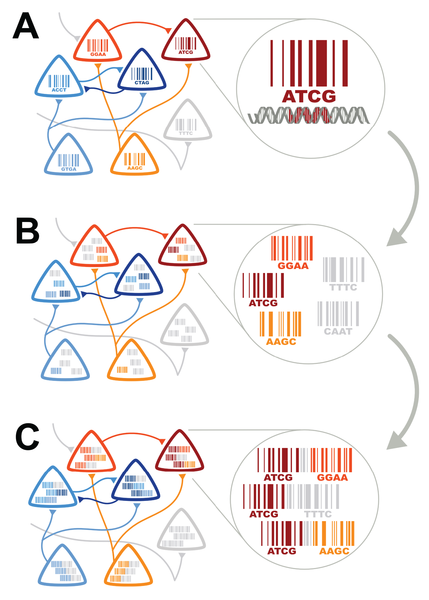
Converting connectivity into a sequencing problem can be broken down conceptually into three components. (A) Label each neuron with a unique sequence of nucleotides — a DNA “barcode.” (B) Associate barcodes from synaptically connected neurons with one another, so that each neuron can be thought of as a “bag of barcodes” — copies of its own “host” barcode and copies of “invader” barcodes from synaptic partners. (C) Join host and invader barcodes into barcode pairs. These pairs can be subjected to high-throughput sequencing. (Credit: Anthony M. Zador et al./PLoS Biology)
A team of neuroscientists led by Professor Anthony Zador, Ph.D., of Cold Spring Harbor Laboratory have proposed a revolutionary new way to create a connectivity map (“connectome”) of the whole brain of the mouse at the resolution of single neurons: high-throughput DNA sequencing.
The only current method for obtaining the connectome with high precision relies on laboriously examining individual cell-to-cell contacts (synapses) in electron microscopes, which is slow, expensive and labor-intensive. (See A circuit diagram of the mouse brain.)
This reconstruction of serial electron micrographs has yielded what to date is the only complete connectome, that of C. elegans (a nemotode or roundworm). However, even for this simple nervous system, the reconstruction required a heroic effort — more than 50 person-years of labor to collect and analyze the images.
The appeal of using sequencing is that its scale and speed — sequencing billions of nucleotides per day is now routine — is a natural match to the complexity of neural circuits. And it’s getting faster exponentially.
An inexpensive high-throughput technique for establishing circuit connectivity at single neuron resolution could transform neuroscience research, the open-access PLoS Biology paper says.
Barcoding synapses
“Our method renders the connectivity problem in a format in which the data are readable by currently available high-throughput genome sequencing machines,” says Zador. “We propose to do this via a process we’re now developing, called BOINC: barcoding of individual neuronal connections.”
The proposal comes at a time when a number of scientific teams in the U.S. are progressing in their efforts to map connections in the mammalian brain. These efforts use injections of tracer dyes or viruses to map neuronal connectivity at a “mesoscopic” scale — a mid-range resolution that makes it possible to follow neural fibers between brain regions. Other groups are scaling up approaches based on electron microscopy.
Zador’s team wants to trace connectivity “beyond the mesoscopic,” at the level of synaptic contacts between pairs of individual neurons, throughout the brain. The BOINC barcoding technique, now undergoing proof-of-concept testing, will be able, says Zador, “to provide immediate insight into the computations that a circuit performs.”
In practice, he adds, most neural computations are not currently understood at this level of precision, partly because detailed circuit information is not available for mammals. The BOINC method promises to be much faster and cheaper than approaches based on electron microscopy, Zador says. (The paper includes a cost analysis, with a possible $1,000 mouse cortical connectome,)
How BOINC would work
- Label each neuron with a specific DNA barcode, consisting of just 20 random DNA “letters.” (A barcode consisting of even 20 random nucleotides can uniquely label 420 = 1012 neurons — 10,000 times more than the number of neurons [<108] in a mouse brain.)
- Look at neurons that are synaptically connected and associate their respective barcodes with one other. One way to do this is by using a virus (such as the pseudorabies virus) that can move genetic material across synapses. “To share barcodes across synapses, the virus must be engineered to carry the barcode within its own genetic sequence,” explains Zador. “After the virus spreads across synapses, each neuron effectively ends up as a bag of barcodes, comprising its own code and those from synaptically coupled partners.”
- Join barcodes from synaptically connected neurons to make single pieces of DNA, which can then be read via existing high-throughput DNA sequencing methods. These double-barcode sequences can then be analyzed computationally to reveal the synaptic wiring diagram of the brain. (Barcodes are joined in vivo, so there is no need to isolate individual neurons prior to extracting DNA.)
If BOINC succeeds in its current proof-of-concept tests, it will offer a dramatically inexpensive and rapid means of assembling a connectome, even of the complex brains of mammals, says Zador.
This work was funded by grants from the NIH and the Paul Allen Family Foundation.
Comments (19)
by Michael Zeldich
Magnificent technological brake true, but what is at the and? The functions of a brain are misunderstood, as well as the reasons for which the neurons are interconnected. That will make the practical impact of that finding negligibly small.
brain is not a kind of a computer and it nor performing any calculations.
by codesimian
Sounds like a great way to evolve sexually transmitted diseases, as some of them are so hard to cure because they live in nerves, the long axons of neurons that branch out into the body. If viruses are used to travel axons/synapses/neurons and spread DNA, this is likely to happen in worse forms.
by John Middlemas
This is the same old thing again, mapping the brain. Even if you can do it then how will you analyse the map? It’s so obviously wrong it’s not even wrong. Hope springs eternal among the singularitarians but reality it a differen’t question.
Until you know how to analyse the data final result then what’s the point of all this effort certainly wasted. If the nematode was a problem at 200 neurons how can you do the brain at 100 billion. It’s just ludicrous. Try a cockroach first and waste less money but at least you would find out quicker you are down the garden path.
by Editor
The paper does not mention the human brain. Mouse brain connectome studies are essential for many reasons, including developing treatments for neurological disorders.
by Gorden Russell
Right, Amara, we have to start somewhere. The longest journey starts with a single step. Just think of this research as another paving block in the yellow brick road. With the exponential increases that are accelerating scientific knowledge, neurology will one day look like wizardry. We have to get behind this work. None of us want to face a future of Parkinson’s or Alzheimer’s.
by Gorden Russell
You’re too much of a pessimist, Middlemas. Just look at the big picture, mapping the brain will save your mind one day. Go back and look at Ray’s book, “The Singularity is Coming.” Look at the way the lines on the graphs all go off-chart to the top right. Fantastic discoveries are coming.
by John Middlemas
Of course I would say realist rather than pessimist. I am in fact extremely hopeful and positive in other areas. For example, if you want machine intelligence I believe you will get some kind of that by a different approach. Forget the brain and neurons since the analysis will certainly defeat you as well as not knowing the source of human intelligence. Do a Ben Goertzel approach from the programming strategy side and you may get somewhere although it will not be a human type intelligence but some other and very likely inferior in many ways but could be superior in some ways too (e.g. speed maybe). The trouble here is where are the values to come from, love, hate, empathy etc etc. I think these belong to the realm of humans and God and the angels and will remain “unprogrammable”. However, you could get some pretty nifty machine intelligences and might surprise me. New things we couldn’t have imagined but some danger too.
by Dolleater
John,
In c.elegans, we don’t know the actual relationships between the neurons (is it excitatory? inhibitory? can it be removed without functional loss? ect ect). There is a possibility that something like vesicular release is important in understanding brain function with regards to computation, but we won’t know until we get there.
If we knew how it worked, we wouldn’t have to do the experiments to find out. Making sense of what we find is half the process. But we can’t make sense of data we don’t have, and mapping out the connectivity is an important step– hardly a waste of time.
by John Middlemas
It is a waste of time because resources would be better spent on a Goertzel approach from the programming and software side rather than uncertain biological analysis. If you were going the biological way then take Deutche’s suggestion and look in the DNA for differences between ape and human DNA because therein might lie a few clues but not the whole story I feel (assuming DNA exists of course and is not witchcraft).
Can someone give Ben Goertzel some money for his research please? He is always moaning of lack of funding and he’s right. Your best hope is there since he has FAITH.
by star0
Amy Bernard, director of the Allen Institute for Brain Science, has some very positive things to say about the idea. See:
http://www.technologyreview.com/news/506127/connectome/
Quoting from the article:
“This strategy is really nice, particularly as the cost of sequencing is going down,” says Bernard. “It’s not going to give you the whole-brain, whole-structure information that some of the other connectome projects are focusing on,” but instead will provide a more up-close view of the brain’s connections.
by A4i
Mapping should be done noninvasively. That is possible with single cell resolution MRI. Computational power is there for 3D reconstruction. What is needed is more Tesla and better sensors.
by nanotech.republika.pl
“Label each neuron with a specific DNA barcode…”
How would you do that? Each and every neuron in a living brain of a mouse would get a slightly different DNA label?
The paper says: “(The barcoding) is conceptually similar—though different in detail—to the generation of antibody diversity by B cells in the immune system through somatic recombination.” But how would you implement this? Do you insert some enzymes into the living brain that go into neurons and randomly modify DNA in every neuron at some specific location?
by Gorden Russell
“The appeal of using sequencing is that its scale and speed — sequencing billions of nucleotides per day is now routine — is a natural match to the complexity of neural circuits. And it’s getting faster exponentially.”
This is part of what will be needed to repair the damage done by freezing in cryogenics.
So has young Kim Suozzi made her donations target yet? I sent in some money a few days ago.
by Giulio Prisco
@Gorden re KIm – see http://www.kurzweilai.net/23-year-old-with-terminal-brain-cancer-hopes-to-be-cryopreserved-update
I think we are approaching the donation target, and she is in good hands, but of course every dollar counts. Thanks for contributing, I also donated what I could afford, and many other friends have done the same.
Please, keep contributing to the fund raising!
by star0
wow! Sounds like a brilliant idea — out of the box thinking.
by keyboard guy
If this really works it is an astounding step towards our ability to upload our minds to a new host. The singularity looms.
by Ian Clarke
So all species specific connectomes are the same? No differences between healthy individuals?
If it works, this has to be a big step forwards in our understanding.
by Micahel B
No, connectomes are not exactly the same, but neither are genomes (about 0.1% genetic variation between individuals). One insight that could come from techniques like this is the degree of similarity between individual connectomes.
by Ian Clarke
Ah, I see. Thanks Micahel.