Sequoia is the new world’s fastest supercomputer at 16 petaflops
June 19, 2012
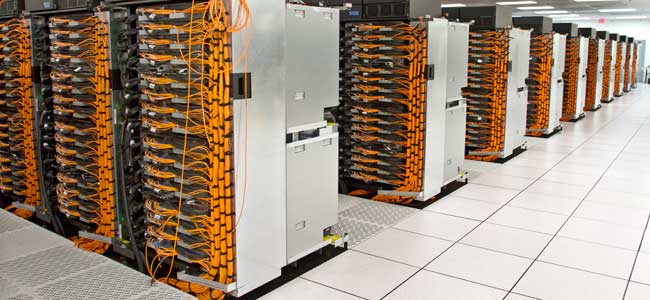
Lawrence Livermore National Laboratory (LLNL)’s IBM Blue Gene/Q Sequoia supercomputer is the new world’s fastest high-performance computing system, at 16.32 sustained petaflops (quadrillion floating point operations per second), according to the Top500 list of the world’s fastest supercomputers.
For the first time since November 2009, a U.S. supercomputer tops the ranking.
A 96-rack system, Sequoia will enable simulations that explore phenomena at a level of detail never before possible. Sequoia is dedicated to to the The National Nuclear Security Administration’s (NNSA) Advanced Simulation and Computing (ASC) program for stewardship of the nation’s nuclear weapons stockpile, a joint effort by Lawrence Livermore, Los Alamos and Sandia national laboratories.
“The quantitative leap forward in computational power Sequoia represents will have a huge qualitative impact on the nuclear weapons calculations we will be able to conduct for stockpile stewardship. This capability is critical to the program to extend the life of such aging weapons systems as the B61 and W78 and will help to accelerate other NNSA research efforts such as fusion experiments at the National Ignition Facility,” said Bruce Goodwin, principal associate director for Weapons and Complex Integration.
On the latest Top500 list, Japan’s “K Computer” at the RIKEN Advanced Institute for Computational Science, is now the no. 2 system on the list with 10.5 petaflops.
Argonne National Laboratory’s new Mira BlueGene/Q system makes its debut at no. 3 on the list with a performance of 8.15 petaflops on the industry-standard Linpack benchmark.
Other systems in the top 10 include: SuperMUC, an IBM iDataplex system installed at Leibniz Rechenzentrum in Germany, at no. 4; China’s Tianhe-1A, no. 5; Italy’s IBM Bluegene/Q system installed at CINECA; Jaguar at Oak Ridge National Laboratory in Tennessee, no. 7; Germany’s JuQUEEN BlueGene/Q, no. 8; France’s Bull supercomputer, no. 9; and China’s Nebulae, no. 10.

Comments (26)
by G Bernstein
Brain FLOPS under-estimated? Astrocyctes missing:
==
Astrocytes seem left-out of brain FLOPS estimates which take, IIRC, num_synapses * frequency ~= 38 Peta-FLOPs (IBM?)
Is it reasonable to leave out astrocytes? If not, by what factor would the FLOPs estimate of the brain need be increased? Astrocyctes are the most numerous of brain cells, and interconnect with several to 100s thousands synapses.
Why would astrocytes need to be considered?
1) Astrocyctes affect synaptic signal strength, and thereby neuron firing. Astrocyctes communicate with each other and with synapses, so shouldn’t the processing represented by the collective states therein need to be considered as more than just a single alteration of the “floating point” value, and, rather, an alteration of the calculation necessary for the value?
2) Something to also consider) Recent discoveries such as, e.g., augmented intelligence in mice injected with human astrocytes.
by Editor
Right.
by G Bernstein
Hi!
Amazing! So the Editor of Kurzweil AI agrees with me that Brain FLOPS might be (grossly) under-estimated?
Don’t get me wrong, I hope we aren’t farther from brain FLOPS equivalence, but this is potentially big news in the Universe Epoch 5/6 timeline, is it not? Google doesn’t show me estimates involving astrocytes, only neurons, and so ~38 Peta-FLOPS.
I understand that some of the complexity of processing functions of astrocyctes are controversial. Even so, there is research that suggest significant processing (1):
We might be talking about ~20 doubles required ~= +20 years at 1-year/doubles. I can’t calculate it precisely from the limited info I’ve found thus far on astrocycte average number of connections and gliotransmitter frequency.
Why 20 double-times (2^20)?
We have maybe ~10x more astrocytes than neurons, right?
They are connected to “several” to 100s thousands (some research points to 2 million in some cases) of other astrocytes and synapses. How many on average, I haven’t seen. Any research on this?
Let’s say it is similar to neurons, and also ~10,000 on average. As they fire and communicate among themselves via glio-transmitters. At what frequency? I’ve seen research indicating about 10-200 hz in different cases, but I’ve only had a chance to skim this info for now.
Let’s suppose the same 100 Hz.
Well than, than is just 10x more computation than a neuron-centric estimation. That is just ~3 doubles. 3 years. No big deal.
But we have 2 systems here (neuron and astrocyce), so we might need to consider them in combination. Since astrocyte (A’s) connections have a chance to ‘process’ signals on ~10,000 points of contact with neuron (N’s) synapse (S’s), and since there are 10x more A’s than N’s, then we should multiply processing by 100,000, right? Also, ways in A’s affect S signals are numerous. Say 10. So 10x for that right, or not? so 1-million fold increase now? And there might be many more A connections on avg than 10k. As stated, up to 2 million connections have been found. I’ll ignore that additional 10-100 factor for now.
So 1-million-fold increase = ~20 doubles = 20 years at 1-year/doubles. Not insignificant. But maybe several years less at the double exponential curve, right? How much less? What are some double exponential growth functions KurzeilAI and others use anyway? Public info?
Oh well, 20 years isn’t the end of the world. We might find some other snags though. On the plus-side, we’re already putting some chips in animal brains so maybe we’ll just jump onto brain +/* cpu soon, and benefit from the types of calculations computers are good at in a that is fundamental to our thought-process that way, anyhow.
PS, ya, have Ray email me : ) I have some other thoughts I haven’t heard mentioned. Some stuff that’d be great for the next book. More about a new way to view Identify etc, so a crowd-pleaser as well. : )
(1) http://brainblogger.com/2012/02/03/the-many-emerging-roles-of-astrocytes/
by Editor
>some other thoughts I haven’t heard mentioned
Tell all!
by Brian Roberts
If most of the top supers are IBM what are they being used for now? I can’t think they are ALL being used for stockpile and college whatzits.
by Don
Why don’t we sell all our Nukes to IRAN since many of you hear think we should just disarm….. We would all be speaking Russion if we disarmed back during the Cold War……. Or Chinese…… Or Cuban…. etc…
by Mortran
Neither Chinese nor Cuban are languages. In China they speak Cantonese or Mandarin, in Cuba Spanish.
by Mr.x
If the sovjetunion had reduced its arsenals we all would be speaking English by now.
Srsly, this obsession with language is an anglo-american thing, most people in most countries do not care that much which language you, on the other side of the planet, speak.And of course, sell them to Iran, some people would feel safer if the only country to ever have used nuclear arms gets rid of its WPMs.
@ Mortran: Nice comments, and agreed.People vastly overestimate the power of a human brain and undestimate the complexity of the software necessary to have strong AI.Even if one says that the human brain is ‘better’ than most contemporary supercomputers he/she has to reflect upon the fact that we are nowhere near “the end of history.”
I mean the period of so called “Modern Art” was somewhere from 18xx to 19xx.Todays hightech could be tomorrows trash.
by Steven Roth
If everyone would sign up to donate your computers processing power to scientific/ medical research at World Community Grid by IBM, it would probably total well over 16 petaflops. So, help accelerate science and sign up!!
by JohnnyG
I can donate money, but NEVER my pc. That’s for games.
by joao
The entire BOINC network averages about 7.3 petaFLOPS as of December 24, 2012.
check: http://en.wikipedia.org/wiki/FLOPS#Distributed_computing_records
by DeBee Corley
You need 16 petaflops for nuclear stockpile maintenance? How do these laboratories get funding for these monstrosities.
Oh, hi mister congressperson, I need 2 billion dollars to have a toy, er, a defense expenditure to safeguard the nuclear stockpile.
Stupid question from the back of the room. How did you do this work in 1958 with vacuum tube computers?
by JohnnyG
Awesome news.
I hope in ten years we can have the processing power of the whole Sequoia in, say, a cellphone.
by james
High end cellphones have the processing power of the worlds fastest supercomputer 25 years ago, more or less. Thats been constant for a couple of decades now.
by Mortran
Angry Birds would run really fast on that one.
by Conrad Green
We finally have a computer that exceeds the processing power of the brain. Singularity is either here or we’re really close.
by Mortran
You didn’t get it.
The processing power of a human is estimated to be between 10^14 and 10^16 flops. (see Kurzweil’s books) The Sequoia is already around twice as fast as the highest estimate for the human brain.
The problem is not the hardware anymore, it is the software. We haven’t developed a software that would be able to simulate a human brain. This will probably take another 30 years.
by Mark
That assumes that thinking really takes place in the brain. Haven’t you ever wondered why it is that when we tinker with the brain, it more resembles tinkering with an interface than tinkering with the computer itself?
It is not a popular idea yet, but with the “cloud” perhaps people will being to start thinking a little differently. There is more to humanity than just biological electrical functioning.
by joao
it seems that YOU didn’t get it. the sequoia has 16.32×10^15 flops. So it’s only 63.2% faster then the highest estimate for the human brain.
but the K Computer already achieved the highest estimate for the human brain.
And software AND knowledge about how the brain actually functions, are the next hurdles.
by Editor
Estimates of brain speed depend on the model. With the tubulin dimers model, for example, the estimate is 10^27 flops (J. Tuszynski, Ed., The Emerging Physics of Consciousness, Springer, 2006), and with a quantum model, it would be much higher.
by Lord Penguin
It would be better if the computer didn’t have to be used for nuclear weapon maintenance, like if we had disarmed our old bombs. But at least some of the time it’ll be used for science, and hydrogen fusion (which should be top priority).
by D
I appreciate that sentiment, but disarming bombs is work for relatively dumb robots. Simulating nuclear explosions is really powerful and can help to eliminate the need for live tests. This can lead to reduction of the nuclear arsenal. Meanwhile, countries that don’t have the petaflops and programming power we do will still have to build arsenals and do tests…which will make them look like jerks in the international community. So we can get back on our high horse and criticize them from moral high ground without looking like hypocrites (as much as before).
by Snake
Why do we ‘have’ to test nuclear explosions at all?
by Gorden Russell
You’re right, Lord Penguin. We certainly want to see this computer accelerate the work of the National Ignition Facility. Fusion power is a world-saving technology. Also, you need a fusion reactor to build a starship.
by Conrad Green
It only exceeds the human brain slightly. I think simulating nuclear explosions could be baby work for the first synthetic brain. Fusion science would most likely be achieved for a exaflop computer. So i agree on both of your points.
by Mark
Only if you think inside the box.