Serious Blow to Dark Matter Theories?
April 19, 2012
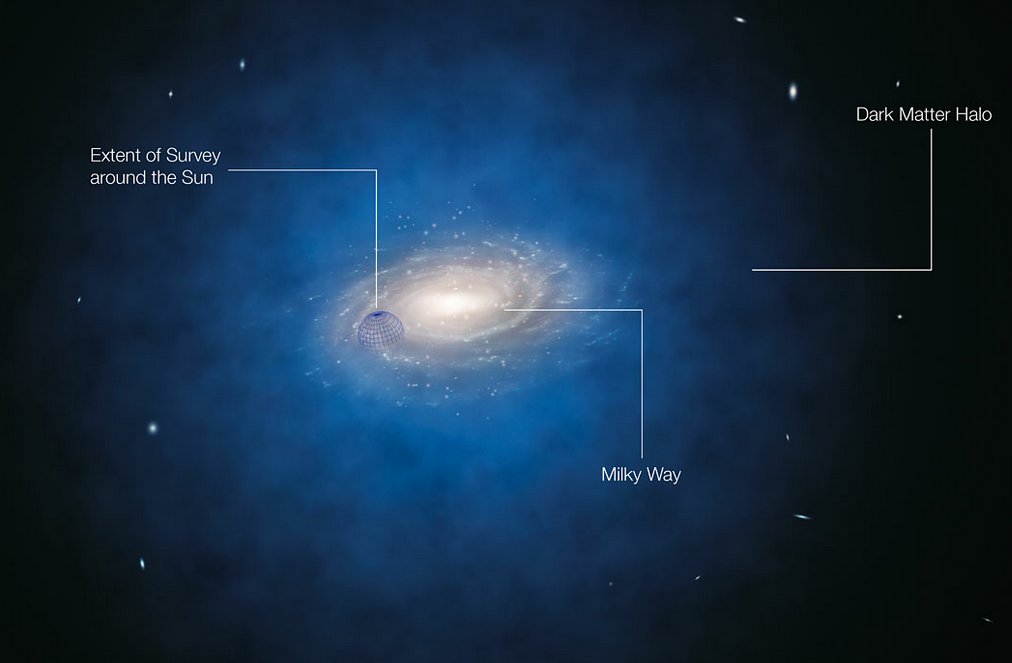
Artist’s impression of the expected dark matter distribution around the Milky Way (credit: ESA)
The most accurate study so far of the motions of stars in the Milky Way has found no evidence for dark matter in a large volume around the Sun.
According to widely accepted theories, the solar neighborhood was expected to be filled with dark matter, a mysterious invisible substance that can only be detected indirectly by the gravitational force it exerts. But a new study by a team of astronomers in Chile has found that these theories just do not fit the observational facts. This may mean that attempts to directly detect dark matter particles on Earth are unlikely to be successful.
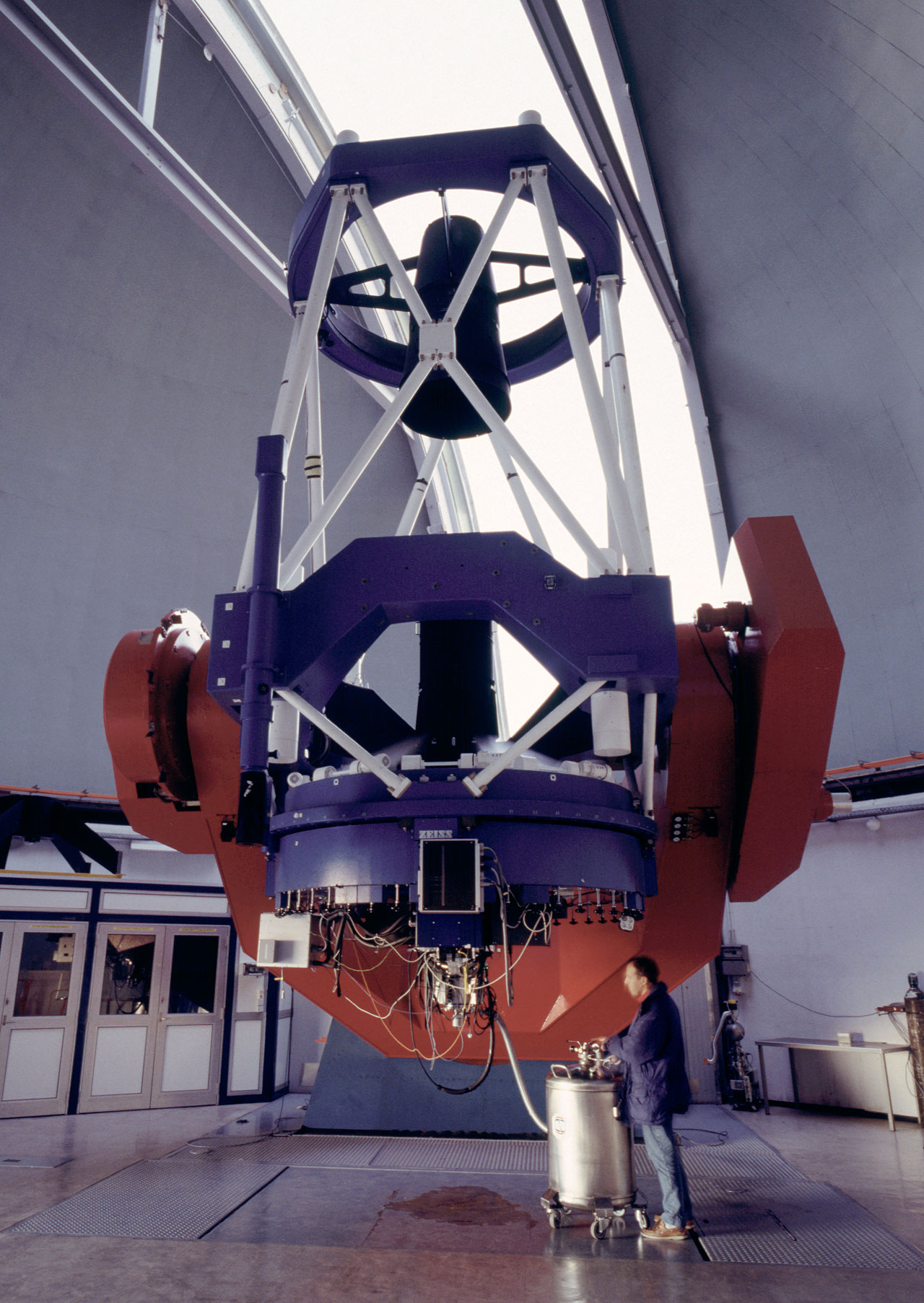
A team using the MPG/ESO 2.2-metre telescope at ESO’s La Silla Observatory, along with other telescopes, has mapped the motions of more than 400 stars up to 13 000 light-years from the Sun. From this new data they have calculated the mass of material in the vicinity of the Sun, in a volume four times larger than ever considered before.
“The amount of mass that we derive matches very well with what we see — stars, dust and gas — in the region around the Sun,” says team leader Christian Moni Bidin (Departamento de Astronomía, Universidad de Concepción, Chile).
“But this leaves no room for the extra material — dark matter — that we were expecting. Our calculations show that it should have shown up very clearly in our measurements. But it was just not there!”’
Dark matter role in cosmology
This extra ingredient in the cosmos was originally suggested to explain why the outer parts of galaxies, including our own Milky Way, rotated so quickly, but dark matter now also forms an essential component of theories of how galaxies formed and evolved.
Today it is widely accepted that this dark component constitutes 83% of the mass in the Universe [1], despite the fact that it has resisted all attempts to clarify its nature, which remains obscure. All attempts so far to detect dark matter in laboratories on Earth have failed.
By very carefully measuring the motions of many stars, particularly those away from the plane of the Milky Way, the team could work backwards to deduce how much matter is present [2]. The motions are a result of the mutual gravitational attraction of all the material, whether normal matter such as stars, or dark matter.
New model may be needed
Astronomers’ existing models of how galaxies form and rotate suggest that the Milky Way is surrounded by a halo of dark matter. They are not able to precisely predict what shape this halo takes, but they do expect to find significant amounts in the region around the Sun. But only very unlikely shapes for the dark matter halo — such as a highly elongated form — can explain the lack of dark matter uncovered in the new study [3].
The new results also mean that attempts to detect dark matter on Earth by trying to spot the rare interactions between dark matter particles and “normal” matter are unlikely to be successful.
“Despite the new results, the Milky Way certainly rotates much faster than the visible matter alone can account for. So, if dark matter is not present where we expected it, a new solution for the missing mass problem must be found. Our results contradict the currently accepted models. The mystery of dark matter has just become even more mysterious. Future surveys, such as the ESA Gaia mission, will be crucial to move beyond this point.” concludes Bidin.
Notes
[1] According to current theories dark matter is estimated to constitute 83% of the matter in the Universe with the remaining 17% in the form of normal matter. A much larger amount of dark energy also seems present in the Universe, but is not expected to affect the motions of the stars within the Milky Way.
[2] The observations were made using the FEROS spectrograph on the MPG/ESO 2.2-metre telescope, the Coralie instrument on the Swiss 1.2-metre Leonhard Euler Telescope, the MIKE instrument on the Magellan II Telescope and the Echelle Spectrograph on the Irene du Pont Telescope. The first two telescopes are located at ESO’s La Silla Observatory and the latter two telescopes are located at the Las Campanas Observatory, both in Chile. A total of more than 400 red giant stars at widely differing heights above the plane of the galaxy in the direction towards the south galactic pole were included in this work.
[3] Theories predict that the average amount of dark matter in the Sun’s part of the galaxy should be in the range 0.4-1.0 kilograms of dark matter in a volume the size of the Earth. The new measurements find 0.00±0.07 kilograms of dark matter in a volume the size of the Earth.
Ref.: Moni Bidin C., Carraro, G., Méndez, R.A., & Smith, R., Kinematical and chemical vertical structure of the Galactic thick disk II. A lack of dark matter in the solar neighborhood, The Astrophysical Journal, in press
Ref.: Moni Bidin C., Carraro, G., Méndez, R.A., & Smith, R., Kinematical and chemical vertical structure of the Galactic thick disk II. A lack of dark matter in the solar neighborhood, arXiv:1204.3924

Comments (34)
by egore
If any type of matter is in another dimension, how would we be able to detect it?
by Lord Penguin
The website won’t string more than 16 comments, so I’ll post here.
Take the sun, for example, because it is the star we know the most about. The sun releases 384 yotta watts (yes, that’s an actual SI prefix, meaning 10^24, or 1 million exa-watts) per second in energy. Now, say there’s a star of the same size and type 10 lightyears away. In 10 years, this energy will have spread out to a sphere 10 lightyears in radius, which has a surface area of 1.1888×10^29 square kilometers, for a density of 0.003 watts/square kilometer. The sun has a diameter of 1391000 kilometers, for a cross section area of 1.52×10^12 kilometers, which would absorb 4.9 gigawatts of that energy, which exerts that same amount in newtons of force. For each of the 1.98892 × 10^30 kilograms in the sun, that’s 2.468×10^-24 newtons.
What about the force of gravity? 10 light years (9.46×10^13 kilometers) is 2.2×10^18 times the radius of earth, at which the gravitational force is one “g”, so the force at that distance for each earth-mass is 8.9×10^-27. The sun has 330000 times the mass of the earth, so that equates to 2.937×10^-21 “g”s, or 2.878×10^-20 newtons per kilogram.
The gravity is orders of magnitude above that of the photonic push, and stars tend to have a lower light energy to gravity ratio, such as with red giants and black holes.
The spherical interpretation works because every single point on the surface of the photosphere of the sun releases photons in a hemisphere outwards. A few sun-lengths away, this doesn’t really work, but at a long distance (even as “close” as Pluto), all of these hemispheres are no more than the radius of the sun away from each other, forming a hollow sphere one sun radius in thickness for each Planck second of emission. These spheres overlap to form a continuous emission.
by Carl Brooks
excellent maths dude, i got the acceleration due to gravity between two sun like stars, 10 light years apart as 2.962×10^-21 m/s^2 (Newtonian approach). i’m still unsure however, take a look at this article http://vixra.org/pdf/1108.0029v1.pdf this is like my idea, the first picture in this article is what i see in my head when i think about it. its not the inverse square law i have a problem with its the point source reference compared to a probabilistic function of all the individual photons being revived by the area of the other star (imagine that first pic in the article but with 2.4963×10^44 lines connecting the two spheres, the lines being photons). my original number was a maximum value. its an incredibly low probability that all the photons emitted from one hemisphere of a star will be received by the other star but the probability does exists. however with the inverse square law (from a point source) that probability does not exsist.
by Lewis
http://www.thunderbolts.info/wp/2012/04/22/the-missing-matter-is-missing/
One alternative from different assumptions—different from gravity—is the lab-based simulations of Anthony Peratt. He has shown that interacting Birkeland currents will rotate around each other at a constant velocity, trailing plasma behind them into spiral “arms.” More plasma will accumulate between them into a “bulge” that eventually swallows the currents. Is an interaction like this at the galactic scale the motive force of galactic rotation?
by Lukas
In some respects, Dark Matter is our generation’s ‘Ether’. We sit high upon our modern scientific horse and scoff at the mistakes of the past while simultaneously committing similar sins of our own.
by Mortran
If we cannot account for 83% of the gravity, then we should just admit that we have currently no working theory of gravity. And all those theories about Black Holes, the Big Bang, black matter are just speculations.
Our physics is only able to describe the mechanics of our local solar system and not much far beyond. There are more questions than answers.
The problem are scientists who take these theories for given facts and build new theories on top of them
To know that you know nothing is better than to know nothing and not even knowing it.
by Fred Bosick
Dark Matter is just another luminiferous ether or phlogiston. Cosmologists can do better than this.
by ben seabourne
Tom – you took the words right out of my mouth, to coin meatloaf in not too cheesy a manner. i love science for the fact that people are constantly marching forward and we will never reach a point where we have ‘got it’ all.
by Lord Penguin
One theory I’ve heard is that dark matter is really the gravitational force of other universe(s) parallel to our own. This doesn’t explain, however, the distribution predicted… unless the universes formed together, matter clumping not just towards other matter in that universe, but towards matter in other universes nearby, and all the galaxies we see are just 3D slices of “super-galaxies”.
In any case, its very intriguing.
by steve
Have these findings been confirmed by any other observatory?
by Kerroni
isn’t it possible that the reason we see the red shift everywhere we look is because we are looking from inside a Gravity Well? Isn’t it like taking a photograph while going over and down Niagra Falls and judging that because the further up the falls you snap your shots the longer the wavelength is, concluding from that, that the top of the falls is moving away from you, when in fact it is stationary?
by Lord Penguin
Kerroni, scientists have observed not only that our galaxy is moving away from the others, but also that other galaxies are moving away from each other. So the way it seems is that faraway galaxies are moving apart (too far for gravity to overcome the expansion).
by Carl Brooks
I’ve always had a big problem with the dark matter/energy theory. The idea of a stable, consistent material that effects all the visible matter in the universe and yet has never been detected seems flawed. I have an alternative theory that i was working on last night, see what people think, tell me where I’m going wrong. (i can best describe it with a thought experiment) Imagine if you will two ideal stars, with the same properties of our sun (size, mass etc). Lets imagine that these two stars are far enough apart so that the gravity between them is negligible. If u were to stand on the surface of one of these stars u would see the other in the sky above you just like we see stars on earth. Now, each of these sun like stars is emitting about 10^45 photons per second out into the universe, a proportion of which will be absorbed by the other star. This would look like a cylinder of light connecting the two stars, a cylinder of photons flowing from one star to the other and vice versa. This flow of photons has a definite “push” value, i estimate the “push” exerted by one sun like star on the other in this thought experiment to be about 150’000’000 kg ms^-1 s^-1. I know that this doesn’t sound like a lot of “push” when u consider how massive the stars are but if you then move the thought experiment into the real world and imagine that every star in the universe exerts this “push” on every other star in the universe. Its possible it could add up to become an observable phenomena, i think. What do ya think? I call it Photonic momentum theory.
by Lord Penguin
Carl, the energy exerted by the photons that far away (and by photons in general) is extremely minimal. Imagine trying to power, well, anything purely from the light from the stars in the night sky.
Remember, the power of electromagnetism decreases over distance the same way as gravity. The thing about “dark energy” is it appears to get stronger over distance, which is why it can force galaxies apart.
by Carl Brooks
i can see where your coming from, however you cant use the inverse square law to estimate the photonic push like you can with gravity. You can use the inverse sqaure law with gravity as it acts like a one dimentional point in space (centre of gravity). A star in the night sky may look like a one dimentional point of light in space but that is because our retinas are small, imagine if your retina was the size of our sun, it defiantly would not look like a point of light. The photo kinetic effect maybe small (as i wrote earlier), 150 million kgms^-1 s^-1 (between two stars in a two star universe) but the effect is constant and only stops when the star stops emitting photons, which is generally a lot of billions of years. I’ve also underlined a very imortant part of the units (s^-1) this is per second, 150 million kgms^-1 every second, so in essence this is an acceleration effect and becomes more pronounced the longer the two stars are connected by the cylinder of light. Also it is important to understand that if you cant consider the two stars to be point sources then distance does not apply the two star might aswell be right next to each other (because the speed of light is constant and the time scales are so large) however the gravity between the two stars would then become an issue.
by Lord Penguin
Gravity is not a point source force. It is the combined forces of all the particles between two forces, just like electromagnetism. It is often simplified by the center of gravity, but that point is not where gravity comes from. One example of this is how, over the Hudson Bay, gravity is less than elsewhere on earth at the same altitude because the ice sheets depressed the plates, then melted.
Both gravity and electromagnetism decrease at the same rate over a volume of space. Even the light from a laser pointer would spread out over square kilometers by the time the light gets to the moon, a distance almost negligible on an intergalactic scale. The fact is, there are an infinite number of angles for emitted photons and the theoretical gravitons, and no way of controlling those angles precisely.
by Carl Brooks
i agree, gravity is not a point source and i never said it was, it acts like a point source, and that is why physicists use the inverse square law to estimate the gravitational force between two objects.
Our sun emits an estimated 10^45 photons per second from all angles on every part of its spherical surface. it has a surface area of about 6.1×10^18m^2, so that’s 1.6×10^26 photons emitted per meter squared every second. now if you take the cross sectional area of the sun (1.5×10^18m^2) and then consider the number of photons emitted from the surface that are perpendicular to this cross section, these are the photons i’m interested in, the maximum number of photons this can be is about 2.5×10^44 photons. The relativistic mass of a photon is 1.8×10^-45 kg. the momentum of which is about 5.4×10^-37 kgms^-1, equate all these numbers between two sun like stars and that gives you a momentum per second of about 150 million kgms^1 s^-1 from one star to the other and visa versa.
where’s an astro/theoretical physicist to do the maths when you need one.
by Lord Penguin
The sun (and other stars) can’t emit any amount from all angles, because there are an infinite number of angles photons can go. Because of this, there cannot be any more than one photon going precisely perpendicular to any given plane (and that’s not even counting quantum physics, with particle-wave duality, meaning photons don’t go “straight” in the first place).
Whichever way you look at it, electromagnetism decreases with distance the same amount as gravity does. So if electromagnetism on any object nearby, large or small, isn’t already greater than gravity, it still won’t be a million light years away.
by Mortran
Wouldn’t this “push” come from every side equally and so have no effect, since every push from one direction would be compensated by a push from the opposite direction?
by Carl Brooks
only a centralized star that is surrounded from all sides by identical stars would have equal push from all sides but then you have to take into consideration that all of the surrounding stars then act on each other and the central star also pushes all the other stars away from the central point. its a cumulative process, aptly being on kurzweils page, its exponential. the more stars there are the more and more the push has an effect. it can also explain why stars that are far from the center of there respective galaxies orbit there galactic center much faster than they are supposed to. they are receiving allot more push from the side facing towards the galactic center than the face of the star facing out into inter galactic space.
on the point about infinite angles of emitted photons, that also plays into the idea, it makes it even more possible that a single star can send a column of photons to every other star in the visible universe. infinite angles outside of the cylinder also means infinite angles inside the cylinder, such is the nature of infinity, unless your talking about an asymmetrical infinity which i don’t think exists.
by Lord Penguin
You have to stop thinking about “columns” or “cylinders” of photons. Stars don’t know about the position of other stars. Each star emits a fixed amount of energy that spreads out like a ripple in a pond, getting less powerful the farther out it spreads. However many angles there may be or photons emitted, there is only a certain amount of energy released, and if that energy isn’t strong enough to push relatively low density objects (planets) harder than its gravitational attraction, how would it release enough energy to push stars?
by carl brooks
i agree, stars don’t know the position of other stars, when did i say that? a star is made up of many atoms like hydrogen. each hydrogen for example, has one electron, when this electron is excited it moves to a higher orbital (moves from an s orbit to p orbit for example) in order to get back to a more stable energy level it will release a photon of specific wavelength. this individual photon when it is emitted (what ever angle you want) will keep going on its trajectory unless acted upon by a gravity source, till the end of time (unless seen from the photons perspective, where time does not exist) so this photon or quanta will either keep on going forever or will be received by another atom in the universe. this is fact. it is not a ripple in the pond effect, it is 10^45 individual photons emitted. so that means there is a probability that a photon emitted from a tangent on the north and south pole of the sphere (the star) will be received by the other the star, now take all the photons that run parallel to these tangent photons and there you have your cylinder/column. also, planets are high density compared to stars and planets are not black bodies, stars are.
by Lord Penguin
All photons will be absorbed by other stars, yes. But the net force of all of the photons being emitted by the star is less than the force of all the gravity being emitted, hence stars tend to pull together. If two stars at any distance (considering that gravity and electromagnetism decrease at the same rate) pushed each other apart, how would galaxies stay together?
Once again, you have to stop thinking about columns of photons. Photons cannot run parallel to each other, and even if they did, quantum mechanics would soon cause them to spread apart. It is like a ripple in a pond, every nanosecond of emission creates an ever expanding spherical ripple of photons, which get more and more spread out. Photons act like waves, singularly and in mass quantities.
by Carl Brooks
gravity is not emitted, it is a curvature in space-time, yes light propagates like gravity but only from a point source, a star is not a point source of light so you cannot consider gravity and electromagnetism to decrease at the same rate. the net force of gravity decreases very rapidly, this is the inverse square law, this is why i said “Lets imagine that these two stars are far enough apart so that the gravity between them is negligible”,
galaxies stay together because of gravity but i never at any point said that my theory is more or equal to gravity, i say it is very weak, but is a cumulative effect over great swathes of time and great distances. photons have no charge so can run parallel to each other. quantum mechanics would not cause them to spread appart. it is not like a ripple in a pond, photons do not exist as propagating spheres they exist as packets of energy which are both a wave and a particle. if you cannot prove my theory wrong, with rigor and mathematics, we shal have to agree to disagree
by Lord Penguin
Gravity and electromagnetism decrease at the same rate. It doesn’t matter how you look at it, science and observation have time and again proved that they both decrease over distance according to the inverse square law.
A ripple in a pond is composed of individual water molecules. Yet they act, together, as a wave. Even without particle-wave duality (which applies for photons as well as other particles), a large number of photons would act like a wave. In a similar sense, while it is possible that two photons could be parallel, because of the number of angles they can be released at, it rarely, if ever, would happen.
by Carl Brooks
this is not mathematical rigor, this is me saying the same thing over and over again and you not proving me wrong. the inverse square law DOES NOT APPLY in my thought experiment. i have shown my working, i have shown my method, i have shown my hypothesis, i have shown that the inverse square law does not apply. this is science, i have used science to come to the conclusion and yet you still dont prove to me that the theory is wrong. a good scientist uses proof to disprove a theory. you have no proof. a good scientist sticks to a null hypothesis. where is your null hypothesis? until i am shown with mathematical certainty that i am wrong, i’m guna stick with my theory. so its definitely looking like we’re agreeing to disagree
by Lord Penguin
The inverse square law isn’t due to a property of photons or of gravity. Its because of the 3-dimensionality of space. This explains it better than I can: http://en.wikipedia.org/wiki/Inverse-square_law
Basically, a sphere’s area is 4(pi)r^2, so a sphere twice the radius has 4 times the area, three times has 9, and so on.
Because your math doesn’t take into account the inverse square law, it turns out with an answer that doesn’t properly reflect how the universe works. It’s the same with any theory, if I proposed that pigs could fly by flapping their ears, and did the math to demonstrate it, but failed to take into account the effect of gravity, math wouldn’t be needed to prove me wrong. One could simply note that my theory is missing out on key information, and until I could “prove” it with gravity, my theory would be wrong.
Your theory isn’t a bad theory. But until you can incorporate the inverse square law in calculating the photonic push, and compare it to the force of gravity (again with the inverse square law), I won’t agree with it. Science isn’t a right-until-proven-wrong system.
by Carl Brooks
did you even read any of this wiki entry, i tell you stars are not point sources, and yet in the section titled, “Light and other electromagnetic radiation”. the 16th word along, what does that say? it says from a point source. when has the suns light ever come from a 1 dimensional point in space. answer, it doesn’t. it emanates from the surface of a sphere. this fact gives my theory validity. and i guarantee you that every photon emitted from the surface of this sphere is not emitted at a right angle to the tangent (from the radial line). but you know what, you can actually use the inverse square law (which was taken into consideration in my original comment), however you just have to use it for every single one dimensional point on the surface of this sphere, which once again gives my theory validity. the way to figure it out?:- take the area of the the surface of the star, divide this by the Planck length, this will give you how many effective one dimensional points there are on the surface (not taking into consideration photons emitted from below the surface), by the way this is an absolutely massive number. now you have to use the inverse square law on every single one of these points, now add another star and there will be the answer. what was that about having to stop thinking about cylinders or columns? because there my friend is your cylinder. hidden away there in the maths. and once again i shall explain. at every single one dimensional point on the surface of the sphere, there is a probability that a photon will be emitted parallel to the the photon emitted from the one dimensional point that lies next to it, so on and so forth for every single 1D point on the surface of the star, all happening in plank time. but only from one hemisphere of the sphere. because photons cant pass through the star to join its mates in the cylinder. technically, it is only cylinders of light that connect stars (for photons not gravity). To reiterate, gravity inverse square law, photons NOT the inverse square law.
by DeBee Corley
Amazing stuff. Mathematical models of the Universe don’t work without “dark matter” So the “priesthood” invents dark matter.
I suggest revisiting the models.
I also remember new information that the Universe is expanding, which I had thought had invalidated the dark matter theory. Dark matter being needed to make the Universe collapse into a new “bIg bang” . Or has big bang lost it’s luster.
I notice that “fractal” mathematics is not being used in the cosmology profession.
by Fore
Seems dark matter is a type of wave, not particles. Using the wrong tool to measure it.
by Ray Roberts
How about that we are the dark component of mater and 83% is the active universe of which we cannot interact with except through gravity. Why do we
assume that we are the primary component of mater. Our view of a unified physical universe is only partial because we are not part of the larger reality.
We are looking at a 10 dimensional world through 4 dimensional eyes.
by craig fox
has any work been done on the interaction between dark matter and the apparent directional travel of the entire universe? This is fascinating stuff, but it seems a bit humiliating that there is so much we don’t have a clue to understanding. In some respects, It makes me feel better about my own ignorance..
by Skye
I’ve always had serious doubts about Dark Matter as a concept. The one benefit of looking for it has been clearing a huge swath of what there is and isn’t (according to our current most sensitive detection methods). But I’ve always been suspicious that it’s not mass that’s missing in our current most accepted models.
by Tom Calloway
Very exciting stuff! I love the fact that there is still so much that we don’t understand about our universe. It gives us something to work on.