Single-molecule motor sits on a single-atom ball bearing
December 31, 2012
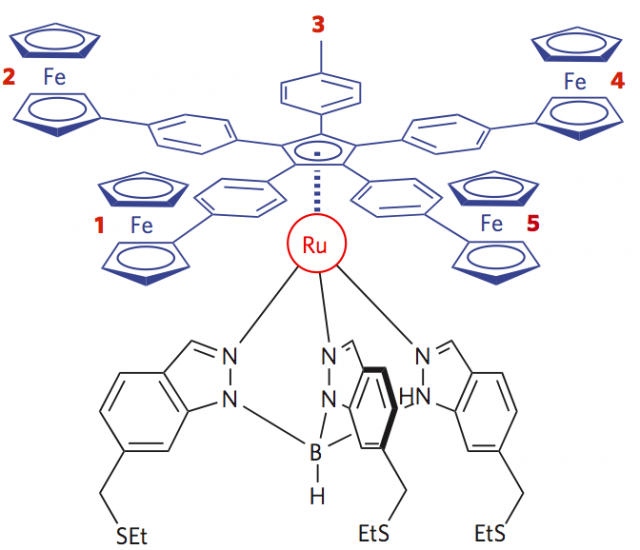
The base of the device holds a ruthenium atom, and the five-armed device can rotate on top of it (credit: U. G. E. Perera et al./Nature Nanotechnology)
Researchers have created a reversible rotor that sits atop a ball bearing — a single ruthenium atom, Ars Technica reports.
The base of the system involves a boron atom that coordinates three ringed structures that are chemically similar to the bases of DNA. Nitrogens at a corner of these ringed structures coordinate the ruthenium atom, placing it at the peak of a three-sided pyramid.
The ruthenium atom acts like a ball bearing, allowing the molecule sitting atop it to rotate, spinning like a windmill tilted on to its back, with its blades oriented horizontally.
To actually get it to rotate, a scanning-tunneling microscope was used to inject electrons into the system. The added charges allowed the rings to overcome interactions with the base, and rotate. The authors could also control the direction of rotation.
Comments (19)
by Renzo Canepari
Have you ever wondered where mankind and our country would be if we had not spent 900 billion dollars in Iraq, and instead spent it on various scientific research and on the society’s infrastructure?
“Bill Nye the Science Guy” in November had two programs on the infrastructure. On had the theme that 8,000 bridges in this country could collapse at any time, and the other was that leaky water mains lose 7 billion gallons of water daily.
The Singularity is the holy grail, but don’t forget that the copyright of Future Shock will be 43 years old next month.
I believe that we could have something very close to Utopia: since the Time of Future Shoc kwe could have done sooo many things concurrently, and that this is the precise way to go about it. Things change so rapidly that we could do things a few bridges at a time, a few factories at a time, a few miles of pipeline at a time. WE COULD DO IT ALL. Instead, we fight all of these senseless wars.
by Jim Mooney
Alas, all these wonderful science-based predictions, and I’ve read them for decades, keep forgetting that our political and economic systems are INSANE. Until science comes up with a cure for the insanity of the human race, progress will never be what we think it will be.
by jerry fisher
Zeitgeist. The Venus Project.
by Cybernettr
I agree to a point. Getting involved in Iraq was a tragic blunder. However, not all military spending is wasteful. Think of the work Boston Dynamics is doing in the field of robotics.
On the other hand, Bill Gates is pouring money into Africa that could be better spent funding the research of biotechnology firms. That would benefit all mankind, not just those confined to one continent.
by Jos Smit
So this is actually a microscopic windmill that spins when the electron-wind is blowing. I like the sound of that. An electron canon is easlily built (they are used in television tubes), so if they can make the shape of the “blades” such that it spins no matter where the “wind” blows from, then you have a motor that can do useful work in nano machines. I it is easily energized by the electron beam, and when the beam is switched off, they stop building or whatever they do. There is no danger for nano machines taking over the world.
by Camaxtli
Check out ATP synthase. Very cool little molecular turbine that keeps us alive.
by Jim Mooney
Unless the nano machines build a teeny little electron gun ;’)
by Peter Kinnon
A gorgeous little machine, for sure!
Unfortunately the entirely gratuitous reference to DNA in the description will likely lead many of the uninformed to mistakenly infer some direct association with biological systems..
by Durabys
..exatly, and therefore I think it should be adressed that this is a human creation, not nature at work.
by izumi3682
…soon to be running respirocytes..?
by Spikosauropod
See Exy, nanomachines!
by Gorden Russell
In the future these single-molecule motors can be incorporated into the self-assembling photo-voltaic carbon nanocells that I keep talking about. These little motors can pump up minerals from the soil of your lot to your house where atoms can be assembled into any compound you want. Calcium from the soil can be joined with carbon from CO2 in the air to make CaCO3 (calcium carbonate). With this you can cause the siding of your house to grow into limestone blocks and your home can really become your castle. Once you’ve got your castle as big as you want it, or at least as big as the size of your real estate allows, you can pump more energy into the limestone and metamorphose it into marble.
These little pumps would also be used in the pipelines that grow inland from the desalinization plants using graphene to filter salt out of seawater.
Once the deserts are greened then gleaming marble palaces can be grown for all the dispossessed of the world.
This will give us breathing space until the asteroid miners can start building fusion-powered charged particle beam thrusted starships.
And don’t forget the space elevators made by lowering perfect cables of carbon nanotubes down from carbonaceous asteroids hauled into geosynchronous orbits.
by Anasazi
Problem is that DARPA will weaponize the technology and then struggle to keep the weapons out of the hands of terrorists. I’ve seen this movie before.
by Ian Clarke
I always enjoy your thoughts on the future, Gorden.
Perhaps this could also provide propulsion for the nanobots that will one day course through our veins?
by Gorden Russell
I’m glad you thought of that, Ian. Yes, this little motor can whip a flagellum and send nanobots from your head to your toes. You’ll have more petaflops of processing power in your little toe than the world has now.
by Ralph Dratman
You are making my toe feel all funny.
by Dr.Pratt
Wow! I like the way you think!
by Jennifer
As one who grew up in a desert, I would be sad to see my desert “greened.” I’m perfectly happy with its current olive-drab coloration.
by Camaxtli
When I envision minerals being sucked up out of the ground all I can think is “unintended consequences alert, proceed with extreme caution”.