Singularity Summit 2011 roundup
October 19, 2011 by Giulio Prisco
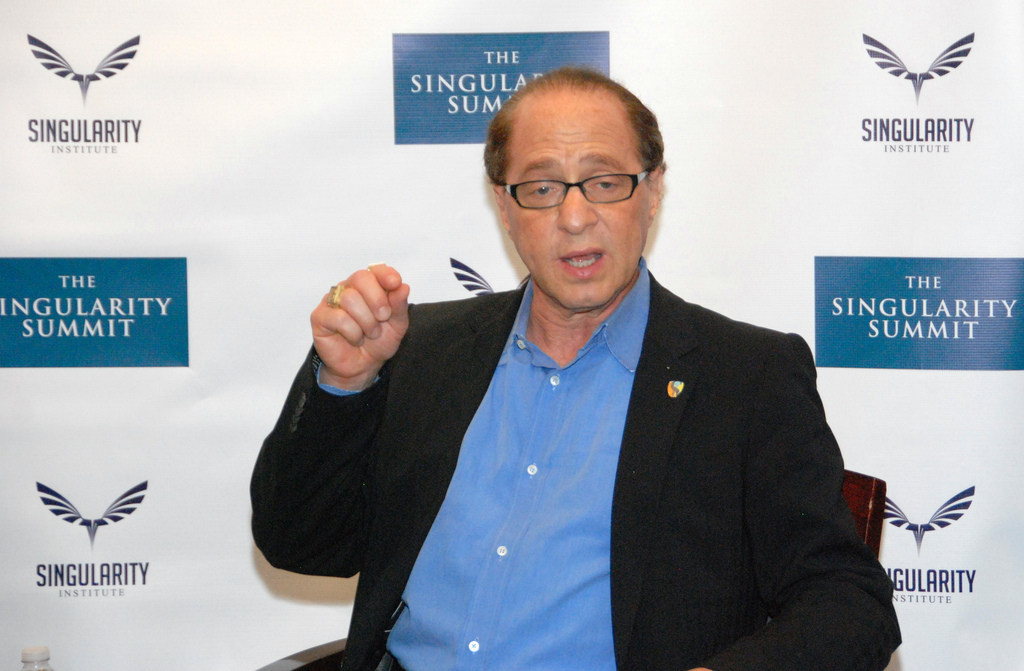
Ray Kurzweil (credit: Singularity Institute)
The tone of the Singularity Summit 2011 in New York was set by Ray Kurzweil, who presented many examples of accelerating developments, countering the arguments presented by Microsoft’s co-founder Paul Allen in a recent article, The Singularity Isn’t Near.
Robots vs. humans
James McLurkin introduced the concept of swarms of small, light, and cheap robots that communicate with each other, solve problems collaboratively, and call others for help. He wowed the audience with a demo of a flock of small wheeled robots following each other, aligning and dispersing on the podium. A single robot can be assembled with a low-cost kit and programmed with Python, he said. Practical uses aside, McLurkin believes his system can also trigger a revolution in engineering education by permitting students and hobbyists to link their individual robots and experiment with new programming and problem-solving paradigms.
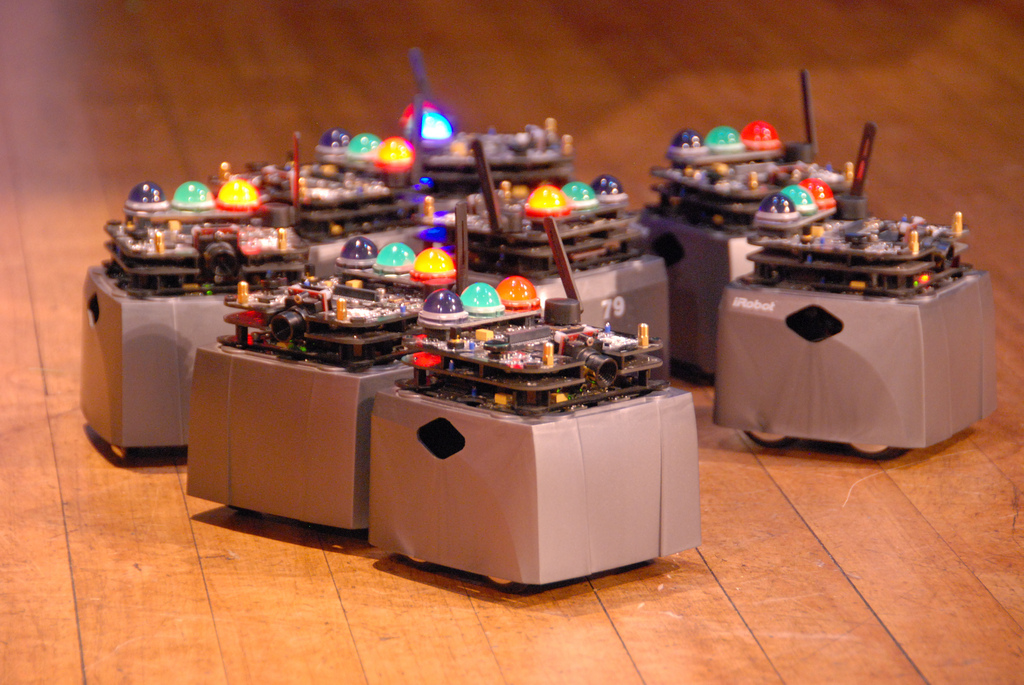
Robot swarms, presented by James McLurkin (credit: Singularity Institute)
Riley Crane suggested that swarms of communicating persons, can solve complex crowdsourced problems better than robots. The people must be “programmed” with suitable incentives (cash or social reputation, for example) and provided with suitable communication tools like Twitter (proven effective in humanitarian relief operations).
Sharon Bertsch McGrayne presented Bayesian reasoning as a rational method for analyzing data and making decisions.
Christof Koch discussed the search for neural correlates of consciousness. Rather than than general self-awareness, he is more interested in consciousness of something, which does not require emotions, long term memory, language, or selective attention. He suggested that consciousness should be seen as a continuum, rather than discrete. He pointed out that Tononi’s “measure” assigns a high value to fully interrelated states of consciousness that cannot be easily decomposed in parts. As an example, Koch suggested that identifying “impossible” pictures, such as a picture containing subtly wrong perspectives or impossible situations (e.g. a person levitating) may be a good criterion for consciousness.
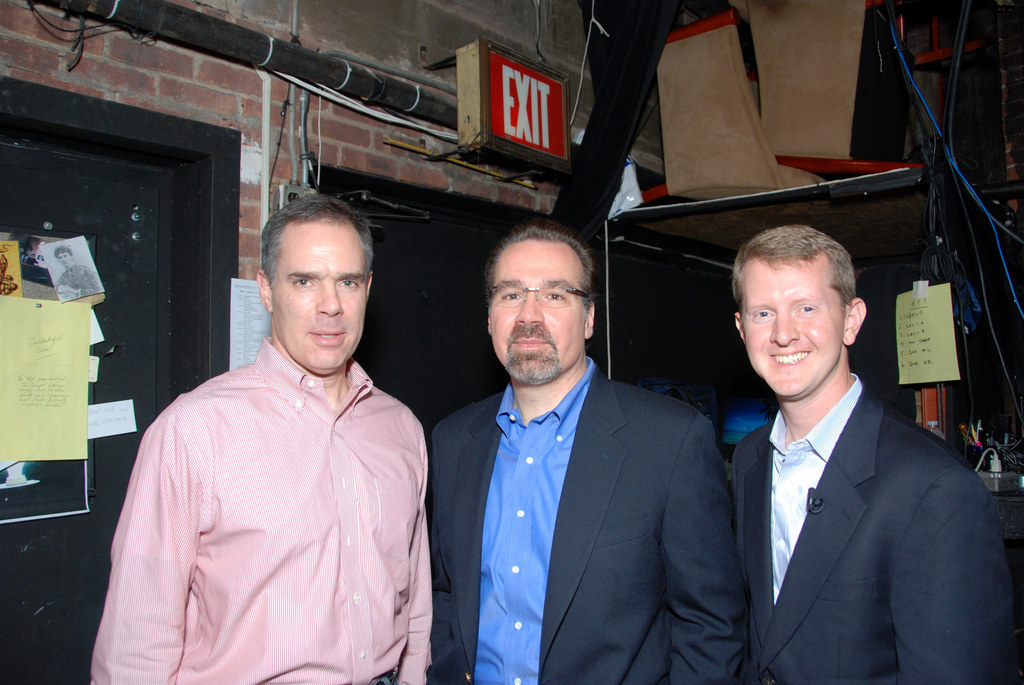
Dan Cerutti, David Ferucci, Ken Jennings (credit: Singularity Institute)
Singularity Institute Research Fellow Eliezer Yudkowsky, and D. Scott Brown and Dileep George, co-founders of Vicarious, discussed their approach to AI. And David Ferrucci, Dan Cerutti (both from IBM) and Jeopardy! winner Ken Jennings discussed the implications of the Watson Jeopardy! victory.
Most speakers were optimistic about the eventual development of human-level (or higher) AI. Alexander Wissner-Gross suggested that the first true AI could emerge on a planetary scale from the developing system of interlocked exchanges for high-frequency financial trading, which could be seen as a developing global “brain” already operating at relativistic speeds.
The big picture
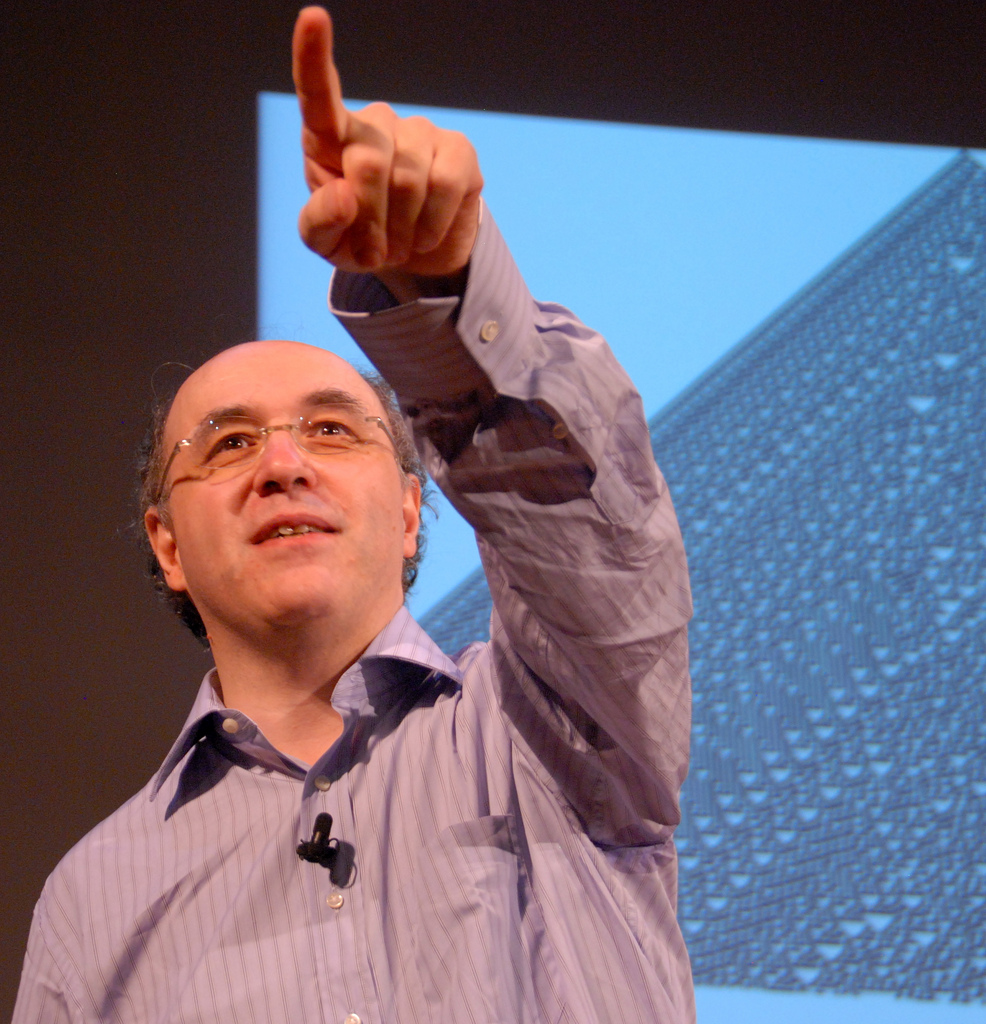
Stephen Wolfram (credit: Singularity Institute)
Stephen Wolfram described computational universes, from simple cellular automata rules to complex simulations, and suggested that perhaps a universe could be generated by a simple program, yet show all the complexity of our universe to observers living inside. Max Tegmark suggested that we are probably alone in the part of the universe that we can access, whose evolution and emergence to life and intelligence could then be seen as our task.
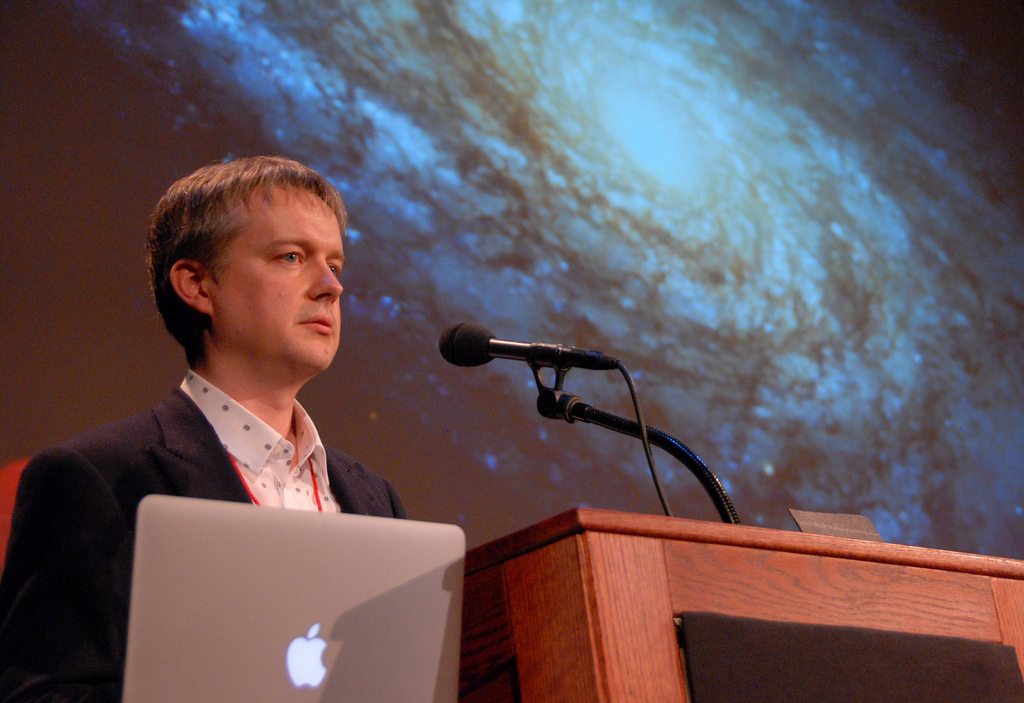
Jaan Tallinn (credit: Singularity Institute)
One task for the Singularity community suggested by science fiction author David Brin would be to seek a dialog with religious people. The Tower of Babel, commonly interpreted as a punishment for human hubris, could actually be seen as an encouragement to spread around the Earth and gain more experience before attempting to become gods, he suggested. Jason Silva, a filmmaker and founding producer/host for Current TV, took it a step further, suggesting we make futurism more appealing and sexy.
Optimists vs. pessimists
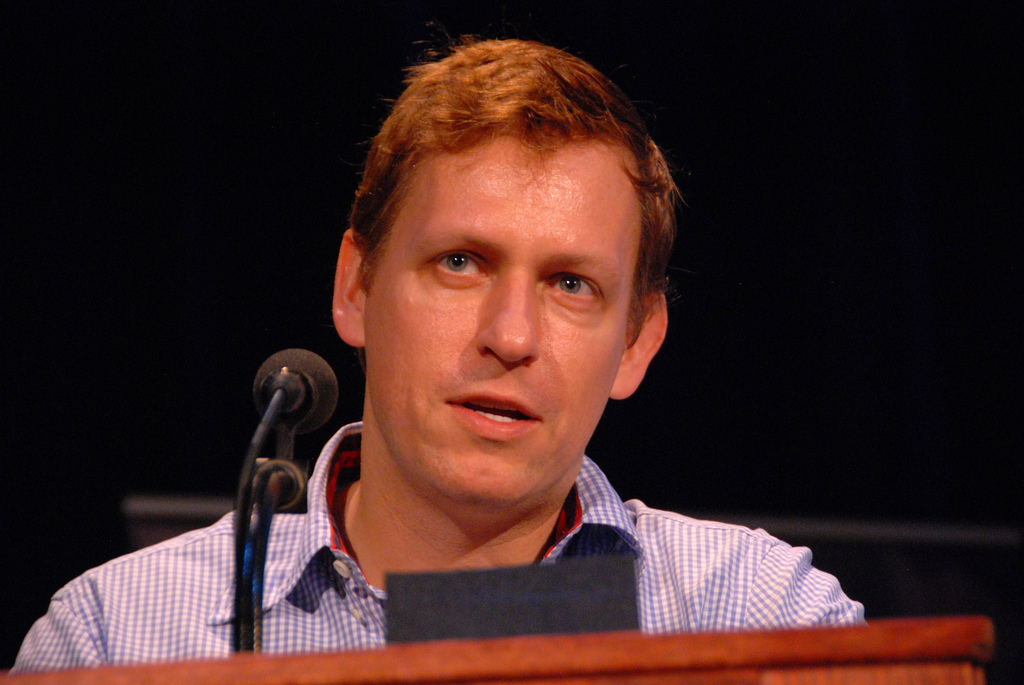
Peter Thiel (credit: Singularity Institute)
Macroeconomics, the roles of free markets and government programs, and innovation mechanisms played a more important role than in previous Summits, with frequent references to the social protests at Occupy Wall Street a few miles away. Skype founder Jaan Tallinn welcomed the emergence of new social movements of people interested in the long term future and the welfare of future societies. He praised one of the silent heroes of recent history, Stanislav Petrov, who by deviating from standard Soviet protocol and correctly identifying a missile attack warning as a false alarm on September 26, 1983 may have single-handedly prevented a major conflict.
After stating that there are not enough public discussions about the future, Peter Thiel defended real innovation against the current trend of letting emerging market cheaply produce products and services copied from past innovations (he referred to this concept as vertical innovation vs. horizontal globalization). He advised the many entrepreneurs at the Summit to base their businesses on compelling mission stories, both unique and doable.
John Mauldin predicted that a next big innovation wave will arise from wireless connectivity, sovereign individuals empowered to make their own decisions, biotechnology, nanotechnology, robotics, AI, and new sources of energy, and Michael Shermer presented evidence that our world is indeed nicer than the world of our grandfathers, and that this trend will continue.
Tyler Cowen presented a less enthusiastic view in his talk (and in a following debate with Singularity Institute President Michael Vassar), suggesting that we may be in a stagnation phase.
Biomed advances
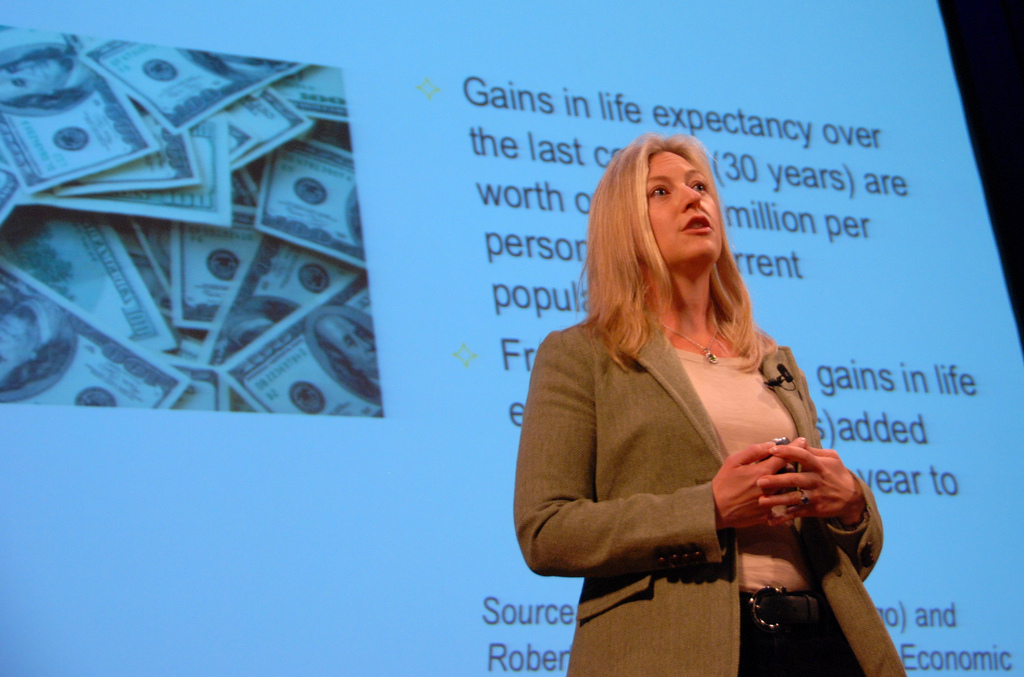
Sonia Arrison (credit: Singularity Institute)
Sonia Arrison said medical advances could nearly double human life expectancy in the next few decades and suggested ways for society to cope with increased lifespans. Stephen Badylak gave an overview of advances in tissue engineering, regenerative medicine, and biological scaffolding able to help tissues to heal themselves. Dmitry Itskov described Russian plans to develop humanoid avatar bodies within this decade, followed by human brain transplants and mind uploading in a few decades.