Smartphone technology acceptable for remote stroke diagnosis
October 3, 2012
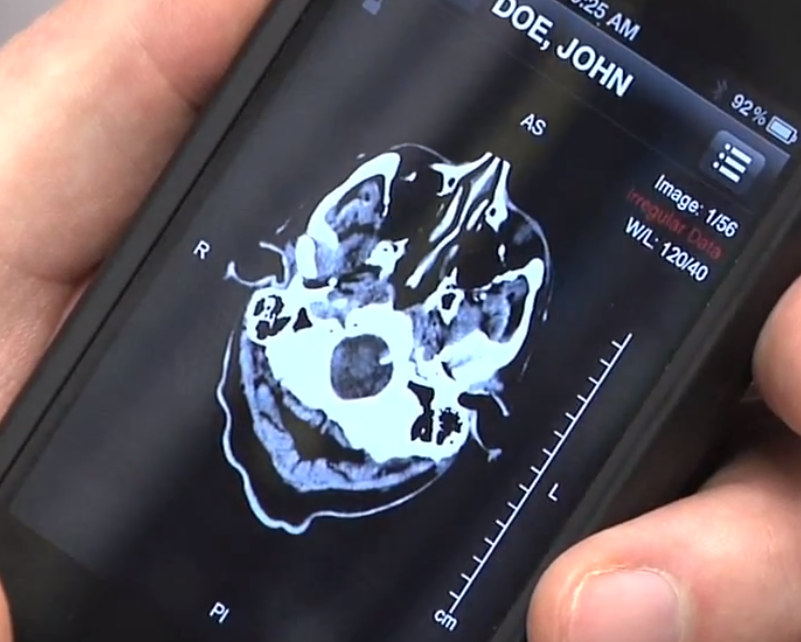
Stroke image (credit: Mayo Clinic)
A new Mayo Clinic study confirms the use of smartphones medical images to evaluate stroke patients in remote locations through telemedicine.
“Essentially what this means is that telemedicine can fit in our pockets,” says Bart Demaerschalk, M.D., professor of Neurology, and medical director of Mayo Clinic Telestroke.
“For patients this means access to expertise in a timely fashion when they need it most, no matter what emergency room they may find themselves.”
Mayo Clinic was the first medical center in Arizona to do pioneering clinical research to study telemedicine to serve patients with stroke in non-urban settings. Today, Mayo Clinic is the hub in a network of 12 other spoke centers, all but one in Arizona.
In telestroke care, the use of telemedicine platforms or robots located in a rural hospital lets a stroke patient be seen in real time by a neurology specialist who typically is working from a desktop or laptop computer in Phoenix. The Mayo Clinic stroke neurologist, whose face appears on a computer screen, consults with emergency room physicians at the rural sites and evaluates the patient.
Patients showing signs of stroke can be examined by the neurologist who can also view scans of the patient’s brain to detect possible damage from a hemorrhage or blocked artery. If necessary, patients can be administered clot-busting medications within the narrow window of time necessary to minimize permanent injury to the brain.
How does it compare to desktop computer images?
The study compared the quality of medical images using a particular smartphone application to the same types of information and images typically viewed via desktop computers. Mayo Clinic neurologists worked with emergency physicians and radiologists at Yuma Regional Medical Center to compare brain scan images from 53 patients who came to that medical center with stroke.
The scans were reviewed by radiologists in Yuma and a separate adjudication panel of stroke neurologists to determine the level of agreement between these traditional interpretation routes and new images and scans on smartphones interpreted by telestroke doctors. The study shows there was a high level of agreement (92 to 100 percent) among all the reviewers over the most important radiological features.
“Smartphones are ubiquitous, they are everywhere,” Dr. Demaerschalk says. “If we can transmit health information securely and simultaneously use the video conferencing capabilities for clinical assessments, we can have telemedicine anywhere, which is essential in a state like Arizona where more than 40 percent of the population doesn’t have access to immediate neurologic care.”
The study was funded by the Arizona Department of Health Services and the technology and technical assistance was provided by Calgary Scientific, the maker of ResolutionMD.
The Mayo Clinic Telestroke Network includes hospitals in Kingman, Flagstaff, Parker, Cottonwood, Show Low, Globe, Yuma, Bisbee, Casa Grande, Tuba City and Phoenix, all in Arizona; and a hospital in St. Joseph, Mo. To date, more than 1,000 emergency consultations have taken place for stroke between Mayo Clinic stroke neurologists and physicians at the spoke centers. Such comprehensive evaluation techniques lead to appropriate life-saving treatment for stroke, and have resulted in significant cost reductions by not requiring ground or air ambulance transfer of the patient to another medical center.
Comments (9)
by ProfessorZ
“Significant cost reductions” is an understatement. My dad had to be airlifted to Phoenix just for a stroke diagnosis and that little helicopter trip cost over $30,000. And “medical evacuation” is not covered by health insurance.
by melajara
Yes, that’s awful, and those doctors are frowning when you say those antibiotics will kill her microbiome. Either they will pay no attention to you or they will reply with something like that: “Huh, microbiome? Don’t mess with words you don’t understand!”
by melajara
My comment was directed @Bri.
Gosh, where is the Delete button?
by Camaxtli
How’s this for an idea for a requirement necessary for nurses and physicians to retain their licenses: Must take a bi-annual comprehensive test in undergraduate level Anatomy, physiology, microbiology and pharmacology. If they don’t pass with a 90 percent or better, their license is suspended until they make the grade on a make-up exam.
I have an intuition that a lot of them would not perform very well at all. And if they have forgotten the basics, how can they work effectively in their fields?
by Bri
I wish that was the only sad story of inept professionals. They bounce her around like a yo yo to different specialists, that charge money that I can only dream of charging. If they actually knew something I wouldn’t mind so much. Another simple story that isn’t to difficult to relate. My dad slipped off the bed while trying to get in. My mother panicked because he couldn’t get up. Three weeks in the hospital and one hundred thousand dollars later, they said that he needed his arteries to his brain cleared. Through our private doctor we knew about the blockages, but knew the risks to benefit wasn’t worth it. Through our family physician we figured that his lower back is terribly degenerated from sitting on the couch all day long. When he gets up he can’t straighten out it’s so bad. Through nerve pinches and loss of muscle tone, this problem has occurred many times, but if you go to emergency they have to evaluate you thoroughly because of lawsuits. It was a total waste of time and money.
by Dan Tanna
Just make sure one is not being diagnosed with a leggy, buggy, hacked Android phone…
by Hoss
This is a huge step in the right direction, but the bottleneck will occur when tens of thousands of patients are sending their scans to the emergency room waiting for humans to diagnose them. The future potential of the tricorder will allow all 7 billion people on earth to receive the equivalent of an fMRI scan each day before breakfast, then receive an instant diagnosis and treatment from home.
by Bri
I look forward to a Watsonesque / art evaluation program to find the details that a human would. Get those over paid poorly trained doctors out of the loop. I can’t tell you all the times I have to intercede in my mothers medical care because doctors don’t know what they are doing. They certainly charge like they do. A quick example. My mother had a serious infection in her leg. It could have lead to an amputation. After she was hospitalized and pumped full of intravenous antibiotics. The head nurse told us to continue the course of oral antibiotics plus two new ones. I said to her . Wouldn’t that mess up her GI tract. She said we had to do as they said . Later when I read the prescription, it was the same as the two that our doctor had prescribed earlier. When the visiting nurse came she said we should discontinue using the old ones and that the new ones were different. When we got the prescriptions the pharmacist said they were the same. My mother has a nasal infection now, but the family physician say’s that he doesn’t want to give her antibiotics because she has had too much.
by Camaxtli
Sounds like your mother’s nurse isn’t advocating for your mother and just mindlessly carrying out the doctor’s commands and doing a very poor job communicating with you and your mother, not listening to concerns, not forwarding those concerns to the physician, and not explaining the reasoning behind these prescriptions and the care strategy in general.
On a side note, like to see more nurse practitioners in the loop, combining high level general medical knowledge with a greater emphasis on treating the patient as a human being and not a diagnosis. I believe a well trained nurse practioner are as effective as a family practice doctor at a more reasonable cost. Especially when combined with all these advancements in testing and diagnostics we are seeing.