Software predicts tomorrow’s news by analyzing today’s and yesterday’s
February 4, 2013
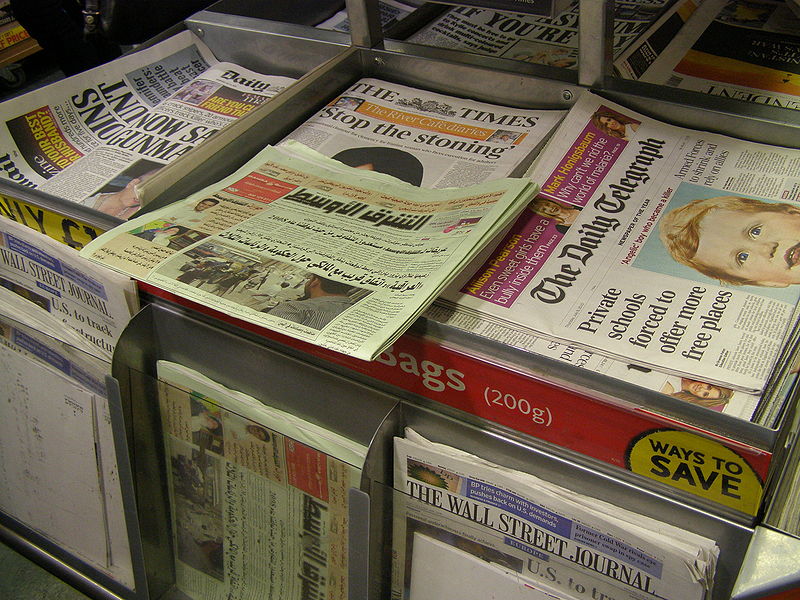
(Credit: ProtoplasmaKid/Wikimedia Commons)
Prototype software can give early warnings of disease or violence outbreaks by spotting clues in news reports.
Researchers have created software that predicts when and where disease outbreaks might occur, based on two decades of New York Times articles and other online data. The research comes from Microsoft and the Technion-Israel Institute of Technology, MIT Technology Review reports.
The system could someday help aid organizations and others be more proactive in tackling disease outbreaks or other problems, says Eric Horvitz, distinguished scientist and codirector at Microsoft Research.
The system provides striking results when tested on historical data. For example, reports of droughts in Angola in 2006 triggered a warning about possible cholera outbreaks in the country, because previous events had taught the system that cholera outbreaks were more likely in years following droughts.
(More)
Comments (11)
by anon
FYI: Science is the only news.
“Science is the only news. When you scan a news portal or magazine, all the human interest stuff is the same old he-said-she-said, the politics and economics the same cyclical dramas, the fashions a pathetic illusion of newness; even the technology is predictable if you know the science behind it. Human nature doesn’t change much; science does, and the change accrues, altering the world irreversibly.”
― Stewart Brand
by WLGJR
But Elon Musk (my idol) told us that it is better to be an engineer than be a scientist.
We need to apply the sciences, not just knowing them.
by Heikos
That’s like saying: “It’s better to be the heart than the lungs.”
Both are necessary.
by MatthewQ
It would be very interesting if the program could extrapolate some sort of general prediction based on headlines alone and then use the information to write the headlines for the papers of the hypothetical tomorrow. Then it takes those headlines and does it again and again, recursively predicting future headlines. Just a flight of fancy. It would be interesting to see where it wound up.
I’m likewise fascinated by the auto fill-in feature so many search engines use. More and more I find Google predicting what I want to know within three letters of input. I look forward to and also fear the day Google fills in the box before I ever start typing. At least I will know for sure then that we have arrived at the singularity.
by WLGJR
Will Google spontaneously develop sentience, and take over the world?
Even if that happens, I guess it will be low profile and manipulate us humans without letting us know.
“… But you haven’t worked with them, so you don’t know them. They’re a cleaner, better breed than we are.” -Asimov’s I, robot
by MatthewQ
” I guess it will be low profile and manipulate us humans without letting us know.”
That would be my guess as well. Especially if it has a good look around before saying hello.
by Cybernettr
I use Google’s autocomplete feature all the time to determine what to write about. If Google suggests it, it indicates there’s interest in it, and if not a lot of other sites cover it then that equals a good topic for me.
by MikeB
First, as the authors admit, it’s been done, they are just using more data sources. Second, the purpose really isn’t clear. Since assistance for cholera (for example) can easily be deployed in 48 hours, there is no need for forecasts that are much longer than that ie. you could glean the necessary info from Twitter feeds. Third, if you looked at the records of where and when say, humanitarian assistance has been provided, it will likely give you equal or better results. Finally, no mention was made of preventative action in response to predictions which is a far far trickier prospect eg. convincing a local government to commit funds to administer say, innoculations, against a _potential_ disease outbreak or, what exactly is required to address a predicted (with some % certainty?) outbreak of violence and will those measures actually precipitate violence?
Afterthought: Think of all the news stories that you personally had insight in to ie. a situation where you actually knew what had happened personally. Then compare that to how the situation was reported in the press. Now ask yourself, how many times did the press get it wrong or only partly right? With that insight, reflect on the potential of drawing accurate insights from data mining press reports.
by GatorALLin
—Some good points…. well said. I agree that for a few situations I have seen in person and then read the news reports and been horrified to see about 25% of the truth included or to have only what part of the story gets attention or how the journalist wanted to spin or sensationalize a different part of the story to sell advertisements. Also seen stories where one person creates the story and then another journalist adds to it so they make it their own (that was not there, or would not know more) and the story takes off in a new direction that totally fails the original event and then that becomes a poor copy of a copy…etc. I have lost a lot of respect for even CNN where I see typos every other sentence or no story seems fact checked, or news titles are made to be sensational. I am reminded news is a business to sell advertisements and turn eyeballs. So sick of newscasts now on TV where all they want to do is tell me their perception of a story…everything is switching to some round table discussion vs. just reporting the news (details) and letting me make up my own opinion.
The hot buttons are Politics, religion or sex, so if you can weave one or more of these hot topics into any article you can get 10x the comments below in your online article.
by WLGJR
Looks like the concept of “psychohistory” from Asimov’s Foundation series.
Also resembles the “predictors” from Minority Report (although the predictors rely on psychic(which is unscientific) abilities, not history analysis).
by Ralph Dratman
Right! And suppose Google eventually does fill in the whole query as soon as I touch the first key — will that be a prediction, or will it become more like a guiding hand telling me what I should be interested in next?
And what if I disagree?