Solve for X: radical ‘moonshot’ technology ideas for solving global problems
February 7, 2012
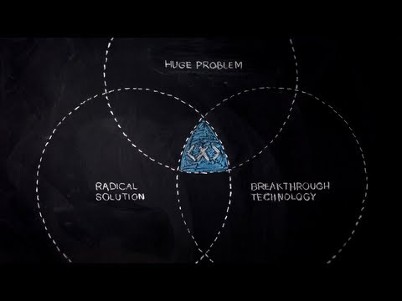
“We’d like to introduce Solve for X, an experiment to encourage individuals and groups to undertake “moonshot” technology projects to solve global problems,” says Google’s new Solve for X forum in a low-key announcement on Google+. It continues:
Solve for X is a place where people can go to hear and discuss radical technology ideas for solving global problems.
Radical in the sense that the solutions could help billions of people. Radical in the sense that the audaciousness of the proposals makes them sound like science fiction. And radical in the sense that there is some real technology breakthrough on the horizon to give us all hope that these ideas could really be brought to life.
“This combination of things — a huge problem to solve, a radical solution for solving it, and the breakthrough technology to make it happen — is the essence of a technology moonshot.

Solve for X is intended to be a forum to encourage and amplify technology-based moonshot thinking and teamwork.
Our goal is to make this page a source of interaction and dialogue, discussing the Solve for X talks from our Feb. 1–3 event co-hosted by Astro Teller, Megan Smith and Eric Schmidt.
Most importantly, hearing your ideas for Solve for X thinking. What’s your <x>? What radical science and technology ideas are you thinking about?
We’d love for you to share other talks (maybe yours, maybe someone else’s) and explain (1) what’s the huge problem, (2) what’s the radical solution, and (3) what’s the science and technology detail? We’ll re-share posts to the broader group to further the discussion.


Comments (5)
by Carl
From the second video: “People aren’t getting their kids vaccinated because they don’t believe in science anymore.”
I hate hearing people spot that garbage. There are always idiots who will get serious about nonsense, but all the convincing arguments against vaccinations that I’ve heard have more to do with the fact that the science behind them is poor, some ingredients are questionable, and that they are more a for-profit product than a health benefit. All reasonable arguments – it doesn’t take a conspiracy for a drug company to take the low road to profit. I would say that those who agree with that stance are not anti-science, but they are simply aware that “sounding scientific” is a useful tool for marketing as well as a great political excuse to enforce laws that will benefit interested providers rather than the general population.
It’s not that people don’t believe in science, it’s that it’s that there is bad information coming from even authority sources such as government institutions, making them harder to trust. What’s a vigilant mind to do other than question everything they hear and demand more openness and scientific rigor before they trust the results?
by Laura Bailey
Problem: Climate Change, sea ice is disappearing and sub tropical waters are stratified causing O2 depletion.
Solution: Replacing Sea Ice and cool off sub-tropical waters.
Technology: I recently received a Patent for a Mechanically Produced Thermocline. I intend to replace sea ice by flooding the surface of the Arctic by pumping water from below the Ice onto the surface. Replacing sea ice will ensure the continued function of the Thermohaline.
I plan to put our pumps in the Gulf of Mexico 200 miles off shore to create a cold water Thermocline as a barrier to hurricanes and to promote diatomaceous phytoplankton growth to oxygenate and eliminate the dead zones.
by Ryan P Reed
They have “nano bots” which are controlled via electromagnetic field for eye surgery… basically put your head in a big ring with several points on it.. then increase/decrease the field to ” drive” the responsive bot through the eye to Inject whatever medicine into the optic nerve.. saw them on.. hmm. discovery/history channel. I dont see why you couldnt reverse the flow from pushing out medicine to sucking in foreign particles/ dead cells etc.
by Rogers George
I have often thought that we could remove these floaters (aka photosomes) with a fine hypodermic srynge: draw out the liquid inside the eye, run it through a filter, and return the filtered humour to the interior of the eye. I imagine it would be disconcerting to “see” your eye collapse as the liquid was removed, so I picture this being done under general anesthesia. OTOH, it might be interesting to watch the effects.
by Beatriz Valdes
Regarding impaired vision due to dead cells in the vitreous gel in the eye globe: couldn´t a nano device be created which could be introduced into the eye, to gobble up the debris that creates black spots, grey clouds, etc., which reduce clear vision?