Solving the ‘cocktail party problem’: how we can focus on one speaker in noisy crowds
March 11, 2013
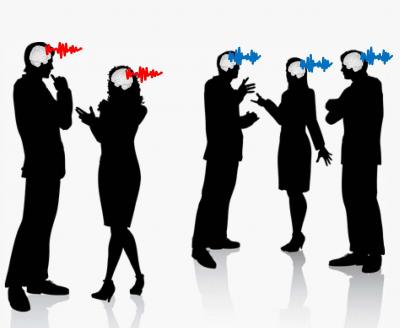
This is a cartoon illustrating the idea that at a cocktail party the brain activity synchronizes to that of an attended speaker, effectively putting them ‘on the same wavelength’ (credit: Zion-Golumbic et al./Neuron)
Researchers have demonstrated how the brain hones in on one speaker to solve the “cocktail party problem.”
Researchers discovered that the brain can selectively track the sound patterns from the speaker of interest and at the same time exclude competing sounds from other speakers.
The findings could have important implications for helping individuals with a range of deficits such as those associated with attention deficit hyperactivity disorder, autism, and aging.
“In hearing, there is no way to ‘close your ear,’ so all the sounds in the environment are represented in the brain, at least at the sensory level,” explains senior author Dr. Charles Schroeder, of Columbia University’s Department of Psychiatry.
“While confirming this, we also provide the first clear evidence that there may be brain locations in which there is exclusive representation of an attended speech segment, with ignored conversations apparently filtered out.” In this way, when concentrating hard on such an “attended” speaker, one is barely, if at all, aware of ignored speakers.
Using direct recording of brain activity in surgical epilepsy patients, who were listening to natural spoken sentences, Dr. Schroeder and Dr. Elana Zion Golumbic, also of Columbia University, and their colleagues from New York University, University of Maryland, and Hillside-Long Island Jewish found two types of effects.
In and near auditory cortex, brain signals reflect both attended and ignored speech, but attended speech generates higher signal amplitudes. However, in regions of the brain involved in “higher-order processing,” such as language and attention control, representation of attended speech was clear, while that of ignored speech was not detectable. Remarkably, the selective, higher-order representation is progressively refined as a sentence unfolds.
“This will stimulate future research to continue the study of this and related issues under rich, natural conditions.
“Just as importantly, the ability to directly analyze widespread brain activity patterns in surgical epilepsy patients provides an unprecedented opportunity to firmly connect the work on the Brain Activity Map at the model systems level in mice, songbirds, and nonhuman primates to the study of capacities like language and music, that may be uniquely human.”