SOPA opponents unveil ‘Digital Bill of Rights’
June 13, 2012 | Source: ars technica
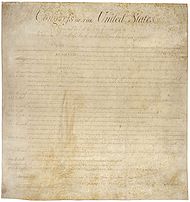
United States Bill of Rights
The “Digital Bill of Rights” debuted at the Personal Democracy Forum in New York City on Monday. The document draft comes from Rep. Darrell Issa (R-CA) and Sen. Ron Wyden (D-OR), two key figures in the battle against SOPA.
Issa and Wyden created the Digital Bill of Rights because they were concerned about what seemed like a legal oxymoron: lawmakers trying to regulate the Internet without understanding how individuals use it.
“Government is flying blind, interfering and regulating without understanding even the basics,” Issa wrote on his website, KeepTheWebOpen.com. “Where can a digital citizen turn for protection against the powerful?”
At the conference, Wyden likened this project to a digital version of the “Constitutional convention.” It’s a convention that Issa and Wyden hope Internet users will participate in. On Issa’s site, he openly encourages readers to consider the current draft and suggest revisions (at the publication of this post, several individuals have already logged in to take that offer). Currently, the ten key rights are as follows:
- The right to a free and uncensored Internet.
- The right to an open, unobstructed Internet.
- The right to equality on the Internet.
- The right to gather and participate in online activities.
- The right to create and collaborate on the Internet.
- The right to freely share their ideas.
- The right to access the Internet equally, regardless of who they are or where they are.
- The right to freely associate on the Internet.
- The right to privacy on the Internet.
- The right to benefit from what they create.
Have any edits for Issa and Wyden? Contribute directly (sign-up required) or add them in the comments below.
A Digital Citizen’s Bill of Rights
I believe that individuals possess certain fundamental rights. Government should exist to protect those rights against those who would violate them. That is the revolutionary principle at the heart of the American Declaration of Independence and U.S. Constitution. No one should trample our right to life, liberty and the pursuit of happiness. That’s why the Bill of Rights is an American citizen’s first line of defense against all forms of tyranny.
But where can a digital citizen turn for protection against the powerful? This question lay at the heart of the fight to stop SOPA and PIPA and keep the web open. While I do not have all the answers, the remarkable cooperation we witnessed in defense of an open Internet showed me three things. First, government is flying blind, interfering and regulating without understanding even the basics. Second, we have a rare opportunity to give government marching orders on how to treat the Internet, those who use it and the innovation it supports. And third, we must get to work immediately because our opponents are not giving up.
We need to frame a digital Bill of Rights. This is my first draft. I need your help to get this right, so I published it here in Madison for everyone to comment, criticize and collaborate. I look forward to hearing from you and continuing to work together to keep the web open.
— Congressman Darrell Issa
Comments (8)
by Mindreleaser
Come on man, if you live in the U.S. then you know that we already have these rights and it’s not like their disappearing. These guys are not battling SOPA but ,instead, are just two other ants (all apart of the same colony). By establishing a Bill of Rights they’ll have an ultimate and final policy, of the highest order, on what you have a right to do. Anything not listed such as downloading movies and music means you do not have a right to obtain in this manner. What this really does is give them the right to finally exact punishment for downloading,
by Paul T
It’s not explained whether the Digital Bill of Rights is promoting Constitutional Amendments (as in the original Bill of Rights) or simply laws. A cursory look at their site (http://keepthewebopen.com/supporters) shows they are specifically supporting the Online Protection & ENforcement of Digital Trade Act. (OPEN) which is yet another attempt on the part of content providers to use the U.S. legal system to police the Internet. Some questions to ask:
(1) Is this Keep the Web Open just a charade to divert attention from yet another U.S.- led (read corporate) power grab.
(2) Why not advance these “Web Open” ideas in the United Nations? Or as international trade agreements.
IMHO it was a mistake to ever set up country codes in URLs. The Internet belongs to the whole world. Nationalism has been the principal deterrent to world peace for centuries. Why are we going down this path of hegemony yet again? These are the questions that won’t be asked, you can be sure. They don’t correspond with the corporate political agenda.
by Phil Osborn
Intellectual property is important, but the legal methods currently employed are destructive in the extreme. Patents are today primarily used as a weapon against the use of other patents by ones competitors. We are in a situation similar to that described by Fukuyama in “Trust” as taking place in France when one could get a patent on virtually anything and then collect infringement damages – shared with the court, of course. This brought the French economy to a virtual standstill and undermined social trust throughout the nation, as people took out more and more patents out of self-preservation, leading finally to the revolution. The economic loss, however, was so devastating that it gave the advantage to tiny, relatigely poor Britain, paving the way for the British Empire.
Today, we have the Sonny Bono copyright act, which keeps getting extended into the next century, along with a patent office that is now operatiing on the “first filed” principle, granting patents willy-nilly to whoever puts in the first claim for some common business practice that may have been in use for centuries, but is now capable of shutting down a business that might be using it. Or, just look at any major piece of software in existence today, and notice how competing brands aimed at the same market have hamstrung development, with each brand having some fraction of the features that one would naturally assume would be in them all.
The solution: If you’re going to go to the state for a special privilege regarding your ideas or their publication, then there should be a corresponding right for anyone anywhere to use those ideas, so long as they pay a reasonable licensing fee to the patent or copyright holder. Companies should never have the right to simply exclude competition or patent and bury, setting a trap for those who might inadvertently violate one of tens of thousands of software patents, for example.
I would add then to the list a requirement that all intellectual property on the internet should copyrighted – as it is now – and yet free for use on paying a reasonable fee to the owner. Not sure how to set a fee that would be fair to all… Suggestions?
by Onyx
My opinion is that the future will go something like this.
Abuse of power by Government – riots – rule by Corporation -
Abuse of power by Corporations – riots – rule by AI -
incorruptible super intelligent ruler.
by Mortran
The most important point tis missing: The abolishment of the concept of intellectual property.
There will not be a free Internet, as long as websites can be shut down and data be censored under the claim of copyright infringement.
Number 10 of this bill is therefore counterproductive. It should be: “Data or ideas cannot be property.”
by Gorden Russell
By 2046 we will have photovoltaic carbon nanos that take carbon dioxide out of the air to assemble carbon nanotubes, graphene, buckminsterfullerene, and fiberdiamond — as well as other carbon compounds not thought of yet. When this time comes, the only property will be intellectual property and real estate. You won’t buy products anymore, just the patterns to grow carbon into products. Whoever has the bigger piece of land to support his solar array will be able to grow products faster.
This will make it important to have protection from cyber piracy.
You just can’t allow a young designer to lose control of months of work only moments of offering the work for sale on the web.
Yes, we do need protection from a cyberarchy of big corporations, but not at the price of anarchy. The designer must be sure of getting paid, or people will just give up designing new things.
by Chrispium
Corporations love nothing more than when they can get the little fish to say government should be reduced. Because that will open the way for them to rule without regulation. Whether it’s unrestricted rule of nobility, corporations, plutocrats or oligarchs you, the little guy, WILL suffer.
by Jeff
Yes, we do need protection from the powerful, but the government is the most powerful of all. This is true for Internet freedom and for all freedoms.