Supercomputers ‘will fit in a sugar cube,’ IBM says
November 16, 2010 | Source: BBC News
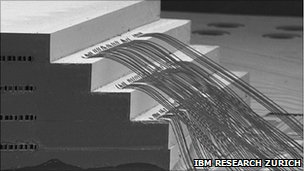
A pioneering research effort could shrink the world’s most powerful supercomputer processors to the size of a sugar cube, IBM scientists say.
The approach will see many computer processors stacked on top of one another, cooling them with water flowing between each one.
The aim is to reduce computers’ energy use, rather than just to shrink them.
Some 2% of the world’s total energy is consumed by building and running computer equipment.
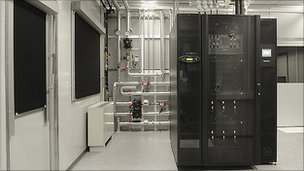
Dr Michel and his team have already built a prototype to demonstrate the water-cooling principle. Called Aquasar, it occupies a rack larger than a refrigerator.
IBM estimates that Aquasar is almost 50% more energy-efficient than the world’s leading supercomputers.
“We currently have built this Aquasar system that’s one rack full of processors. We plan that 10 to 15 years from now, we can collapse such a system in to one sugar cube — we’re going to have a supercomputer in a sugar cube.”


Comments (3)
by Jay27
12 Projects to do what exactly?
by eldras
Yes its fantastic. IBM keeps bouncing back. I favor using the heat as a source of energy for other stuff.
The area of computing is exploding with many different systems possible.
I guess Quantum Computing will have to get smarter and non-determinist swept aside for a better and precise understanding of the quantum world (I think our theories are massively surface ones)
However we are STILL designing by hand and costs are mainly man power costs.
We may turn the corner when machine systems complex enough to design others and modify themselves at speed come.
They are over due and expected since 2005.
The singularity University has put forward 12 projects and Google launched Google A.I.
by Jay27
While it is good to hear that advances in computation are still going strong, this was not unforeseeable.
In 1997, Deep Blue defeated Kasparov. This super computer had a capactity of 1 Teraflop if I am not mistaken.
My current gfx card, the HD5850, has a capactity of 2 Teraflops. It occupies the volume of a breadbox, it cost less than 300 euros and it only uses 110 watts per hour on full load.
Nowadays, consumers consider Teraflop performance on gfx cards as the norm.
When you consciously think about it, it can make the mind boggle.