Support cells found in human brain make mice smarter
March 8, 2013
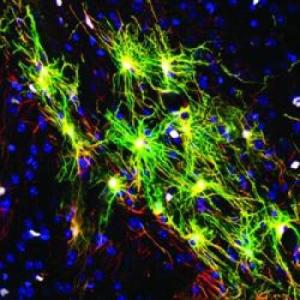
In this image of the brain of the transplanted mice, the human astrocytes appear in green (credit: University of Rochester Medical Center)
Glial cells — a family of cells found in the human central nervous system and, until recently, considered mere “housekeepers” — now appear to be essential to the unique complexity of the human brain.
Scientists reached this conclusion after demonstrating that when transplanted into mice, these human cells could influence communication within the brain, allowing the animals to learn more rapidly.
The study suggests that the evolution of a subset of glia called astrocytes — which are larger and more complex in humans than other species — may have been one of the key events that led to the higher cognitive functions that distinguish us from other species.
“This study indicates that glia are not only essential to neural transmission, but also suggest that the development of human cognition may reflect the evolution of human-specific glial form and function,” said University of Rochester Medical Center (URMC) neurologist Steven Goldman, M.D., Ph.D., co-senior author of the study.
“We believe that this is the first demonstration that human glia have unique functional advantages. This finding also provides us with a fundamentally new model to investigate a range of diseases in which these cells may play a role.”
In recent years scientists have begun to understand and appreciate the role that glia cells — and more specifically astrocytes — play in brain function. Researchers at URMC have been pioneers in unlocking the secrets of astrocytes and demonstrating that they not only serve to support the neurons in the brain, but also communicate with neurons and each other.
“The role of the astrocyte is to provide the perfect environment for neural transmission,” said Maiken Nedergaard, M.D., D.M.Sc., co-senior author of the study and director, along with Goldman, of the URMC Center for Translational Neuromedicine. “As the same time, we’ve observed that as these cells have evolved in complexity, size, and diversity — as they have in humans — brain function becomes more and more complex.”
Astrocytes coordinate activity of synapses, helping regulate higher cognitive functions
Astrocytes are far more abundant, larger, and diverse in the human brain compared to other species. In humans, individual astrocytes project scores of fibers that can simultaneously connect with large numbers of neurons, and in particular their synapses, the points of communication where two adjoining neurons meet. As a result, individual human astrocytes can potentially coordinate the activity of thousands of synapses, far more than in mice.
It was this observation that suggested that human astrocytes might play a significant role in integrating and coordinating the more complex signaling activity found in human brains, and hence help regulate our higher cognitive functions. This in turn suggested that, when transplanted into mice, human glia may influence underlying patterns of neural activity.
“In a fundamental sense are we different from lower species,” said Goldman. “Our advanced cognitive processing capabilities exist not only because of the size and complexity of our neural networks, but also because of the increase in functional capabilities and coordination afforded by human glia.”
“I have always found the concept that the human brain is more capable because we have more complex neural networks to be a little too simple, because if you put the entire neural network and all of its activity together all you just end up with a super computer,” said Nedergaard. “But human cognition is far more than just processing data, it is also comprised of the coordination of emotion with memory that informs our higher abilities to abstract and learn.”
Creating smart mice with human glial cells
The research team decided to determine if human glial cells might provide the human brain with unique capabilities by seeing what happened when these cells were allowed to co-exist with the normal nerve cells of mice. The scientists first isolated human glial progenitors — the cells in the central nervous system that give rise to astrocytes — from brain tissue. They then transplanted these cells into the brains of neonatal mice. As the mice matured, the human glial cells outcompeted the host’s native glial cells, while at the same time leaving the existing neural network intact.
“The human glia cells essentially took over to the point where virtually all of the glial progenitor cells and a large proportion of the astrocytes in the mice were of human origin, and essentially developed and behaved as they would have in a person’s brain,” said Goldman.
The team then set out to examine the functional impact that these cells had on the animals’ brains, specifically the speed and retention of signals between cells in the brain and its plasticity — the ability of the brain to form new memories and learn new tasks.
They found that two important indicators of brain function drastically improved in the mice with human glia. First, when measuring a phenomenon called calcium wave — the speed and distance at which a signal spreads within and among adjoining astrocytes in the brain — the researchers noted that the speed of wave transmission in the transplanted mice was faster than normally observed in mice, and more similar to that of human brain tissue.
Second, the researchers also looked at long-term potentiation (LTP), a process that measures how long the neurons in the brain are affected by a brief electrical stimulation. LTP is considered one of the central molecular mechanism underlying learning and memory. In this test as well, the researchers found that the transplanted mice developed more rapid and sustained LTP, suggesting their improved learning capability.
On the basis of these findings, the team then evaluated the mice in a series of behavioral tasks designed to test memory and learning ability. They found that the transplanted mice were more rapid learners and both acquired new associations and performed a variety of tasks significantly faster than mice without the human glial cells.
“The bottom line is that these mice demonstrated an increase in plasticity and learning within their existing neural networks, essentially changing their functional capabilities,” said Goldman. “This tells us that human glia have a species-specific role in intellectual capability and cognitive processing. While we’ve suspected for a while that this might be the case, this is really the first proof of this point.”
The researchers believe that this animal model, which they call the human glial chimeric mouse, now provides the medical community with a new tool to understand and treat neurological disorders to which glial abnormalities contribute. This may be especially relevant for those neurological and neuropsychiatric diseases that appear more in humans than other species. In these disorders, the human-specific features of astrocytes may be of special importance to the disease process. Goldman, Nedergaard, and their colleagues are already using these mice to study a range of human neuropsychiatric and neurodegenerative disorders to which glial pathology may contribute.
The study was supported by the G. Harold and Leila Y. Mather Charitable Foundation, the Dr. Miriam and Sheldon G. Adelson Medical Research Foundation, the National Multiple Sclerosis Society, and the National Institutes of Health.
Whatever you do, don’t inject these glial cells in the brains of those networked rats! :) — Editor