The amazing trajectories of life-bearing meteorites from Earth
April 12, 2012
The asteroid that killed the dinosaurs 65 million years ago (10 km in diameter, mass greater than 1 trillion tons) must have ejected billions of tons of life-bearing meteorites into space. Now Kyoto Sangyo University physicists have calculated this could have seeded life in the solar system and even as far as Gliese 581, Technology Review Physics arXiv Blog reports.
Their results contain a number of surprises:
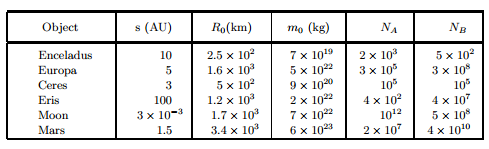
- As much ejecta would have ended up on Europa as on the Moon: around 100 million individual Earth rocks in some scenarios. That’s because the huge gravitational field around Jupiter acts as a sink for rocks, which then get swept up by the Jovian moons as they orbit.
- A previous study found that more Earth ejecta must end up in interstellar space than all the other planets combined.
- About a thousand Earth-rocks from this event would have made its way to Gliese 581 (a red dwarf some 20 light years from here that is thought to have a super-Earth orbiting at the edge of the habitable zone), taking about a million years to reach their destination.
- Life-bearing ejecta from Earth would take a trillion years for ejecta to spread through a volume of space the size of the Milky Way
- If life evolved at just 25 different sites in the galaxy 10 billion years ago, the combined ejecta from these places would now fill the Milky Way.
- The probability is almost 1 (close to certain) that our solar system is visited by microorganisms that originated outside our solar system.
Ref.: Tetsuya Hara, Kazuma Takagi, Daigo Kajiura,Transfer of Life-Bearing Meteorites from Earth to Other Planets, arxiv.org/abs/1204.1719

Comments (11)
by Rob
Let’s assume that other advanced life forms explored the space immediately around them. Could it be possible that “ejecta” from satellites – from urine and solid/fecal waste to food packaging to any of a million bacteria (and viral) laden items left their world and traveled to ours – and vice-versa? It doesn’t always have to be an asteroid-meteoroid impact that splashes organic traces all over the universe. Could it have been an intentional “seeding” or “seed-spreading” event?
What about comets? Aren’t they possibly whole oceans from past planets that froze in space (upon the explosion or destruction of an oceanic planet), carrying their organic soup until it happened upon a nice “goldilocks zone” planet and seeded that planet – or us?
by Rob
This has to be the fuel for religious scientists.
by Lord Penguin
Anything with water in it freezes very quickly in space. The bacteria could have survived the journey simply by being frozen. Some bacteria can live under extreme pressure and heat, although the heat and force of an impact large enough to knock the bacteria into space (and the material they are on/in) would be much, much stronger.
If the bacteria, after all that, survived entry into another planet’s atmosphere. there’s a high chance that it would adapt and soon cover the planet, maybe even evolve into multi-cellular organisms. I just don’t think its likely that it could have survived the extreme conditions when the asteroid hits earth.
by GatorALLin
Have to agree with Ted and James on this one……. seems like a long shot x a Billion or more that life came from this method….
…even if life did survive it would have to land on the right planet…..odds of that might also add a few more billion to ones… it would seem the giant planets suck these rocks up and they are also not earth like and thus even further reduce the chances. (or get caught in some asteroid belt to die a slow death).
by Exploding Diarrhea
Earth ejecta.
by James Motes
Ted made an excellent comment against the theory. I offer another against.
Even if some life or amino acids survive, the host planets environment must be conducive to the continued existance of said life or molecules.
by Lukas
The ejecta would be travelling in many directions and trajectories. Like a plume of dust particles not all would land in the same eventual place. I’m not saying I agree with the theory, I’m merely suggesting it is a straw man to burn down the idea based on the odds of ejecta landing on a ‘single’ hospital planet. Out of the ALL the planets the ejecta reaches, only one would have to be hospitable.
by eldras
Ted Howard’s point is good. Also if we can sperm the cosmos we could have been seeded (the hope would be to find alien intelligence)
by tedhowardnz
So many ifs and buts in those calculations.
The bacteria would have had to survive 3 major events:
1/ heat near vaporisation being ejected from earth;
2/ near a million years without food in the vacuum of space with all the radiation issues leaving and re-entering solar systems;
3/ heat of re-entry into the destination.
In practice, we find that we can sterilise food effectively by temperatures as low at 115 C (pressure cooker).
So while their calculations with respect to rocks reaching far away places may be correct, it seems extremely unlikely that any of those rocks would contain life forms capable of self replication in their destination environment.
Thus the probability of life travelling interstellar spaces seems very low indeed – much less than 0.001 (so rounded to 2 significant digits, much closer to zero than to 1).
by Tom Mazanec
Will bacteria travel trhrough interstellar space for millions of centuries and survive the radiation?
by Gary Mezo
Remember hearing about finding “Life on Mars” in the discovery of Nanobacteria in the Martian meteorite Allende ALH84001 ? NASA scientists/astrobiologists believe that these Martian meteorites seeded our Earth with Nanobacteria approximately 4.6 billion years ago. Here’s one article from astrobiologists at MS State & NASA http://geosciences.msstate.edu/nannobacteria/index.htm Current day work on Nanobacteria and the mammalian diseases they cause can be found at http://www.nanobiotech.us Very Interesting stuff on MANY fronts!