UPDATE | The buzzer factor: did Watson have an unfair advantage?
February 18, 2011 by Amara D. Angelica
Does Watson have an unfair advantage over humans because it can signal its response instantly? It seemed that way in the three “Jeopardy!” TV shows this week, especially Wednesday night, as Watson proceeded to totally own the humans.
ADDED FEBRUARY 24, 2011:
From Final Jeopardy: Man vs Machine and the Quest to Know Everything by Stephen Baker:
“After the match, Jennings and Rutter stressed that the computer still had cognitive catching up to do. They both agreed that if ‘Jeopardy’ had been a written test — a measure of knowledge, not speed — they both would have outperformed Watson. ‘It was its buzzer that killed us,’ Rutter said.”
Note that this appears to contradict statements made by IBM, cited below.
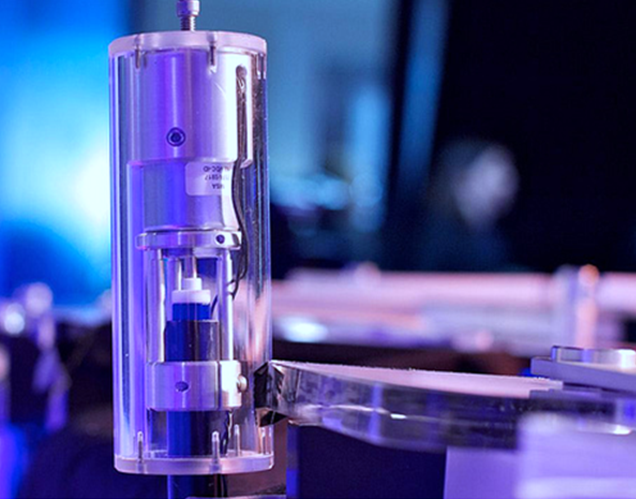
Watson's "hand" is a mechanical device that functions like a human contestant's buzzer. (Photo: IBM)
It gets down to human vs. computer reaction time to the light that signals that players can press the button. (After the host reads the question, a light signals the contestants that the button is armed so they all have the same start cue.) According to one literature review, the accepted figure for mean simple reaction times for college-age individuals for light stimuli is about 190 ms (0.19 sec). (You can test your reaction time to a traffic light change or dot color change.)
What about Watson? Its reaction time is just five to ten milliseconds, according to a white paper provided to me by IBM and written by Dr. David Ferrucci, who heads up the Watson computer design team. That’s a 38:1 advantage!
But wait — Ferrucci throws us a curve: “By anticipating and ‘timing the buzz,’ top players do not have to wait for the enable lights,” he reveals. “Rather, they start their neurons and muscles going well ahead of the very end of the clue.
They win the buzz consistently, with remarkable speeds under twenty, ten and even under four milliseconds after the enable lights go on! They can and have timed the buzzer faster than Watson’s fastest possible speed to the buzz.”
Back on the stage, disconnected from any life-lines, Watson goes head-to-head with “Jeopardy!” champs. The clue appears, and the process begins: Watson deeply analyzes the question, explores millions of pieces of text, and considers hundreds of possible answers, gathering and analyzing all the evidence it can for each possibility. Watson computes a strong confidence in its top answer. It does ALL this before the host finishes reading the clue.
But so did Sue [another contestant in pre-trials]. Sue times the buzz through learned anticipation, as do all good human ‘Jeopardy!’ champs. She’s got the rhythm, she is synced-up to the cadence of Alex’s voice, she knows what the penultimate syllable will sound like, she tenses her muscles, readies her mind, the answer she computed seemingly ages ago is on the tip of her tongue, she is anticipating….anticipating.
The milliseconds are zipping by, the end of the clue is being spoken and then with uncanny accuracy she anticipates the [buzz delay] and finally her own electromechanical delay and bam! — Sue’s electrons steal the buzz just two milliseconds after the enable lights go on. Three whole milliseconds later, Watson’s fastest signal arrives — too late. Watson was beaten to the buzz.
— David Ferrucci white paper
It’s actually even worse for Watson, Ferrucci goes on. “It spends its 2,800 compute cores trying to understand and answer the question in enough time to get any chance to buzz in. The current version of Watson does this about 90%-95% of the time. Depending on the specific game, Watson may not have enough time to even decide to buzz for the about 5%-10% of the clues. If Watson gets ready to buzz in fast enough, it can leverage its speedy hand, but it still does not buzz perfectly; Watson has to manage its risk.” The risk here is that there is a penalty if a contestant buzzes before the light: a quarter-second (250 ms) lock-out.” (The contestant is blocked from responding.)
“According to our estimates, in Ken Jennings’ 74-game winning streak, he buzzed in first for about 60% of the questions in a game. This was his average “buzzer-ability” over the entire streak. He had games where he buzzed in first for over 70% and even up to 80% of the board! On a game like that, he totally dominated, leaving only 20% (not counting rebounds and triple stumpers) for the two other players to split.” (See “Timing analysis” below for more details.)
OK, but what can we realistically conclude about Watson’s capabilities from this demonstration? After all, it’s TV entertainment — not a controlled lab experiment. Watson was capable of giving correct responses to the clues. But we can’t conclude Watson knew more, or “thought” faster that human contestants. Contestant fatigue, distractions, and stress levels could have also affected the outcome. Some might also conclude that the clues were relatively simple (that’s how many of them seemed to me), which could have made reaction time a bigger factor in scoring than the contestant’s knowledge. A definitive test would eliminate the buzzer.
In other words, what are Watson’s (or more importantly, DeepQA‘s — Watson’s question answering software) real capabilities compared to humans? I ran across an in-depth discussion of DeepQA in D. Ferrucci et al., “Building Watson: An Overview of the DeepQA Project,” AI Magazine, Fall 2010 that offers some clues.
Next week, we’ll look at where IBM plans to take DeepQA next. Hint: not a TV show.
Timing analysis
At the same time the clue is displayed on a screen to the contestants, it is transmitted electronically to Watson. It is sent in the same format that appears on the Jeopardy! display (usually all uppercase letters) but is sent as a single line of text. Given the speed of light and of electronic transmission, the clue text hits Watson’s chips at essentially the same time that it hits the human players’ retinas. And then the language processing begins for both human and machine.
The enable light travels to the human eye at roughly the same speed the enable signal travels to Watson’s chips. Electronic signals over wires travel a bit slower than light and Watson is a bit further away from the signal source so perhaps the humans may have a few billionths of a second advantage….
After Watson gets the enable signal, the third and most discussed interface comes into play: the physical buzzer. If and only if Watson has computed an answer with a sufficiently good confidence will it send an electronic signal to its hand.
Yes, Watson has a “hand” that it uses to physically depress the “Jeopardy!” buzzer. Watson’s hand looks like a clear, Plexiglas, cylindrical soda can with a few metal screws in the top and a wire extending from the bottom that is connected to Watson’s Front-End Controller. The mechanical hand wraps around the Jeopardy! buzzer which is inserted in the bottom of the Plexiglas cylinder and is held in place by a clamp. Watson’s hand uses a solenoid to physically press the same button that the humans must press. After all, if the humans have to physically push plastic down onto a spring, so should Watson. It should not have a direct electronic link. Fair enough.
Watson’s hand is pretty fast in terms of raw speed — it takes somewhere between five and ten milliseconds for Watson to activate the buzzer once it decides to answer. This delay is affected by the speed of the solenoid and other small, sometimes hard-to-pin-down delays inherent in the software stack. This refers to layers of software through which the enable signal and then the decision to buzz must go to get to Watson’s hand. Watson does not, however, win the buzz all the time, not by a long shot.
— David Ferrucci white paper
Comments (14)
by BM
That’s exactly right, editor (your post on Feb 24 2011). If there were no buzzer and it were just a test to see which contestant would have answered the highest percentage of the questions correctly, the computer would have been FAR behind the humans. Either that OR if Watson also had to rely on timing the buzz right after Alex stopped talking (instead of being sent a signal when it was time to answer), it would also have failed. Watson was definitely at an unfair advantage.
by RobPreece
My feeling was that Watson could “read” the question whereas the mere humans listened to Alex. Of course the speed-buzzer is impressive but let’s be honest–isn’t it amazing that computer hardware/software allows a computer to ask so many natural language questions? I did notice that the actual questions seemed oriented toward Watson–mostly fact-based rather than some of those complex word play games they sometimes ask. Still, well-done IBM and Watson
by Guest
Watson may have had a buzzer advantage, and perhaps the humans actually knew more of the answers than Watson, but keep in mind that the questions are kept to a limited level of difficulty so as to keep the game interesting. That is, if the questions (I know, it’s “answers” on Jeopardy!) were so difficult that only 10% could be answered, the show would not go on. However, Watson could probably answer questions at a much greater level of minutiae or obscurity than what the humans could. For example, how many species of frogs there are, or the name of the author of some minor novel from 1975, etc. Thus, one of Watson’s major advantages, his sheer volume of knowledge, is eliminated. The questions could be made so simple that the average human would get all the questions right and Watson would still miss some because of his limitations with language comprehension, or they could be made so hard that any human would miss almost every question but Watson might still get a large percentage correct.
What it boils down to is that humans almost always understand what piece of data is being sought from the question, but don’t always know the answer. Watson doesn’t always understand what is being asked (to simplify his processes), or can’t always find an answer in his mass of unstructured data, but he’s pretty good. So Watson may have only won because of his buzzer advantage, but the humans only even had a shot because the questions were kept “easy” for them.
by DCWhatthe
If the buzzer wasn’t an issue, and Watson still won or tied, then some other excuse would have been cooked up to show how ‘unfair’ it is.
When you play a game which involves more than one participant, and all of the players follow all of the rules, and then you claim it was unfair because one of the players is faster at following one of the rules – that’s just being a sore loser.
Even if Watson didn’t perform as well, and lost this series of matches, we all know the next generation of Watsons will win. And the generation after that, will win beyond a shadow of a doubt.
Hopefully, the generation of AIs which directly connect to our brains, will be open-source versions.
IBM has my gratitude, but not my complete trust. No single company or agency, is entitled to that kind of trust – not when the resources are this close to the core of our consciousness, our will, our human identities.
by Editor
ADDED TO THE BLOG POST FEB. 24, 2011:
From Final Jeopardy: Man vs Machine Man vs. Machine and the Quest to Know Everything by Stephen Baker:
“After the match, Jennings and Rutter stressed that the computer still had cognitive catching up to do. They both agreed that if Jeopardy had been a written test — a measure of knowledge, not speed — they both would have outperformed Watson. “It was it’s buzzer that killed us,” Rutter said.”
Note that this appears to contradict statements made by IBM.
by omelv44
What if the Singularity never happens? It is the name of the essay by Vernor Vinge, the shill of the IT companies that coined the collocation “The technological singularity”. The essay was interesting but he didn’t take into account the fact that in the situation when the IT firms realize their limitations and achieve a stalemate in their run for the superhuman intelligence, they will do everithing to conseale this fact. They will pretend that they still make great progress whose rate is exponential. Otherwise, they will lose their market share, they may go bankrupt, their fall may affect the whole US economy triggering the fall of the world’s economy. That is why the US government shouldn’t try to shoot their mouths when the IT firms continue to promise us the earth. But take into account the following scenario:
1) The US and world’s companies have found out that they cannot create AI
2) To avoid collapse they decide to immitate that everything is OK and here is the strategy:
3) They will use their shills such as Kurzweil, Goertzel, Gershenfeld, Moravec, Jacobstein
4) Yudkovsky, Vinge, Guildner, Diamandis, etc. to prove that:
i) The progress is still exponential (bullshit of Kurzweil, Moravec, etc.)
ii) Creating superhuman AI is easier than Windows Vista (bullshit of Goertzel)
iii) AI is ubiquitous (bullshit of Jacobstein, Kurzweil, etc.)
iv) The sing is near (bullshit of Kurzweil, Vinge, Goertzel, Yudkovsky, etc.)
5) Some of those shills will show signs of inadequate behavior to prove that they really believe in the bullshit they spread all over the world, e.g. Kurzweil eating 200 pills a day to be able to live longer and see “the inevitable singularity”
6) Some important persons in the IT industry will say some kind words about such shills to show the world that they are cool guys, e.g. Bill Gates comparing Ray Kurzweil with Edison or Larry Page, talking the bullshit that if he had been a student we would have wasted his money on studying at “the singularity” “university”.
7) The company like IBM would give bribes to the organizers of the show like Jeopardy to obtain from them the list of questions which would be asked when their Kwikaklika (quicker clicker) program challenges the best players at this show. It wouldn’t even look for the answers. It will obtain the question in the form “question number 9.” or “question number 123456789.” And hence it will give the answers stored in the memory of their computer. This fraud would immitate the victory over the best human Jeopardy players.
8) It will create an illusion to naïve singulartarians that the sing is really near and the CEOs of the biggest IT companies will laugh at those gullible dorks how professionally they have bamboozled them (and the world) and enabled themselves to preserve their strong positions in the market for the next decade although they are not capable of shit.
9) They will also produce some walking devices that can immitate abilities of some insects to create an illusion that the progress is still keeping.
10) They will even try to create some kind of religion. Ron Hubbard told that if you want to be really reach, you must create your own religion. So they would create the religion called “singularitarianism” with the main priest Ray Kurzweil. The sectarians will believe in some good fairy in form of some intelligent machine which will do everithing instead of them. And ultimately consume everything instead of them, by the way.
This all combined will cause that thousands or even millions stubborns believing in all this bullshit will pop out like mushrooms and they will be ready to attack everyone with different opinion! Especially people saying the truth like me :) :) :D
by fredpfarnsworth
This is the order of who buzzed in first on the second night (the night Watson took charge). W=Watson, K=Ken, B= Brad
W,W,W,W,W,W,W,W,W,W,W,W,K (W=32%), B (W=98%), W,W,K (W=40%),W,W,K (W=65%),W,W,B (W=97%),W,W,W,W
So, out of 26 questions, Watson buzzed in first 21 times. 2 of the 5 times he did not buzz in first, he did not even try (W<50%). Brad or Ken buzzed in first only two times when Watson was confident (green).
Facts are facts. Most anyone could have beat Ken or Brad if they controlled the game as well as Watson did.
by melajara
On the contrary, the HUMANS had an advantage as they were allowed to buzz instantly, even before having the answer. Of course, that’s amounts to a bet, relying on the human metacognitive ability to say to yourself “I know the answer, it’s on the tip of my tongue as for now but I will have it in 5 seconds”. Why 5 seconds? Because it’s about the time you are allowed to start to express the answer once you buzzed. At several times, this delay was perceptible in the human answer see e.g. when Brad answered “Who is Robert De Niro?”.
by fredpfarnsworth
It is not true that the humans could buzz instantly. There was not a single instance when a human buzzed in before Alex got done reading a question. I’ve seen contestants buzz in early many times before, but that never happened against Watson. Obviously, they did not allow it. The videos are online. Check it out.
by melajara
Well, “instantly” was an exageration. What I really meant is as close as possible from allowed and definitely BEFORE having found the answer. The trick being to recover the answer in the time interval allowed to actually voice it ;-)
by BryanLong
The significance of the IBM achievement is little diminished by any reaction time advantage. But a closer inspection also highlights the amazing power of the human supercomputer, the brain. Consider that Watson consumes about 200,000 Watts, while the combined power consumption of the two human contestants was only about 200 Watts. That’s a 1000:1 efficiency advantage. In my essay on Econosystemics.com, I note that Watson also costs an amortized $5000 per day to operate, compared to 3 billion human brains operating on less than $2.50 per day. I’m a believer in the future of computer consciousness, but right now we could consider various “brainsourcing” technologies that could help alleviate world poverty by tapping into and paying for the cognitive capability of underutilized brains to solve complex problems. Essay at http://bit.ly/hfyS8K
by Carbone
1) What would be the point of having a supercomputer on the show if it were artificially slowed down an never got to answering a question.
2) Why would it be “unfair”? If the game is about buzzing and people suck at buzzing then why restrict a computer? People are better at understanding their own language they invented, noone screams “unfair” and pity the AI here.
And as is said in this article. Ken Jennings was so succesful in Jeopardy mostly because he was better at buzzing than other people.
by omelv44
What if the Singularity never happens? It is the name of the essay by Vernor Vinge, the shill of the IT companies that coined the collocation “The technological singularity”. The essay was interesting but he didn’t take into account the fact that in the situation when the IT firms realize their limitations and achieve a stalemate in their run for the superhuman intelligence, they will do everithing to conseale this fact. They will pretend that they still make great progress whose rate is exponential. Otherwise, they will lose their market share, they may go bankrupt, their fall may affect the whole US economy triggering the fall of the world’s economy. That is why the US government shouldn’t try to shoot their mouths when the IT firms continue to promise us the earth. But take into account the following scenario:
1) The US and world’s companies have found out that they cannot create AI
2) To avoid collapse they decide to immitate that everything is OK and here is the strategy:
3) They will use their shills such as Kurzweil, Goertzel, Gershenfeld, Moravec, Jacobstein
4) Yudkovsky, Vinge, Guildner, Diamandis, etc. to prove that:
i) The progress is still exponential (bullshit of Kurzweil, Moravec, etc.)
ii) Creating superhuman AI is easier than Windows Vista (bullshit of Goertzel)
iii) AI is ubiquitous (bullshit of Jacobstein, Kurzweil, etc.)
iv) The sing is near (bullshit of Kurzweil, Vinge, Goertzel, Yudkovsky, etc.)
5) Some of those shills will show signs of inadequate behavior to prove that they really believe in the bullshit they spread all over the world, e.g. Kurzweil eating 200 pills a day to be able to live longer and see “the inevitable singularity”
6) Some important persons in the IT industry will say some kind words about such shills to show the world that they are cool guys, e.g. Bill Gates comparing Ray Kurzweil with Edison or Larry Page, talking the bullshit that if he had been a student we would have wasted his money on studying at “the singularity” “university”.
7) The company like IBM would give bribes to the organizers of the show like Jeopardy to obtain from them the list of questions which would be asked when their Kwikaklika (quicker clicker) program challenges the best players at this show. It wouldn’t even look for the answers. It will obtain the question in the form “question number 9.” or “question number 123456789.” And hence it will give the answers stored in the memory of their computer. This fraud would immitate the victory over the best human Jeopardy players.
8) It will create an illusion to naïve singulartarians that the sing is really near and the CEOs of the biggest IT companies will laugh at those gullible dorks how professionally they have bamboozled them (and the world) and enabled themselves to preserve their strong positions in the market for the next decade although they are not capable of shit.
9) They will also produce some walking devices that can immitate abilities of some insects to create an illusion that the progress is still keeping.
10) They will even try to create some kind of religion. Ron Hubbard told that if you want to be really reach, you must create your own religion. So they would create the religion called “singularitarianism” with the main priest Ray Kurzweil. The sectarians will believe in some good fairy in form of some intelligent machine which will do everithing instead of them. And ultimately consume everything instead of them, by the way.
This all combined will cause that thousands or even millions stubborns believing in all this bullshit will pop out like mushrooms and they will be ready to attack everyone with different opinion! Especially people saying the truth like me
by davetbo
I disagree with the “especially Wednesday night” sentiments in the first paragraph. The humans clearly beat Watson to the buzzer many more times than the second night, although the results still ended up well in Watson’s favor. It was so dramatic that they were getting more “buzzers in edgewise” that I thought either the humans got better at the buzzer timing or the IBM folks took pity and programmed in a bit of slop factor on Watson’s buzzing algorithm. Most likely the two humans had to get back in their Jeopardy mode, shake off the anticipation cobwebs, and minimize their reaction times. Either way, kudos to Watson! I especially liked Ken’s final remarks about welcoming the new computer overlords. Someone should tell Ken to apply the “if you can’t beat them, join them” principle and pursue the singularity!