The future of medicine is now
December 31, 2012
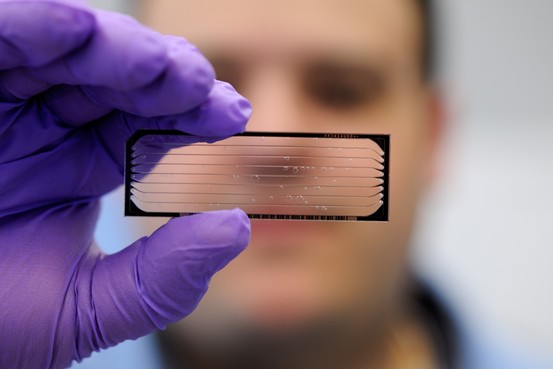
A test developed by Foundation Medicine Inc. analyzes tumor DNA to help find targeted treatment options for patients with cancer (credit: Foundation Medicine)
Six medical innovations are poised to transform the way we fight disease, The Wall Street Journal reports.
- Surgeons at Boston Children’s Hospital have developed a way to help children born with half a heart to essentially grow a whole one — by marshaling the body’s natural capacity to heal and develop.
- Oxford Nanopore Technologies has unveiled the first of a generation of tiny DNA sequencing devices that many predict will eventually be as ubiquitous as cellphones — it’s already the size of one.
- A test developed by Foundation Medicine Inc. enables doctors to test a tumor sample for 280 different genetic mutations suspected of driving tumor growth.
- MK3475, being developed by Merck & Co., is among a new category of drugs that unleash an army of immune cells to hunt down a cancer. — Ron Winslow
- Last month, the FDA cleared a new iPhone add-on that lets doctors take an electrocardiogram just about anywhere. Other smartphone apps help radiologists read medical images and allow patients to track moles for signs of skin cancer.
- Gene therapy is poised to become a viable option for a variety of often life-threatening medical conditions, especially those resulting from a single defective gene.
Comments (19)
by alliwant
My question is if gene therapy could be used to treat allergies, by correcting some of the immune system’s crazy overreaction. Not life threatening (usually) but life changing.
by Brian Roberts
since they have portable MRI machines it may not be too much longer before it is reduced in size further-perhaps down to phone size.
Always read of things like this article and it sounds great. I’d buy into it more if they could do more mundane things like grow hair or something.
by Aaron Wright
The iPhone app that lets doctors take an ECG is very cool. Sure, doctors can already take an ECG, but the iPhone tool has major implications in poorer countries. The lack of infrastructure makes a more mobile option very powerful.
by Michael
especially if they create the app for android phones which is practically free compared to iphones. For example in my country you can get a nexus 4, nexus 7 and nexus 10 (all of them) for the price of one iphone5.
by haglin
I’m still waiting for the nanobots that can travel in my bloodstream. They must come soon, if I’m going to be able to buy a billion of them for a low cost by 2030.
by Jack Reeve
Happy New Year to all! A year from now we’ll all be somewhat less than an old-style year older. I have a bit of achallenge for you all – Can anyone tell us just what that value is these days? I just turned 56. Will I be 0.9 years older this day next year? 0.8? Let’s assume we’re speaking of those of us in otherwise good health, with reasonably current knowledge of nutrition, and an up-to-date awareness of good health habits. Live on… and on… Best regards all, Jack
by Andre Mugnier
I hear you Jack, being older than you. I like Kurzweil’s argument of “a bridge to a bridge to a bridge”. For some of us, the Merck innovation can be the first bridge. New bridges will be available in increasing numbers – it’s the law (of accelerating returns). All the best.
by Mr.X
Law is a misnomer.
by Andre Mugnier
Sure Mr X, everything being relative. Then again, if you can make the case against the 700-page argument for it in The Singularity is Near, we’re all ears (so to speak).
by Steve Waclo
You folks are making all this up, right :-)?
Arthur C. Clarke’s Three Laws are three “laws” of prediction formulated by the British writer Arthur C. Clarke. They are:
When a distinguished but elderly scientist states that something is possible, he is almost certainly right. When he states that something is impossible, he is very probably wrong.
The only way of discovering the limits of the possible is to venture a little way past them into the impossible.
Any sufficiently advanced technology is indistinguishable from magic.
by spencer
some beautiful language right there. truth is beautiful.
by Bob Vasquez
Wow, being able to grow a complete heart from half a heart; too bad this technology wasn’t available for certain legislators in the House and Senate this year.
by Zychowski
Fantastic progress I just hope it keeps going and the life spans extend to the hundreds and thousands of years.
by Vladislav
This innovation of 2012 deserves to be on that list:
http://en.wikipedia.org/wiki/Gladstone_Institutes
Deepak Srivastava, MD—Regenerated the damaged hearts of mice by transforming cells that normally form scar tissue after a heart attack into beating heart-muscle cells. This discovery, now moving forward with pre-clinical trials, could one day change the way doctors treat heart attacks.[12]
by Jack Reeve
Vlad, I agree completely, though it is likely that by this time time next year the number of staggeringly important development stories will grow exponentially. Indeed, one of the potential drawbacks to this tremendous explosion of beautiful technologies is the risk is growing of great discoveries being drowned in the pool of announcement.
by Gorden Russell
DNA sequencing devices the size of a cell phone! This is the kind of medicine Dr. McCoy practiced on the Starship Enterprise.
by Leo Allen
You got that right Russell. Now this is what I’m talking about! I hope the pace of improvement of these technologies keeps accelerating without the interruption of new wars/problems by rogue world leaders and/or nations.
by Warren
I find the first one to be most interesting. Regenerative medicine and anything similar leads to what will probably be the most popular path towards immortality.
by Leo Allen
I agree. I hope they release more details on how they are able to accomplish this. If this scientific field becomes a fashionable topic, perhaps more gifted people will get involved and immortality could finally be achieved during our own lifetime.