The music of the silks
November 30, 2012
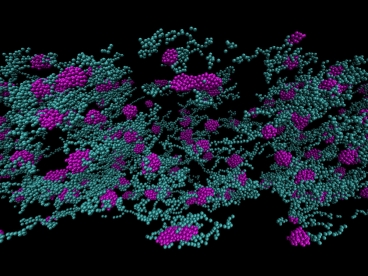
This diagram of the molecular structure of one of the artificially produced versions of spider silk depicts one that turned out to form strong, well-linked fibers. A different structure, made using a variation of the same methods, was not able to form into the long fibers needed to make it useful. Musical compositions based on the two structures helped to show how they differed. (Credit: Markus Buehler/MIT)
Research by MIT’s Markus Buehler — together with David Kaplan of Tufts University and Joyce Wong of Boston University — has synthesized new variants on silk’s natural structure, and found a method for making further improvements in the synthetic material.
The work stems from a collaboration of civil and environmental engineers, mathematicians, biomedical engineers and musical composers. The results are reported in a paper published in the journal Nano Today.
“We’re trying to approach making materials in a different way,” Buehler explains, “starting from the building blocks” — in this case, the protein molecules that form the structure of silk. “It’s very hard to do this; proteins are very complex.”
Other groups have tried to construct such protein-based fibers using a trial-and-error approach, Buehler says. But this team has approached the problem systematically, starting with computer modeling of the underlying structures that give the natural silk its unusual combination of strength, flexibility and stretchiness.
Pound for pound, spider silk is one of the strongest materials known: has helped explain that this strength arises from silk’s unusual hierarchical arrangement of protein building blocks.
Buehler’s previous research has determined that fibers with a particular structure — highly ordered, layered protein structures alternating with densely packed, tangled clumps of proteins (ABABAB) — help to give silk its exceptional properties. For this initial attempt at synthesizing a new material, the team chose to look instead at patterns in which one of the structures occurred in triplets (AAAB and BBBA).
Making such structures is no simple task. Kaplan, a chemical and biomedical engineer, modified silk-producing genes to produce these new sequences of proteins. Then Wong, a bioengineer and materials scientist, created a microfluidic device that mimicked the spider’s silk-spinning organ, which is called a spinneret.
Even after the detailed computer modeling that went into it, the outcome came as a bit of a surprise, Buehler says. One of the new materials produced very strong protein molecules — but these did not stick together as a thread. The other produced weaker protein molecules that adhered well and formed a good thread. “This taught us that it’s not sufficient to consider the properties of the protein molecules alone,” he says. “Rather, [one must] think about how they can combine to form a well-connected network at a larger scale.”
The team is now producing several more variants of the material to further improve and test its properties.
Music-aided design of biomaterials
The different levels of silk’s structure, Buehler says, are analogous to the hierarchical elements that make up a musical composition — including pitch, range, dynamics and tempo. The team enlisted the help of composer John McDonald, a professor of music at Tufts, and MIT postdoc David Spivak, a mathematician who specializes in a field called category theory. Together, using analytical tools derived from category theory to describe the protein structures, the team figured out how to translate the details of the artificial silk’s structure into musical compositions.
The differences were quite distinct: The strong but useless protein molecules translated into music that was aggressive and harsh, Buehler says, while the ones that formed usable fibers sound much softer and more fluid.
Buehler hopes this can be taken a step further, using the musical compositions to predict how well new variations of the material might perform. “We’re looking for radically new ways of designing materials,” he says.
Combining materials modeling with mathematical and musical tools, Buehler says, could provide a much faster way of designing new biosynthesized materials, replacing the trial-and-error approach that prevails today. Genetically engineering organisms to produce materials is a long, painstaking process, he says, but this work “has taught us a new approach, a fundamental lesson” in combining experiment, theory and simulation to speed up the discovery process.
Materials produced this way — which can be done under environmentally benign, room-temperature conditions — could lead to new building blocks for tissue engineering or other uses, Buehler says: scaffolds for replacement organs, skin, blood vessels, or even new materials for use in civil engineering.
Jessica Garb, an assistant professor of biological sciences at the University of Massachusetts at Lowell, says, “The approach these authors take to designing new biomaterials is completely novel [and] represents a bold approach to unite bioengineering and music.” She says that the researchers’ suggestion of attempting to reverse the process — starting with the music to design new versions of the protein structure — “could result in some exciting new materials. The practical impacts could be enormous.”
It may be that the complex structures of music can reveal the underlying complex structures of biomaterials found in nature, Buehler says. “There might be an underlying structural expression in music that tells us more about the proteins that make up our bodies. After all, our organs — including the brain — are made from these building blocks, and humans’ expression of music may inadvertently include more information that we are aware of.”
“Nobody has tapped into this,” he says, adding that with the breadth of his multidisciplinary team, “We could do this — making better bio-inspired materials by using music, and using music to better understand biology.”
Comments (28)
by Randy Handley
To say that everything in the universe is music is a nice metaphor but it is not accurate. Everything in the universe is light ( mostly unseen , like dark energy/matter) and music is a form of this vibrational context which is available to human ears and the structures of which can be easily understood. The same kind of structural integrity applies to light but , like the harmonic overtones of music interacting with its spatial context, it is, at present, more of an afterthought, than the structure of the composition. think it is a better understanding to consider things in these terms.
by Marcos Marin
Hmm.. nooo.. YOUR definition of MUSIC is inaccurate. Or perhaps simply too narrow.
At least you are already halfway and I dont have to convince you about light, vibrations et al..
Not even all humans would agree on what YOU consider harmonic, much less less limited perceptive entities. You might want to ‘think of better understanding’ non-tempered music. Even “primitive” peoples of the earth can make music by throwing their arms on a river stream, I’m sure YOU can widen your prejudices.
by Editor
Marcos: On this topic, this book inspired me many years ago: Music of the Spheres: The Material Universe from Atom to Quasar, Simply Explained, by Guy Murchie, http://www.amazon.com/Music-Spheres-Explained-Macrocosm-Cosmology/dp/0486218090. I think you would enjoy it.
by Marcos Marin
oh hi Ms Angel, thanks for joining me here, it is getting rather lonely. =) It was even surprising that Randy posted here the day after the article went live…
I wonder if I create an account here would it have the option to send reply notifications to my email? It would save pinging the server every 12 hours…though, it probably would not help much, since these people seldom seem to respect the reply button =)
“Sounds” fun! =)
Except for the “Simply explained” bit — just kidding ^_^
Although if I get any more “inspired” I might explode, maybe I’ll download that later too (if not already in the database) after I finish with Kurzweil’s Book =P I’m trying to mine new insights I may not already have figured after jeff hawkins.. I dont think taking it to “established computer science paradigms” — like that numenta deserter advocates — is advised at this stage, which seems what kurzweil seems to be doing (maybe under his influence =P though K certainly has this tendency himself) Also, there is no need for a “name” dendrite! There are no names there (he contradicts this very principle he establishes earlier, he calls it labels), pure association takes care of everything! This is ethereal*, yes, but there would be little room for intelligence if there was only one modality (which this would allow) — except for touch though, which can use geometry to express intelligence, e.g. worms.
But think of music, since we’re On this topic, even here there are multiple modalities, rhythm, melody, tone, volume, and you could interact (the currency of intelligence) using any of them BUT, assuming you had or picked (by keeping the others constant for instance) only one, there would be no way to “name” anything, the “name” would be the pattern itself! There would be no intelligent answer if someone asked such a system, for example, what melody it likes best, or even ‘what was that last melody I just played?’… its only option would be to play the whole pattern again… OR worse, use one pattern (a BEEP) and make a kind of morse code to communicate, which is cheating =) [equivalent to appending a binary beep encoding before each melody == cheating, since it would simply go up the hierarchy and K would say "see! it's a name", but no, for one thing, you changed the original pattern]
*I’ll resist indulging in Bri’s clichès about turtles =)
by Editor
Well, it’s interesting that vibrating strings and their harmonics have emerged as a key theory…. “Theoretical physicist Brian Greene, best known for his work on string theory, explains how music might have the answer we need to find a unified theory.” LMGTFY! http://bit.ly/TEPTPd :)
by Marcos Marin
heh.. thanks…
anyway.. it may be nice and dandy for an abstraction BUT it’s not really “strings” (sounds obvious probably but I mean any kind of “connected” particles — or even interactive(!) particles, since I dont see particles anywhere, only interfering(!) waves).
Spooky (not really) action at a distance takes care of it. =)
Resonant harmonics may indeed be the only interaction strong enough to emerge out of ether khaos… (Mr. K dont like ether I see, =) call it entropic vacuum then)
by Bri
There is a profound understanding of how the holodeck works in string theory. One could easily ask what the string is made of, but that would only evoke turtles all the way down. Even how the brain works evokes string theory. Neurons that fire together wire together. It’s one of the reasons that I’m not interested in the brain wave control of external apparatuses. Brain waves are like metronome beats. Kind of like an FM carrier wave. All those little neurons rhythmically firing. Yes there is a secret to how the holodeck works in string theory and how the mind mirrors the world.
by Marcos Marin
HAHAHAHA! I knew you were going to say that! it’s too irresistible to you!
ahem.. and I bet you know exactly what it is. — I thought the world mirrored the mind…
by trakk
whats k467?
by Marcos Marin
http://lmgtfy.com/?q=k467
by Marcos Marin
Maybe you can now help the poor guy at the youtube comments who didn’t have the benefit of my musical pattern recognition modules?
by trakk
maybe some other time…busy working on quantum computers :)
by Marcos Marin
hmm.. yes, that would be a looong wait..
You are probably NOT Ms. Gildert, right?
Who inaugurated teleXLR8 / openqwaq by giving a talk about Quantum Computing?
If so, maybe you remember a randomly named entity (user19 if I recall) asking an extremely important question regarding the usefulness of quantum computers — or lack thereof — which was completed misinterpreted by Giulio, the host, and subsequently reinterpreted by another user, by then too late to warrant a coherent thoughtful response?
by trakk
Thankfully…no!! :)
by Marcos Marin
lol, being her or remembering the event?
by trakk
being her…. cuz i am a 30 yr old male.
by Marcos Marin
oh =)
by trakk
that was a joke
by Marcos Marin
hehe, i dont get it, too ambiguous… what is so bad about it anyway?
by d-wiz@sbcglobal.net
In great art, music & fibers, The way things are combined make exponential differences.
by aus
“Nobody has tapped into this”
Didn’t Pythagoras know something similar to this 2500 years ago?
Interesting…
by Marcos Marin
I don’t remember.
by Bob Vasquez
This is pretty exciting stuff. I have forwarded this info to all my music professors and musical friends. Hopefully, they will add some thoughts.
by Marcos Marin
Everything in the universe is music.
by trakk
getting squashed to the seat isnt…. :)
by Marcos Marin
oh, it is.. it is indeed…
Actually it is THREE-FOLD, musically:
1) First Adopters Guinea-pigs* will hear this:
- http://www.youtube.com/watch?v=V8rZWw9HE7o
2) Most will hear this:
- http://www.youtube.com/watch?v=qRzO-pYFiR4
3) But actually it will be more like this:
- http://www.youtube.com/watch?v=f7J6qdei7vs
– Note how music is central to all of these=)
*Homophobic acronym not intended. Though there was one clip ending with Tom Cruise hugging the other guy by the theme of “take my breath away”…
by trakk
well then…the reaction engine’s technology doesnt sound that bad now does it :)
by Marcos Marin
You mean after k467? What wouldn’t?