CBS The Big Bang Theory | Technological singularity is primetime hit on award-winning sitcom
June 11, 2014
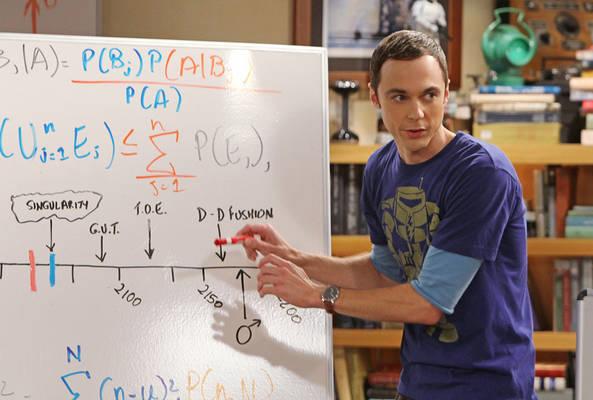
Ubergeek Sheldon explains to his roommate and best friend Leonard that he is trying to determine how much longer he has to live to see the technological singularity. (credit: CBS)
Episode “The Cruciferous Vegetable Amplification” of CBS hit sitcom The Big Bang Theory brings the concept of technological Singularity to one of its widest audiences.
In the opening teaser, ubergeek Sheldon (Jim Parsons) explains to his roommate and best friend Leonard (Johnny Galecki) that he is trying to determine how much longer he has to live.
Referring to his timeline, he laments that he will probably not survive to see the coming future.
related viewing from CBS The Big Bang Theory:
CBS The Big Bang Theory | “The Cruciferous Vegetable Amplification”
Sheldon: At best I have 60 years left. 60 only gets me to here. I need to get here.
Leonard: What’s there?
Sheldon: The earliest estimate of the Singularity, when man will be able to transfer his consciousness into machines and achieve immortality.
Leonard: So, you’re upset about missing out on becoming some sort of freakish, self-aware robot.
Sheldon: By this much!
Leonard: Tough break. You want eggs?
Sheldon: You don’t get it, Leonard. I’m going to miss so much: the Unified Field Theory, Cold Fusion, the dogopus.
Leonard: What’s a dogopus?
Sheldon: A hybrid dog and octopus — man’s best underwater friend.
Leonard: Is somebody working on that?
Sheldon: I was going to. I planned on giving it to myself for my 300th birthday.
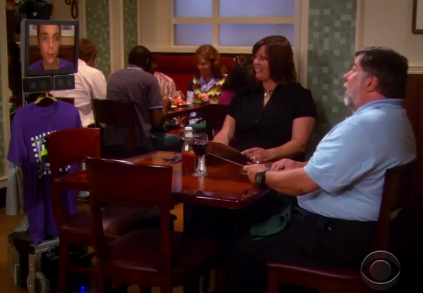
Sheldon talks to Steve Wozniak from his virtual telepresence robot. (credit: CBS)
In the episode “The Cruciferous Vegetable Amplification,” Sheldon — determined to live long enough for the moment when man and machine become one, called the “technological singularity” — decides he must cease all physical contact with the outside world.
When Sheldon calculates that the technology to download his consciousness into a robot won’t be invented soon enough, he desperately tries to find a way to increase his lifespan.
Sheldon no longer goes out into the world, since he thinks his body is too fragile to resist it, and creates a virtual telepresense — “Shelbot” — instead. Using a computer screen and basic, roving robot technology, he ends up alienating the entire gang.
He joins the gang at The Cheescake Factory where they see the famous Steve Wozniak sitting nearby. Shelbot approaches him, and Wozniak compliments his machine.
related reading:
by Phil Bowermaster in The Speculist
Popular both with geeks and with the intellectually inferior sorts that Sheldon refers to as “muggles,” The Big Bang Theory (now in its fourth season) is a major hit, claiming an average of 14 million viewers per week. The show is also critically acclaimed. Just a few weeks ago, Parsons won the 2010 Emmy for Outstanding Lead Actor in a comedy series.
If Sheldon’s description of the Singularity seems imprecise, that’s probably by design. While a serious in-depth explanation of what the Singularity is all about would be edifying, it probably wouldn’t make it onto TV.
Certainly not network TV. In primetime. On a popular sitcom. Twisting serious scientific and technological ideas into comedic material is one of the show’s major tropes. So the audience gains a certain familiarity with terminology and concepts, but something less than a real understanding of these ideas. Hey, it’s a start.
Another major contribution of The Big Bang Theory is that it serves as a kind of mainstream endorsement of geek culture. The Geek Chic movement was one thing, but this is something bigger. As I wrote in 2007 after watching the first few episodes:
After all, isn’t it amazing that a show like this can feature four such characters, not as the annoying neighbors or as the object of derision or pity of the real heroes of the show? These guys are the heroes.
Three physicists and an engineer — heroes for our time.
One major difference between Sheldon’s description of the Singularity and references we may have seen to it elsewhere in prime time (in Fringe, for example) is that Sheldon describes the Singularity not as a catastrophe to be avoided, or something that is simply “going to happen,” but rather as a goal. In just a few short sentences he makes a case for life extension, uploading of consciousness, and the achievement of major longstanding scientific aims via cooperation between human and artificial intelligence.
Sheldon is a transhumanist!
Sure, these ideas are all portrayed as bizarre and ridiculous, but that’s because Sheldon is the nerd of the group. But that’s okay. If The Big Bang Theory has demonstrated anything, it’s how quickly and easily nerdy ideas can become mainstream. Stay tuned.