The state of the future
July 14, 2010 by Jerome C. Glenn
As noted in our 2010 State of the Future (the 14th annual report from the Millennium Project, just published), the world is in a race between implementing ever-increasing ways to improve the human condition and the seemingly ever-increasing complexity and scale of global problems.
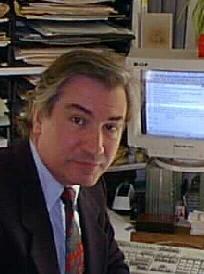
Jerome Glenn addresses the Clean Media movement held in the South Korean legislature in Seoul in 2009
If current trends in population growth, resource depletion, climate change, terrorism, organized crime, and disease continue and converge over the next 50 to 100 years, it is easy to imagine an unstable world with catastrophic results. However, if current trends in self-organization via future Internets, transnational cooperation, materials science, alternative energy, cognitive science, inter-religious dialogues, synthetic biology, and nanotechnology continue and converge over the next 50 to 100 years, it is easy to imagine a world that works for all.
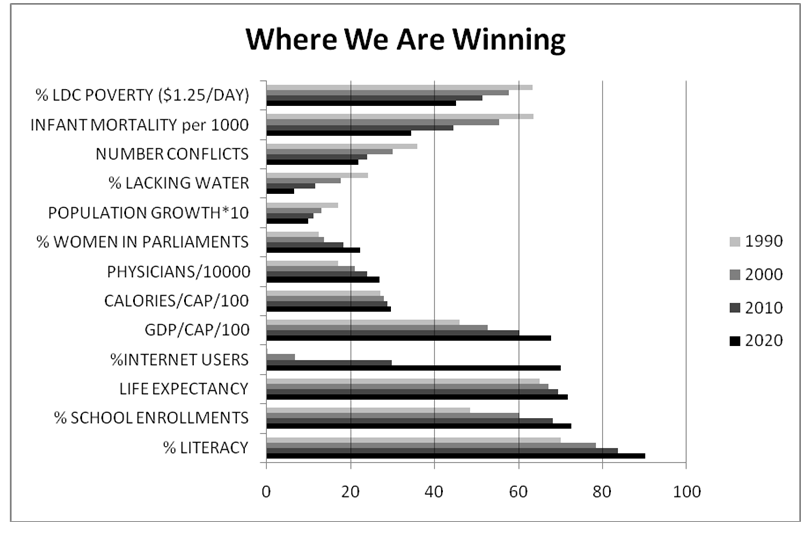
Fewer children are dying, more children are going to school, people are living longer, the world powers are at peace, and the US and Russia have signed a nuclear weapons reduction treaty. Yet the numbers of malnourished children in Africa and Asia are increasing; education is poorly preparing the next generation for a more knowledge-oriented future; aging populations will overburden the financial capability to provide retirement benefits and health care without new policies; and the sophistication and diversity of terrorism continues to proliferate. The 2010 Peace Index in the report shows that while the risk of war is declining in most areas of the world, violent crime has increased.
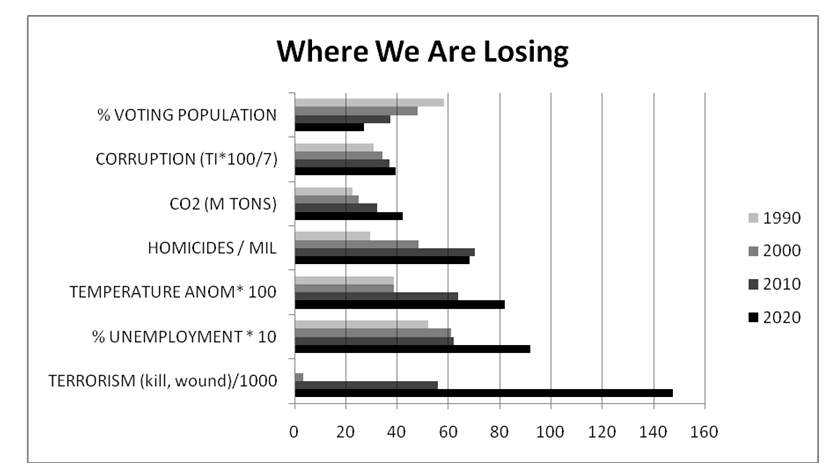
Our study has found eight specific problem areas where things are getting worse: Global Surface Temperature Anomalies, People Voting in Elections (% population of voting age for 15 largest countries), Unemployment (% of total labor force), Fossil fuel energy consumption (% of total), Levels of Corruption (15 largest countries), People killed or injured in terrorist attacks (number), and Refugee population by country or territory of asylum.
Technological solutions
On the plus side, as Ray Kurzweil has shown, the volume of change over the foreseeable future is likely to be far greater than that over the past 25 years, because the factors that made those changes are themselves accelerating (computer power, Internet bandwidth, miniaturization, global interdependence, and synthetic biology). This should change what we think is possible.
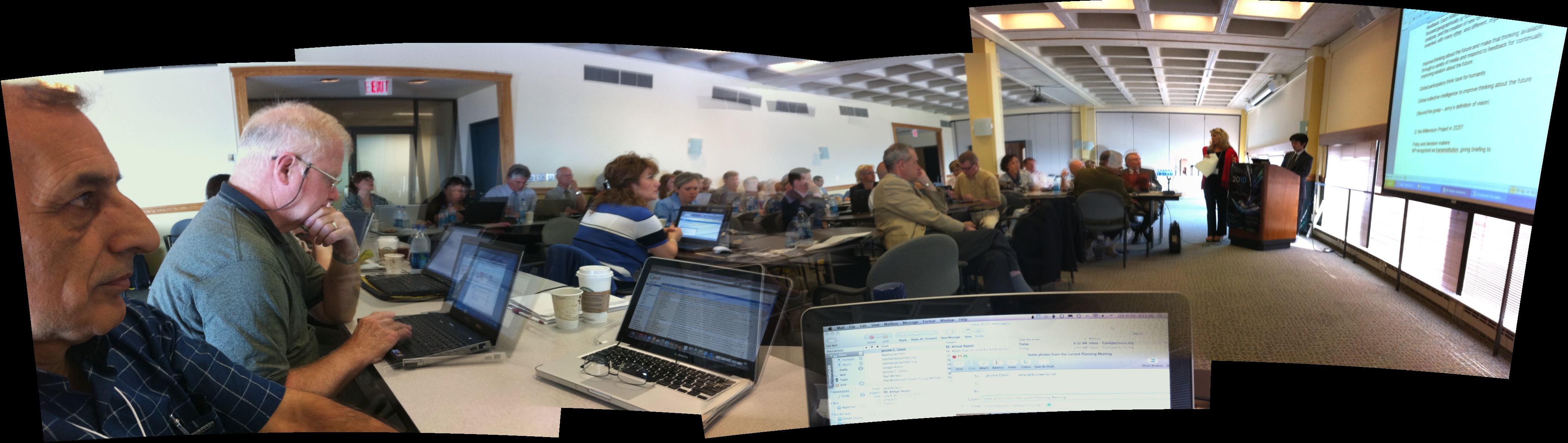
60 people from around the world attend the 2010 Planning Committee Meeting of The Millennium Project in Boston to review, research, and plan next steps
We believe properly managed biotech, infotech, nanotech, and cognotech breakthroughs currently on the drawing boards and the coming synergies among them will help get humanity through the looming environmental, economic, and social conflicts as we move toward a crowded world of about 9 billion people by the year 2050.
Ubiquitous Internet
Nearly 30% of humanity is connected to the Internet. Within five years, about half the world will have Internet access—and on mobile devices. A few years after that, it is reasonable to assume that all of humanity can be connected. The Internet has evolved from a passive information repository (Web 1.0) to a user-generated and participatory system (Web 2.0) and is morphing into Web 3.0, a more intelligent partner that has knowledge about the meaning of the information it stores and the ability to reason with that knowledge.
With 5 billion mobile phone subscriptions, falling prices for smartphones, and the built environment getting multimedia transceivers and a variety of sensors, it is reasonable to assume that the majority of the world—now urbanized—will experience ubiquitous computing and eventually spend most of its time in some form of technologically augmented reality. Meanwhile, Internet bases with wireless transmission are being constructed in remote villages; cell phones with Internet access are being designed for educational and business access by the lowest-income groups; and innovative programs are being created to connect the poorest 2 billion people to the evolving nervous system of civilization.
Collective Intelligence
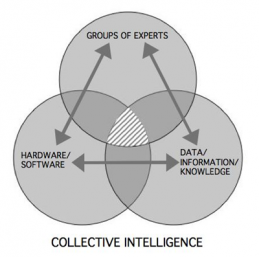
I define collective intelligence as “an emergent property from synergies among data/information/knowledge, software/hardware, and experts (those with new insight as well as recognized authorities) that continually learns from feedback to produce (nearly) just-in-time knowledge for better decisions than these elements acting alone.”
The explosion of knowledge and acceleration of change coupled with the bewildering and continuous information overload makes previous information systems for decisionmaking increasingly inadequate. One approach is to create collective intelligence systems. These are systems that facilitate the interaction and feedback among human judgments, information, and software so that each can change in realtime.
Chapter 3 of the 2010 State of the Future gives two examples: the Global Climate Change Situation Room in Gimcheon, South Korea, and the Early Warning System for the Prime Minister’s Office of the State of Kuwait.
Global Climate Change Situation Room
Synthesis
While the growth and power of the Internet continues to surprise much of the world, the syntheses among the sciences and the resulting technological breakthroughs may have even greater impacts on the human condition. Synthetic biologists forecast that as computer code is written to create software to augment human capabilities, so too genetic code will be written to create life forms to augment civilization. Computers are being constructed with the objective of developing the processing power of the human brain. The wooly mammoth’s DNA has been used to create living blood cells like those that lived in this extinct animal 43,000 years ago.
Nanotechnology-based products have grown by 25% in the last year to over 800 items today for the release of medicine in the body, thin-film photovoltaics, super-hard surfaces, and many lightweight strong objects. A global collective intelligence system is needed to track all these science and technology advances, forecast consequences, and document a range of views so that politicians and the public can understand the potential consequences of new science and technology.
Beyond technology
But technology is not enough. We need serious global policies, discussed throughout our report, that are implemented through governments, corporations, education systems, NGOs, United Nations systems and other international organizations. We also need changes in human values to be discussed within and among religions, media, entertainment, and the arts. Everyone has a part to play in the great race between the increasingly complex problems and ways to improve the prospects for civilization.
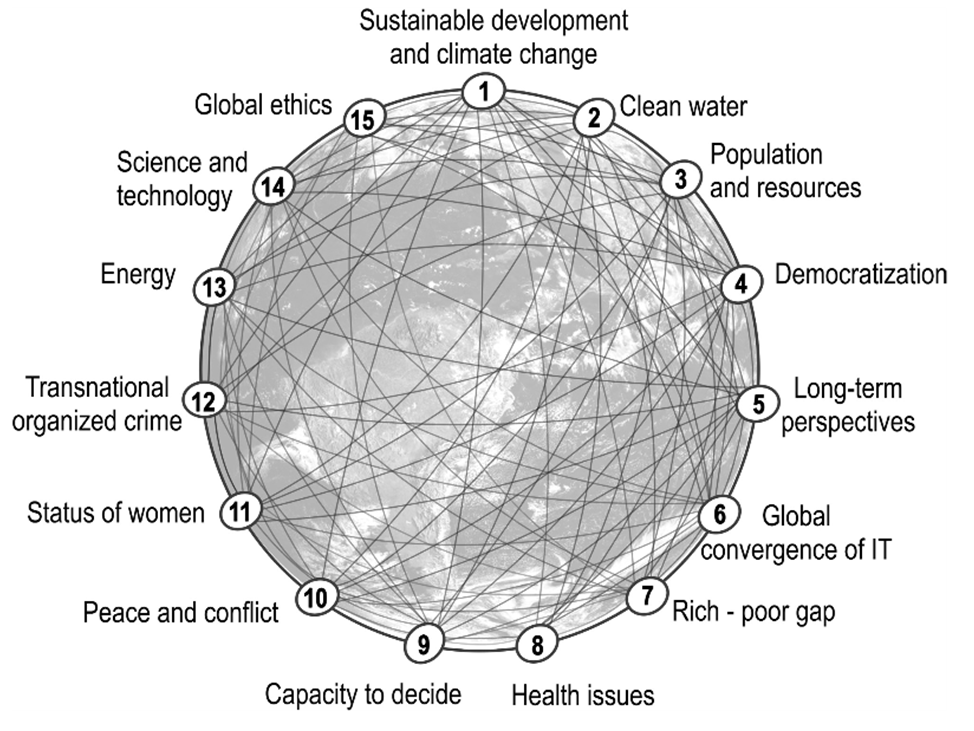
15 Global Challenges
After 14 years of the Millennium Project’s global futures research, it is still increasingly clear that the world has the resources to address its challenges. What is not clear is whether the world will make good decisions on the scale necessary to really address the global challenges.
The Millennium Project is a global think tank founded in 1996 that connects international experts in corporations, universities, NGOs, UN agencies and governments via 35 Nodes around the world in a participatory process and that explores how to build a better future. It was founded after a three-year feasibility study with the United Nations University, Smithsonian Institution, Futures Group International, and the American Council for the UNU. It publishes an annual State of the Future report, Futures Research Methodology Version 3.0, and special studies.