The world’s first 3D-printed guitar
October 12, 2012
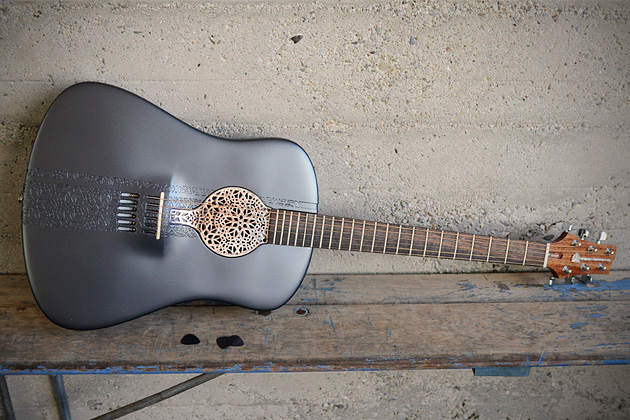
Scott Summit created a 3D model of his ideal guitar and sent the computer design to 3D Systems, which used its massive 3D printers to transform the graphic model into an actual acoustic instrument that Summit can play, Bloomberg Businessweek reports.
As far as anyone seems to know, this is the first 3D-printed guitar on the planet, and it raises all kinds musical possibilities. “It’s rich and full and has a great tonal range,” says Summit.
The model used about $3,000 worth of plastic and had a headstock 3D printed with sterling silver; the plate on the neck was 3D printed out of stainless steel.
Summit is one of the world’s leading 3D printing and design experts. He is currently designing custom body parts and stylish prosthetics that get built from 3D printers.
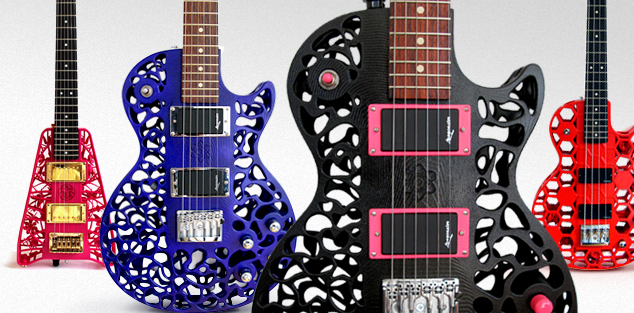
UPDATE 10/18/2012: 3D Systems announced today the exclusive availability of the first-ever line of 3D printed electric and bass guitars, designed by Olaf Diegel on Cubify. Starting today, eight unique electric and bass guitar designs including the Scarab, Atom and Spider will be available for purchase on Cubify. Professional guitarists and enthusiasts alike will be able to work directly with Diegel to customize their instrument for a personalized look and unique sound.

Comments (26)
by joy
I’m going to buy a 3D printer, print more 3D printers, sell them and become the richest man ever in the history of 3D printing.Not that I would need the money, as I would be fine in my printed house, with my printed wife and family, eating printed food.And just to be a greedy douche,I’ll also copyright the idea so no one else can do it.
by Katerine
It looks really nice, and sounds nice, but $3,000 … looks cheaper with that plastic
by GardenMusic
Check out this TED video for a plethora of DIY info on similar topics.
by Scott Summit
There are a few corrections that need to be made. Olaf Deigel (sp?) is, I believe, the first to explore the 3d printed guitar – he’s created a number of visually rich and imaginative electrics. My goal was not about being the first in the game as much as simply to explore what might be uncovered if we apply the vast versatility of 3d printing to acoustic guitars, where tonality and geometry are very much coupled. The bigger goal is to allow anyone to parametrically (not sure if that’s a real adverb) modify a guitar in its virtual state, and then print it on demand. More has to happen before this stage is ready. Indeed, the neck and fingerboard are wood – I didn’t have the time to model those, and they might not lend themselves as well to this process as the body did. This as also an experiment in changing the visual vernacular of a guitar. Since this traditionally. Showcases the beauty of natural wood, I tried to create something visually compelling, even of it was polymer instead of spruce.
by GatorALLin
thought these links were cool. http://www.nytimes.com/imagepages/2010/09/14/business/Print1.html
http://www.bespokeinnovations.com/content/what-drives-us
btw…wondering how long it will be before people start to open source the printing of limbs for folks in countries were bespoke is not an option (due to costs). I just noticed this cool articulating hand you can print for free on http://www.thingiverse.com/thing:17773 (I realize this is not hand is not for prosthetic use, but maybe there should be more free prosthetic options up there. I do appreciate there are materials not easy to print, or designs that require strength or other concerns that prove very important)
by Uri
Ink 2D printer cartridge cost $200
3D printer cartridge cost ?
by GatorALLin
You buy a spool for $48 per color….(total weight is 1 KG)
check out PLA and ABS as 2 of the leading ones used by most DIY printers. http://store.makerbot.com/filament Not counting any time involved, just the cost of the filament depends on the final size/weight of the item. Most the smaller items seem in the $5/each-$10/each ballpark.
by Carl Brooks
How were the strings made???
by GatorALLin
I bet the strings are normal guitar strings and one of the few parts that were not actually printed from a 3d printer (just a guess, but hope scott would confirm)
by Bri
As of now, there is no way to print guitar strings. They are made of special alloys, by pulling the blanks through successively smaller dies. This gives them the tensile strength needed. The first two or three are usually unwound. The bottom three or four are wound. This gives them the tonal characteristic necessary, and have the approximate same amount of tension. It’s quite a science to make them have the appropriate, tension, tone, size and volume of sound created.
by MrFriendly
That is a pretty instrument.
by Bob Vasquez
It would be really helpful to see someone (with a little talent, of course) play the 3D-guitar. The guitar sort of looks like a “finger-picking” style instrument for country western or pop music. Also, I would like to know its weight. It is a curious new toy which should be fun to explore.
by SpottedMarley
i have something unique and insightful to say about this
by Gabriel
This is unbelievable — even if you couldn’t get it to work, the achievement alone is something that should thrill people…I wish I could fastforward 30 years into the future
by Bri
I’m a woodworker and musician. I studied electronic music at Berkley School of Music. Although I only play guitar, I’ve always copied other instruments. I have many ideas for electric guitars. Soon enough they will be able to print wood facsimiles, with any tonal qualities that you could wish. Many people think that to emulate another instrument, all you have to do is synthesize the sounds. It’s far more complex than that. Each instrument modulates the tones with different techniques. All the horn instruments only have the one note at one time. They make up for this lack of complexity, by intensely modulating the sound. To accomplish this on a piano synth, they use a variety of controllers. For the guitar there are a lot of tricks I use. I would love to make an electric guitar that would register those variations and use them to drive synth components. For example, to make a stringed instrument sound, I’ll use a very worn out pick. It gets nicks in it and the tip gets rounded over. Instead of striking the strings, I’ll rub it back and forth very fast. The Rosen on a bow causes what is called a saw tooth wave form. As it grabs the strings it pulls them till all of a sudden the string releases and goes back to it’s original straight line. This happens many times a second, but if you look at the sound with an oscilloscope, you can see the ramp wave form. With the fine cuts on the pick it creates a very similiar sound. With proper sensors, the guitar could sense when I changed technique and augment the sounds to be more realistic. I have s bunch of tricks like that. I actually fooled one of my room mates into thinking there was another trumpet player echoing Miles Davis’s line. He was a real jazz schredder. He could sight read anything put in front of him. You should have seen the look on his face as he opened the door to my room. He was stammering about what tape he had given me with his eyes wide open. I had asked him for the tape because I had made a fool of myself in class. I asked who Miles Davis was! You’d be surprised what you can do with an electric or regular guitar, and I’d love to push it’s possibilities!!!
by GatorALLin
..so cool to see the top end performance of the 3d printers…. keeps us down here at the bottom that are playing with the DIY and kit 3d/home printers inspired to keep dreaming of the future of 3d printing. $3,000 does seem crazy expensive just for the materials costs… must be some new plastics or something super expensive…. maybe that cost also includes the machine time for some high end 3d printers…?? or includes his development time also? Would be cool to see the part by part list with cost per item, time to print, etc… Anyhow.. thanks for sharing this cool story. For you 3d dreamers out there, check out this new toy.
http://www.youtube.com/watch?v=WnMFfEoNW6A&feature=related
by Gorden Russell
Thanks for the link to the Makerbot youtube clip. They’re really looking good. If I win Saturday’s Powerball I’ll invest in their company.
When they get to the point where a printer can print out a copy of itself, along with printing out a robot to operate the printer, then things will really take off.
If you can get the time down to 12 hours to print a printer, and 12 hours to print a robot, then starting with a single robot and printer, they will double their numbers every day. This will give over a billion printers and robots in a month. Just check it out with your calculator. Enter one times two, then hit the “equals” button 30 times. Do this and you get the number 1,073,741,824. Yeah. I really want to invest in Makerbot.
by GatorALLin
.this panda 3d printer is up on kickstarter now, I think retail for it is in the $800 range, so 3d printers are coming way down in price. Also the software so you can use them is much easier to use and free. Also the list of free things to download and print is getting much bigger…. I say heck with investing in makerbot….just invest in yourself with coming up with your own great ideas…. as for the robot to print stuff…. that is just You hitting the print button… As for the dream of having the printer print the next machine… there are lots of parts that need metal or precision that current printers just don’t have yet, or don’t do as well… Yeah its possible, and a cool concept… fun idea for sure… but I think you still have to put the kits together..you still have to know what to printout next… (and not just printers). No robot is that good at what to invent next…they still need us for now… (grin)>
by GatorALLin
..sorry, forgot the panda links.
http://www.youtube.com/watch?v=X03AE3yliMI
http://www.kickstarter.com/projects/pandarobotics/pandabot-a-friendly-affordable-3d-printer?ref=live
by Claus Hansen
It looks like the neck and headstock was made from wood as it usual. The freats may be steel as the article says. Let us hear a sound clip.
by D Lester
It’s hard to tell from the story (and looking at the photo) it appears only a *few* of the components of the guitar were actually printed – basically just the body. Also as Gordon mentioned, how was $3,000 of plastic used? It’s a newly formulated plastic with exceptional acoustic properties made specifically for 3D printed guitars – that’s where the real breakthrough is!
by Bri
I’m a little dubious of the tonal range description. I’d like to see it’s full schemata to see how he has dealt with plastics tonal characteristics. The choice of woods is different for different areas. These pieces are tuned by thinning to achieve tonal balance. The quality of the woods used also affects it.
by Dad
Maybe a new career for SoMTs
by Gorden Russell
This is great news, but how can plastic cost so much?
by rob falgiano
My guess is it’s b/c of the way the printer lays it out in this primitive version of the hardware. Over time I’d think that cost will sink greatly.
by Chrispium
The word plastic covers an enormous range of products. Some more expensive than others.