Thinking quantitatively about technological progress
July 11, 2011 by Anders Sandberg
I have been thinking about progress a bit recently, mainly because I would like to develop a mathematical model of how brain scanning technology and computational neuroscience might develop.
Experience curves
In general, I think the most solid evidence of technological progress is Wrightean experience curves. These are well documented in economics and found everywhere: typically the cost (or time) of manufacturing per unit behaves as x^a, where a<0 (typically something like -0.1) and x is the number of units produced so far. When you make more things, you learn how to make the process better.
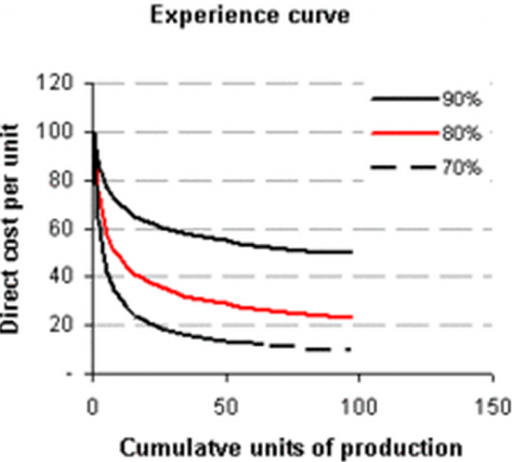
Experience curve (credit: Bruce Henderson, Boston Consulting Group)
Performance curves
On the output side, we have performance curves: how many units of something useful can we get per dollar. The Santa Fe Institute performance curve database is full of interesting evidence of things getting better/cheaper. Bela Nagy has argued that typically we see “Sahal’s Law“: exponentially increasing sales (since a tech becomes cheaper and more ubiquitous), together with exponential progress, produces Wright’s experience curves.
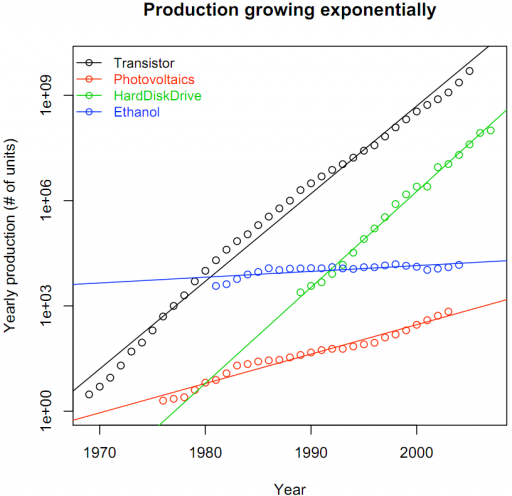
Production growing exponentially (credit: Béla Nagy, Santa Fe Institute)
One interesting problem might be that some techs are limited because of the number of units sold will eventually level off. In sales of new technology we see Bass curves: a sigmoid curve where at first a handful of early adopters get it, then more and more get it (since people copy each other this is roughly exponential) and then a leveling off as most potential buyers already got it.

Bass diffusion model of new adopters (credit: Frank M. Bass, University of Texas at Dallas)
Lots of literature on it, useless for forecasting (due to noise sensitivity in the early days). If Bela is right, this would mean that a technology obeying the Moore-Sahal-Wright relations would certainly follow a straight line in the “total units sold” vs. “cost per unit” diagram, but there would be a limit point since the total units sold eventually levels off (once you have railroads to every city, building another one will not be useful; once everybody has good enough graphics cards they will buy much fewer).
The technology stagnates, and this is not because of any fundamental physics or engineering limit. The real limit is lack of economic incentives for becoming much better.
Discontinuities
Another aspect that I find really interesting is whether a field has sudden jumps or continuous growth. Consider how many fluid dynamics calculations you can get per dollar. You have an underlying Moore’s law exponential, but discrete algorithmic improvements create big jumps as more efficient ways of calculating are discovered.
Typically, these improvements are big, a decade of Moore or so. But this mainly happens in some fields like software (chess program performance behaves like this, and I suspect — if we ever could get a good performance measure — AI does too), where a bright idea changes the process a lot. It is much more rare in fields constrained by physics (mining?) or where the tech is composed of a myriad interacting components (cars?).
Any other approaches you know of in thinking quantitatively about technological progress?
Comments (7)
by jabelar
I think you can measure replacement and obsolescence. Simply measuring sales isn’t quite right because the product definition changes — a smart phone next year is quite different than one this year.
I think the way you’d quantify it is you’d look at the sales of a very specific technology product declining and see if it is being replaced by a similar volume of a next generation device. Presumably replacement is due to something better (in any dimension of functionality, performance, cost, etc.) and therefore constitutes progress.
Looking at replacement would help clarify what is actually saturating a market (i.e. the example of railroads in your article) versus things declining due to obsolescence.
by Jake Witmer
What I think might help: plugging in as much data as possible to a Numenta / Hawkins-type brain architecture, and tell it to separate like/similar patterns (while keeping track of what is known about each pattern). I’d expect to see a large jump in mining and things attached to physical limits as well, come from better computation (much of mining is prospecting, which is bound by information laws, not so much physical capacity, once one has the economic resources), even if the jump wasn’t as large as the one regarding software capacity. Also, you’d need to drill down, and determine when a killer app was written for mining companies, etc…
Go strictly by what is able to be directly physically measured. Ask companies for raw data in units produced, and plug their data in. That’s the best way to get reliable predictions.
by RBynum
You may be interested in the book “What Technology Wants” by Kevin Kelly. In particular he discusses the drivers of technology and some of the effforts of others to project the path of technological progress.
I thnik it its interesting to note the rapid decrease in the cost of DNA sequencing, lab on a chip diagnostic devices, progress in electronic records keeping and patient monitioring. What could this technological path lead to in the near future?
by RBynum
Many advances result from a cross polination beween multiple lines of techonology advances. This would be simlar to genetic selection and mutations. The fitness selection process is through the economic/cultural forces. So what we desire to have and what we can afford to produce and sell at a profit determines the direction of techological progress.
Consider the current desire for affordable green energy and advances in solar cell efficency, battery storage improvements, and electric smart grids. These drivers are moving techology forward in one direction. While biofuels are being driven by advances in genetic studies of cellular organisms, synthetic life, and bioreactor designs are driving energy technology in another direction.
To predict technological progress you need multiple future experience/ cost curves for various tecnology lines and some polling of desirable future features. When the experience/cost lines meet the desirable future features at a reasonable time in the future (say 5 years from now) you will have a movement towards that technology point and a convergence of the technolgy lines needed to acheive that point.
by jaknight89
Diminishing marginal utility is that factor that causes the technological trend to reach a limit point and fall. I think we need a reconstruction of multiple facets of our culture to create economic incentive for improved technological advancement.
by gillammi
Quantifying the Frequency of Disruptive Technologies is something I have yet to see done. For example, railroads in every city may saturate, but the cost of movement continues to decrease and the breadth of places to travel increases from innovation from other transport mediums – ships, cars, buses, trucks, planes. The replacement of hard drives with flash memory is an example from Clayton Christiansen. These punctuated disruptions must occur to create the step-wise stack of sigmoidal curves. The question is whether this step-wise stack is predictable. Can we predict the rough moment when disruption is expected?
Another principle to quantify is the impact of Product Upgrades. For example, though the world may saturate itself with the iPhone 4 – customers may upgrade to the iPhone 5 whether needed or not. What is the quantitative role in sales of replacements & upgrades?
by Khannea Suntzu
Now that’s interesting – you are trying to model progress as a diffuse, holistic, abstract (algorithmic) mechanisms. If you can do that you can also adjust for the same diffuse, holistic, abstract (algorithmic) detractors to progress. There are quite a few, and I am sure you, me, and your side kick could both come up with a list. Peak Oil, Climatic disturbance and Disparity are a few that would be modelacious.
Even better, if you use the world quantitative you miught also be able to model a deep field, where you can depict outcomes (ranging from utopian to desirable to dystopian and hellish) in a graph. I.e. depict policies and choices in a nice visualization. Kinda Asimovian, right?
People respond out of bounds to visualizations and pretty pictures. If you are able to spur on/create a visualization tool with colors and timelines and signposts and critical transition moments, you can rub that same thing in the face of our beloved policy makers.
Might even change their more flawed policies a little.