Three radical new energy technologies
November 21, 2012
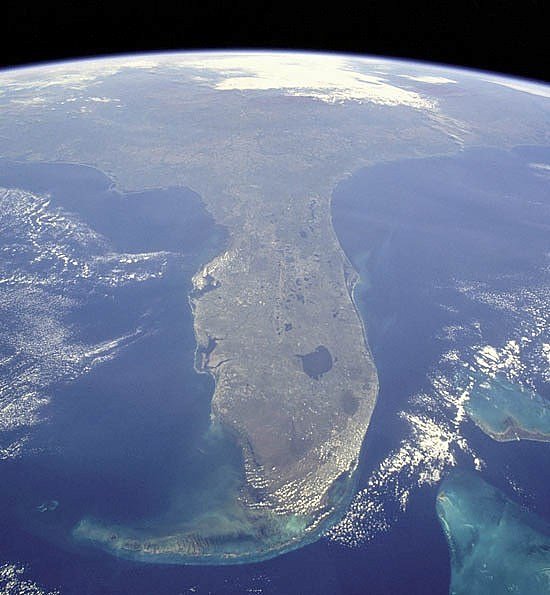
(Credit: NASA)
Three innovative new energy technologies are explored in the current issue of Technology and Innovation — Proceedings of the National Academy of Inventors:
- Tidal currents and ocean waves that can be recovered using ocean thermal conversion technology.
- Infrared thermal radiation (more than half of the power provided by the Sun).
- A new nanophosphor-based electroluminesence lighting device that caters to the exact wavelengths of light required for photosynthesis in indoor, hydroponic agriculture.
Capturing ocean energy
The kinetic energy in the Florida Current and in Florida’s ocean waves can be captured and used, said Howard P. Hanson of the Southeast National Marine Renewable Energy Center at Florida Atlantic University.
“Capturing the kinetic energy of the Florida Current will require both materials advances and new designs for marine current turbines and their efficient deployment,” he said. “The hydrokinetic energy of tidal and open-currents, as well as ocean waves, and the thermal potential of the oceanic stratification, can be recovered using ocean thermal conversion technology.”
Hanson calls this concept “marine renewable energy,” or MRE, and noted in his article that the U.S. Department of Energy has formed three national MRE centers to investigate the resource potential in the oceans and to advance the technology for recovering MRE.
Nanoscale “rectennas” can convert waste thermal energy to electricity
“Converting waste heat to electrical energy can be a reality by using a rectenna, a combination of high frequency antenna and a tunnel diode,” wrote three clean energy engineers from the University of South Florida’s Clean Energy Resource Center.
According to article co-author Yogi Goswami, thermal radiation, or the infrared (IR) portion of the electromagnetic spectrum, is often an overlooked source of renewable energy and more than half of the power provided by the sun — both directed and re-radiated — lies in the infrared part of the spectrum.
“If the IR radiation potential of the earth could be harvested with 75 percent efficiency, it would generate more energy per unit area than a fixed orientation solar cell located in a prime solar location,” said study co-author Subramanian Krishnan.
Rectenna components (antenna and rectifier) used to recapture wasted IR radiation is developed from the decades old concept of using the wave nature of light rather than its thermal effect. Recent advances in nanotechnology have made possible the harvesting of solar energy by rectenna more viable, they said. Recent research has shown that rectenna can be developed at IR frequencies with existing technology and used for IR energy conversion.
Nanotechnology solutions for greenhouse light
Sarath Witanachchi, Marek Merlak and Prasanna Mahawela, of the USF Department of Physics, present the specifics for a new nanophosphor-based electroluminesence lighting device that caters to the exact wavelengths of light required for photosynthesis in indoor, hydroponic agriculture. The new, nanotechnology-based grow light also has the potential to reduce energy costs significantly.
“Conventional technologies used in today’s agriculture are inefficient and lead to natural resource waste and degrade the environment,” said Witanachchi. “Urban agriculture will become the choice in the future. Nanophosphors required to fabricate the active layer of the electroluminescence device are grown by a microwave plasma process, which was developed at the University of South Florida. This process enables the growth of crystalline nanophosphors directly on a substrate as a uniform coating without further processing steps.”
References:
- Howard P. Hanson, Hydrokinetic Energy in the Sunshine State: Challenges of Florida’s Unique Renewable Resource, Technology and Innovation, 2012, DOI: 10.3727/194982412X13462021397615
- S. Krishnan, Y. Goswami, and E. Stefanakos, Nanoscale Rectenna for Thermal Energy Conversion to Electricity, Technology and Innovation, 2012, DOI: 10.3727/194982412X13462021397651
- Sarath Witanachchi, Marek Merlak, and Prasanna Mahawela, Nanotechnology Solutions to Greenhouse and Urban Agriculture, Technology and Innovation, 2012, DOI: 10.3727/194982412X13462021398056
Comments (11)
by Dan Robinson
And another ocean-based possibility, use the heat and high pressure around at least some deep ocean volcanic vents for energy, while also capturing the CO2 they produce, without necessarily harming lifeforms around the vents.
by grettir76
You better leave the gulf stream alone! My small country would freeze to death without it!!
But a nice mix of hydro, solar, geothermal, wind and tidal should be an optimal option when possible.
by GatorALLin
….just wondering… if you had a device that would convert heat in the ocean’s to electricity, then would it cool the oceans and thus likely create some other problems? Or change currents so drastically that it causes a problem ? I guess there is no concern now that a few thousand windmills will change the air-stream and create some unknown problem down the road… Just wondering…?
by graham caldwell
farmers in scotland could use the greenhouse light and cver thier fields with poly tunnels , no more crop failures due to bad weather.
by Gorden Russell
“Converting waste heat to electrical energy can be a reality by using a rectenna, a combination of high frequency antenna and a tunnel diode,”
Those little plutonium reactors, like the one that powers NASA’s Curiosity rover on Mars, could use these to be more efficient. You’re going to need a reactor to power those grow-lights during the long Lunar night.
Of course, to grow crops on the Moon, you’re going to need to send robots out prospecting for carbon and nitrogen, but those elements are up there, though they are scarce.
by Gorden Russell
“A new nanophosphor-based electroluminesence lighting device that caters to the exact wavelengths of light required for photosynthesis in indoor, hydroponic agriculture.”
This is just what you need to grow crops on the moon. Sure, the days are always bright and sunny, but the nights are two weeks long.
by Bri
IR capture would be ideal for server farms. They could recover all that wasted heat..
by Bri
Every drop of energy that the ocean currents use to circulate arm ocean water affects local temperatures elsewhere. Although this might help reduce the effects of global warming, it will affect it in locally different ways. It could have unwanted side effects. It really depends on how much energy is taken out of the system and where.
by Editor
Good point. I’d like to understand that better.
by Timothy
The total energy in a given ocean current would be several orders of magnitude larger than anything we could possibly extract from it. A very large turbine farm might be 100 meters wide and 10 meters tall, and would extract only a portion of the energy from the current impinging on it.
From Wikipedia: “The Gulf Stream is typically 100 kilometres (62 mi) wide and 800 metres (2,600 ft) to 1,200 metres (3,900 ft) deep–flow is 30 million cubic meters per second”. By comparison all the rivers that flow into the Atlantic combined run at 0.6 million CMS. It’s like being concerned about the cooling effect of solar cells because of the shadow they cast–it’s infinitesimal compared to what reaches the earth.
by Dennis R.
I have to echo Bri’s caution on this. These types of things always start small, and the supplies are always limitless. And their will need to be some types of structures for housing the tech that harvests all that energy– possibly leading to greater erosion and impacts on the local ecosystems. Better solar that can be implemented locally and on a small scale could have a smaller impact. Big projects mean big expenditures and require higher returns to justify the investment. Cheap energy becomes less cheap once infrastructure is built.