Tongue-tingling interface lets you taste data
February 18, 2013
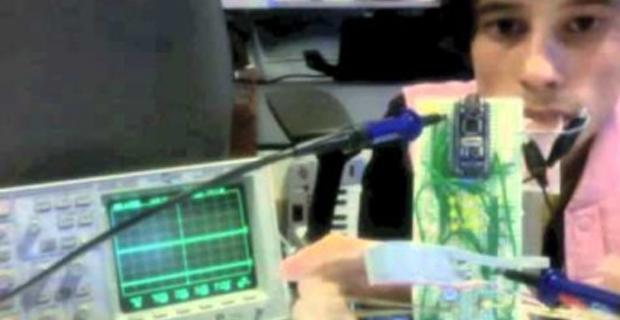
Tongueduino (credit: Gershon Dublon, Joseph A. Paradiso)
Gershon Dublon of the Massachusetts Institute of Technology has devised the Tongueduino — a small pad containing electrodes in a 5 × 5 grid, New Scientist reports.
When hooked up to an electronic sensor, the pad converts signals from the sensor into small pulses of electric current across the grid, which the tongue “reads” as a pattern of tingles.
If Tongueduino (tongue + Arduino) is attached to a sensor that detects Earth’s magnetic field, users can learn to use their tongue as a compass.
Blair MacIntyre at the Georgia Institute of Technology in Atlanta says a wireless version of Tongueduino could prove useful in augmented reality applications that deliver information to users inconspicuously, without interfering with their vision or hearing.