Transparent solar cells for windows that generate electricity
July 23, 2012
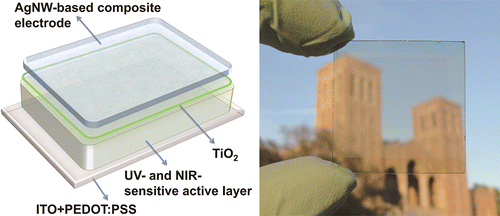
High-performance, visibly transparent polymer solar cells fabricated via solution processing. The photoactive layer of these visibly transparent polymer solar cells harvests solar energy from the near-infrared region while being less sensitive to visible photons. The top transparent electrode employs a highly transparent silver nanowire-metal oxide composite conducting film, which is coated through mild solution processes. (Credit: Chun-Chao Chen at al./ACS Nano)
Researchers from UCLA and California NanoSystems Institute have developed a new transparent solar cell, giving windows in homes and other buildings the ability to generate electricity.
This new kind of polymer solar cell (PSC) produces energy by absorbing more near-infrared light but is less sensitive to visible light, making the cells nearly 70% transparent to the human eye. They use a near-infrared light-sensitive polymer and silver nanowire composite films as the top transparent electrode.
“These results open the potential for visibly transparent polymer solar cells as add-on components of portable electronics, smart windows and building-integrated photovoltaics and in other applications,” said study leader Yang Yang, a UCLA professor of materials science and engineering, who also is director of the Nano Renewable Energy Center at California NanoSystems Institute (CNSI).
Yang, who is also the holder of the Carol and Lawrence E. Tannas, Jr., Endowed Chair in Engineering, added that there has been intense world-wide interest in polymer solar cells. “Our new PSCs are made from plastic-like materials and are lightweight and flexible,” he said. “More importantly, they can be produced in high volume at low cost.”
Polymer solar cells have attracted great attention due to their advantages over competing solar cell technologies. Scientists have also been intensely investigating PSCs for their potential in making unique advances for broader applications. Several such applications would be enabled by high-performance visibly transparent photovoltaic (PV) devices, including building-integrated photovoltaics and integrated PV chargers for portable electronics.
Previously, many attempts have been made toward demonstrating visibly transparent or semitransparent PSCs. However, these demonstrations often result in low visible light transparency and/or low device efficiency because suitable polymeric PV materials and efficient transparent conductors were not well deployed in device design and fabrication.
Another breakthrough is the transparent conductor made of a mixture of silver nanowire and titanium dioxide nanoparticles, which was able to replace the opaque metal electrode used in the past. This composite electrode also allows the solar cells to be fabricated economically by solution processing. With this combination, 4% power-conversion efficiency for solution-processed and visibly transparent polymer solar cells has been achieved.
“We are excited by this new invention on transparent solar cells, which applied our recent advances in transparent conducting windows (also published in ACS Nano) to fabricate these devices,” said Paul S.Weiss, CNSI director and Fred Kavli Chair in NanoSystems Sciences.
The study was supported by the Henry Samueli School of Engineering and Applied Science, the Office of Naval Research, and The Kavli Foundation.
Comments (14)
by Tom
Great, now we just need a way to paint it onto existing windows and walls and cars and other surfaces, at a tenth of the cost of current solar-power technologies, and all the worlds problems will be solved!
Seriously, though, it would be rather cool.
by Bri
When manufacturing gets closer to nano scale, these advances will have more benefit. It will be far more cost effective, and far more efficient. Right now it’s like a salmon trying to swim up stream, trying to compete for market.
by josdorpjossie
In order to meet the Dutch energy regulations I have special glass in my windows that heat my house (=let the infra red pass through) better than regular double glass. That combined with the fact that most houses have plenty of room on the roof makes this invention mostly useless.
Maybe it is useful on high buildings in really hot countries.
by Mark
I can empathize with your viewpoint and it might not be the breakthrough we need at this point. However it is valuable in at least on major sense.
People want their homes, businesses, and communities to look a certain way. Someday maybe that vision will include solar panels but right now they often don’t fit in. Just like a tie can look great with the right outfit but you wouldn’t wear it with your bathing suit solar panels fit on some buildings and not others in the aesthetic sense.
If they were transparent they could coat billboards, cars, windows, street signs, poles, walls, and still also cover roofs without significantly changing the appearance of the surface. This scores solar panels a lot of ‘sexy’ points that could make the difference when they hit grid parity between solar being just another option and it catching like wildfire.
by Bri
Like the emperors new clothes, you see through there false arguments, as they try to make a quick buck
by pedantic fkwt
there, their, they’re.
Three words that sound the same, but have different meanings. I cannot stress how important it is to learn the difference between them.
by Mark
I’m really not sure what your point here is. Do you mind elaborating?
by George
Mark, were you not distracted a bit in reading Bri’s misuse of “there” when meaning “their”? She probably just mistyped her reply; but that was what pedantic fkwt was commenting on.
by Andrew
Placement of solar panels has not been the problem. There is plenty of rooftop area and unused land available for placing solar panels. The problem that needs to be solved is $/kW. Until solar panels can compete with fossil fuels economically, they will be a niche product.
by Anthony
The very first car was so expensive that most people could not afford it. This is true of all new technologies. When more items are made in mass the price falls. This is what is known as “economy of scale.” $/kW is not a static ratio – it is dynamic. As more of an item is made, the cheaper each unit becomes.
by GatorALLin
Love to hear more details about the cost per square foot and the possible future release date to the marketplace. So much of these solar powered options seem exciting and then you hear that they cost so much that you don’t get your investment back for 10+ years or the amount of fossil fuels that go into making them are more than the power they save/create. Plants are about 11% efficient, so I would love it if there could be some published standards that lets us truly understand the costs and efficiency of these solar powered options. In no way do I want to sound like I am complaining, I just want some universal info that everyone can easily understand about where the rubber meets the road. I think we all want to switch over and be more efficient, etc…but hard also to clear away some of the bogus hype that has often come with solar or wind power promises in the recent past.
In summary I am just asking for more transparency for a product that ironically is sold to us as being transparent (grin).
by snake0
I second this, even if it would take 5+ years to get back my investment, it would feel very liberating to take myself off the grid (to some extent). Solar power seems to have progressed in leaps and bounds but it seems the main bottleneck may be in battery tech.
Speaking of which, I wonder why there hasn’t been any articles related to the Next Generation Battery conference that was held a few days ago. (I only saw one article on Lithium-Air so far). Kind of disappointing.
by Gorden Russell
This is great news. I’ve always wanted to live in a geodesic dome. This could allow it to power itself.
by Sherrie
Can these be applied to existing windows and how are they wired into the energy grid at the location?