Turning off the stem-cell aging switch
May 24, 2012
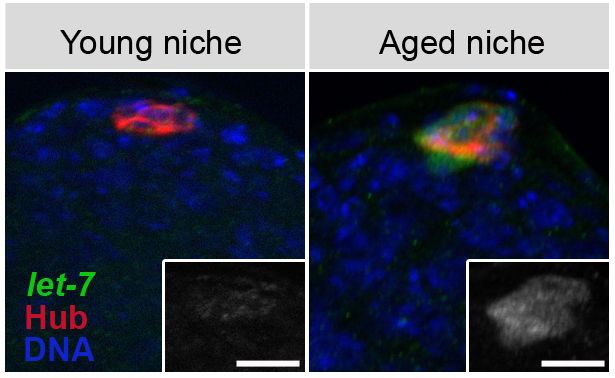
These fluorescent microscope images of testes from young (left) and old (right) fruit flies show the effect of aging on the stem cell niche. The hub cells (red) that function as part of the stem cells' supporting niche express more of a microRNA known as let-7 (green) in aged flies, which changes the signaling properties of hub cells, leading to fewer stem cells surrounding the hub that are available for tissue maintenance. (Credit: Salk Institute for Biological Studies)
Researchers at the Salk Institute for Biological Studies have uncovered a series of biological events that implicate stem cells’ “niche” (surroundings) as the culprit in loss of stem cells due to aging.
Their findings have implications for treatment of age-related diseases and for the effectiveness of regenerative medicine.
Stem cells are essential building blocks for all organisms, from plants to humans. They can divide and renew themselves throughout life, differentiating into the specialized tissues needed during development, as well as cells necessary to repair adult tissue.
So because they recreate themselves and regenerate tissues throughout a person’s lifetime, they can be considered “immortal.” But that doesn’t mean they don’t age. They do, gradually losing their ability to effectively maintain tissues and organs.
Stem cells reside within a microenvironment of other cells — the niche — that is known to play a role in stem cell function. For example, after a tissue is injured, the niche signals to stem cells to form new tissue. It is believed that stem cells and their niche send signals to each other to help maintain their potency over a lifetime.
“The findings suggest, for example, that putting new or young stem cells into an old environment—that of an aged patient—might not lead to the best outcome in tissue regeneration,” says the study’s senior investigator, Leanne Jones, associate professor in Salk’s Laboratory of Genetics.
Lost signals: increased let-7 mRNA —> less Udp —> decreased stem cells
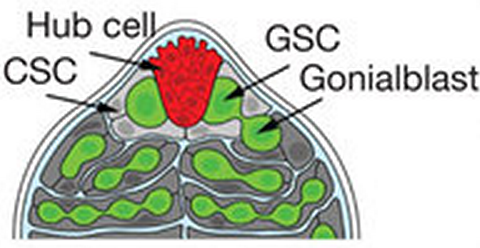
The stem-cell niche in the Drosophila testis is located at the apical tip, where both germline stem cells (GSCs) and somatic cyst stem cells (CSCs) are in direct contact with protective hub cells. Aging results in progressive decrease in levels of the self-renewal factor Upd, expressed in hub cells. Expression of upd in hub cells was sufficient to block the age-related loss of GSC.
But while the loss of tissue and organ function during aging has been attributed to decreases in stem cell function, it has been unclear how this decline occurs.
Jones’ lab has been investigating a number of possible scenarios, such as whether the loss of tissue function is due to a decrease in the number of stem cells, to the inability of stem cells to respond to signals from their niche, or to reduced signaling from the niche.
To explore stem cell aging, Jones uses cells found in the testes of the male fruit fly, Drosophila melanogaster, which are remarkably similar to those found in humans.
The researchers show how signals from the niche that act to maintain the vitality of the flies’ stem cells are lost over time, leading to a decline in the number of stem cells available to maintain the tissue. They also show that restoring those signals revitalizes the cells.
“Stem cell behavior is similar between flies and humans, so our findings have major implications for breakthroughs in using tissue stem cells to treat age-related tissue decline or regeneration after an injury,” says one of the paper’s first authors, Hila Toledano, a former Salk investigator who is now at the University of Haifa in Israel.
The Salk researchers discovered that as the stem cell niche ages, the cells produce a microRNA (a molecule that plays a negative role in the production of proteins from RNA) known as let-7. This microRNA is known to exist in a number of species, including humans, and helps time events that occur during development.
This increase in let-7 leads to a domino effect that flips a switch on aging by influencing a protein known as Imp, whose function is to protect another molecule, Upd, which is secreted from a key area of the niche.
In short, Upd promotes the signaling that keeps stem cells active and in contact with the niche so that they can self-renew. And as aging advances, increasing expression of let-7 ultimately leads to lower Upd levels, decreasing the number of active stem cells in the niche. What leads to accumulation of let-7 in the niche of aged flies still remains an open question.
Stopping age-related loss of stem cells
The researchers also demonstrated they could reverse this age-related loss of stem cells by increasing expression of Imp. “We turned the aging switch off,” says Jones.
This antidote to aging might be accomplished in a number of ways, such as by preventing let-7 from being elevated, blocking the destruction of Upd or increase the expression of Imp. “This research opens new avenues for drug development aimed at stimulating a patient’s own stem cells to overcome the consequences of aging,” says Toledano.
Jones says the study uncovered a mechanism by which a niche can lose its supportive function and demonstrates this can be reversed. “In patients, this could include co-transplantation of components of the niche itself, or rejuvenation of the niche using drug therapy to support the transplanted stem cells,” says Jones.
Co-authors include Cecilia D’Alterio, from the Laboratory of Genetics at Salk, Benjamin Czech, from the Howard Hughes Medical Institute and Cold Spring Harbor Laboratory, and Erel Levine, from Harvard University.
Ref.: Hila Toledano, Cecilia D’Alterio, Benjamin Czech, Erel Levine, D. Leanne Jones, The let-7–Imp axis regulates ageing of the Drosophila testis stem-cell niche, Nature, 2012, DOI: 10.1038/nature11061
Comments (14)
by Daniel Adams
Peter Simmons, I like what you have to say and you bring a fresh perspective. If you’re interested in becoming a blogger for my site (SlashDot.com), send me an email at slashdotjobs (at) gmail.com, or come to the site, visit my profile (Daniel Adams) sign up and send me a PM.
by Katherine MacLean (old science fiction writer and research fan
reply to gaoptimize. The very high cost of medicare for the aging is mostly a long term scam put on by the pill manufacturers to suppress any cheap answers to the most painful diseases so the families of people suffering from the side effects of the expensive treatments are moved by their suffering to pay for their hugely expensive treatments, Positive feed back in the precise meaning always increases its own cause. THe medical establishment is paid by the treatment, aka paid by the disease itself. feedback tends to support and increase the most painful and costly diseases of aging. Active, long lived people are not usually found taking pills and radiation. Statistics on the result of treatments are fuddled by being mixed with other causes and effects and selection of patients as subjects. Putting it as clearly as possible, through all the gaudy optimistic advertising by manufacturers of pills and treatments and lack of effective reporting of results from follow up of patient histories, there seems to be a reverse correlation. between cost and result. The more expensive the treatment the less effective the treatment. And the reverse A prolonged life is not a disabled old age withprolonged treatment in hospitals It is a prolonged youth activity and variety of skills and experiences and friends career choices and company productivea healthy life extension is old age is not costly it is prolonged youth.Even now unbiased statistics of corporation employees show that older workers are more effective and take fewer days off Retirement ia uaually by forced layoff and failure of the factory itself The reason for retirement is often boredom with the job and not enough time on vacations to find alternative activities, Specialization and long hours are boring and golf is very boring. Being a lab rat in a cage is boring. Being n a hospital is boring. The study of the causes of death in hospitals puts mis-diagnosis and error near the top of the list Even in or out of hospitals study of the results of treatments should include boredom. and inactivity as a major cause. of death complicating all the other causes Only overworked workers with not enough time off can be sold the dream that they want to lie on a sand beach or walk around on an endless lawn alone chasing a small golf ball with humiliating failure to hit it like the world champion on TV not even a dog for company to fetch the ball back for you . with not even trees for shade. .
by Dan Foley
A post inspired by this story: http://wfnt.com/why-fruit-fly-testes-matter-and-not-just-to-lady-fruit-flies/
by egore
I wonder what would happen if somehow we were able to grow younger, and ended up all growing too young to learn anything?
by Peter Simmons
We already have an answer to ageing, it’s called procreation. What is it with you cult devotee believers? Selfish to a [wo]man you want it all forever, so future generations can go away? Apart from the distance between humans and fruit flies making it unlikely in the near future, your fear of death needs addressing, not pushing away with a fantasy belief. That’s religion you know. The appeal of religion and it’s proponents has always been the fear of death, of not being, which some egos just can’t handle. But it won’t change anything; you WILL all die, just like me and everyone. Belief in ‘the singularity’ is the same as belief in ‘the saviour’ the prophet’ or just god.
by Griffin Stiles
Look. My opinion is that if you don’t want to live an extended or indefinite life, don’t. Feel free to naysay all you wish and live a normal hearty lifespan but leave those who believe in and wish to take advantage of quantifiable scientific advancement to their own devices, yes?
by Not Religion
Peter; except that in religion there is no explanation for how you ‘wont die’, its just stated as an axiom, “you won’t die”. The difference here is that this contains an actual scientific explanation – a mechanical if you will, description of the process by which preventing of delaying aging can occurr in humans. Think of it just as you would getting a shot of penicillin to prevent an infection. Its simply the mechanics of health – not religion or mumbo jumbo.
by Phil Osborn
I’ve wondered occasionaly about the social implications of a society in which it might be possible to live indefinitely, so long as one can pay for the upgrades, therapies, supplements, replacements, etc. It might come down to a choice for a lot of people to keep working – often at a lower-waged job, due to aging deficits in performance and out-of-date skills – in order to pay for the meds to keep living… Actually, some people are there already, of course, but I’m talking about people who are not sick, apart from wearing out.
The scarier option would be for the state to come in and regulate the options in the name of fairness, meaning that perhaps the really hot advances would never be financed, due to the state-imposed lid on medical costs. Fueling that, one could imagine a society in which some people can afford options such as individualized therapies based on intensive DNA/RNA modeling, taking into account the metagenetics involved with individual biospecs, a process that might involve thousands of dollars of computer analysis and intelligent human-judgement – perhaps a lot more – to yeild worthwhile results. A few people could afford to acheive major age reversals, which might not make the masses on the other end of a perhaps poorer economy particularly pleased.
A key here might be a focus on changing the perspective of today’s kids, who have heard a lot of gloom and doom and how capitalism and science are destroying a mythical Eden. If they saw the possibilities of positive progress and saw themselves as participating, then that might defuse a potential problem at the start.
On that note, I recommend a book by the man who invented the term “singularity” as applied to human progress, Vernor Vinge. The book is “Rainbows End” which does a remarkably good job of picturing a near-term future in awesomely great detail. Not everything in the RE world is utopian, but there is genuine objectively-based hope, and it provides a concrete model to refer to. Perhaps even better, since RE won the Hugo Award in 2007, several of the technical predictions in the book have come to pass or are well on their way – the Google Car and Google Glasses, just for a couple…
In a different vein altogether, I recall in the ’70′s almost literally stumbling accross a collection of papers by an Italian medical researcher in the 1930′s, who claimed to have demonstrated that cells in the body organized and communicated with each other using pulses of very low level visable light. I did nothing to follow up on this and don’t even know if I still have the papers, which included a number of photomicrographs allegedly demostrating this effect. Probably nothing there, but I am curious if there has been anything further published along this line.
by Editor
Phil: “the man who invented the term ‘singularity’ as applied to human progress” was actually Stanislaw Ulam in 1958, as noted in “Tribute to John von Neumann”. Bulletin of the American Mathematical Society 64 (3, part 2): 1–49. Vinge’s coinage of “technological Singularity” was actually in his 1993 essay “The Coming Technological Singularity” (not in Rainbow’s End).
by Phil Osborn
I think we are both partially correct here. The way the wiki on the subject reads does not make it clear, referring to the 1993 Vinge essay up front, but then discussing his implicit use in the “Marooned In Realtime” ~trilogy (Two novels and a novella) but without ever definitively stating that he used the term as such.
(I consider the novel “Marooned…” itself to perhaps be the best SF novel ever written, BTW.)
However, in answer to your claim, I recall explaining the singularity to people in the mid-80′s, using that term as such, borrowing it from a forward or afterward to the Peace War which I think was only published in one edition. There were the separate novels and novella – “The Ungoverned” – and then there was a single book which was a trilogy in one edition but dropped the “Ungoverned” in another edition. I believe the divide was between the hardback and paperback editions, but in any case, in one of them Vinge explicitly discusses his use of the bobbles as a way to slow down the approach to the singularity. He made them up on the belief that we would never last long enough as mere homo-sapiens for his – or any other actually realistic hard sf – novel to work. Hard science dictates the singularity and that ends any realistic portrayal past that point.
Like an ant trying to write a novel about a human, Vinge introduced the bobbles in the Marooned series and the “zones of thought” in his later work, “A Fire Upon the Deep,” “A Deepness in the Sky,” and the recent “Children of the Sky,” all of which are written from the same explicit introduction of artificial barriers to the Singularity. You cited 1993, but even “A Fire Upon the Deep” is listed in the wiki as 1992, while the Peace War is 1984.
Thanks very much for the Ulam reference. BTW, rereading my earlier post again, I don’t see that I ever claimed that Vinge’s use of the term started with “Rainbows End.” I’m trying to recall if he used it at all, in fact – at least explicitly, in RE. Implicitly, it’s all over the place, and one of the central characters may be the first of our inheritors.
In Marooned, to illustrate how deeply the Singularity is woven into the novel, there is a charcter who survives from the Peace War, somehow, by accident, finds herself on the other side of the Singulary, essentially alone, and decides to use the leftover scraps of near-Singularity tech lieing about in the wreckage to further enhance herself, and then go a viking to nearby star systems, having all the time in the world. At one “landing” she instantly finds herself in a war with the non-sentient (but very smart) guards of a previous non-human civilization from eons past, and spends the next 50,000 years in a tooth and nail struggle – ultimately defeating them, all to illustrate the fact that the disjunction of the Singularity from our own primitive world of today is more extreme than we can even imagine.
by Chrispium
They don’t add stem cells from another drosophila, instead they prevent the individual drosophilas stem cells from aging.
by GatorALLin
…so when can they get a fruit fly to live forever…. just by putting in more Stem Cells from other fruit flies…
by egore
What is considered to be immortal Stem Cells, as I understand it, is Cancerous cells.
This research certainly sounds encouraging.
by gaoptimize
This is great news! That “Nature” published it is potentially even more important. Soon, the policy makers are going to reallize that the economic losses from aging, given current demographics (while bad in the West and Japan, just wait for 1-child China’s disaster) are unaffordable. Now, the realization that it is avoidable will we dawning on them. Anyone with common sense and aware of the acturarial realities and trends for Social Security and Medicare knows they are going to work until the drop anyway.