Under the skin, a tiny blood-testing laboratory
March 20, 2013
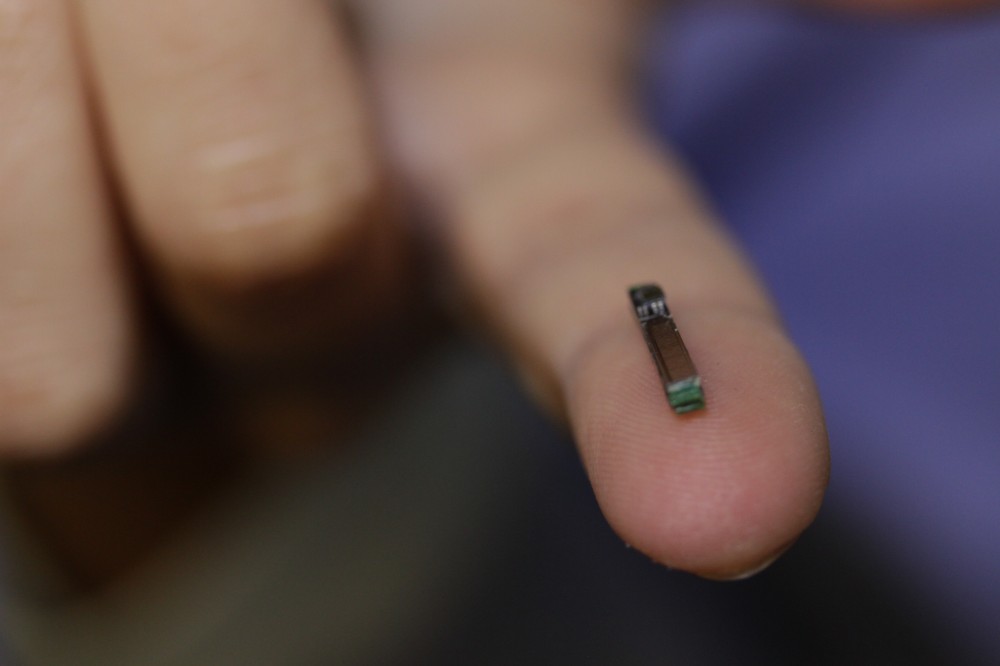
(credit: EPFL)
EPFL scientists have developed a tiny, portable personal blood testing laboratory: a minuscule device implanted just under the skin provides an immediate analysis of substances in the body, and a radio module transmits the results to a doctor over the cellular phone network.
This feat of miniaturization has many potential applications, including monitoring patients undergoing chemotherapy.
Humans are veritable chemical factories — we manufacture thousands of substances and transport them, via our blood, throughout our bodies. Some of these substances can be used as indicators of our health status.
A team of EPFL scientists has developed a tiny device that can analyze the concentration of these substances in the blood. Implanted just beneath the skin, it can detect up to five proteins and organic acids simultaneously, and then transmit the results directly to a doctor’s computer.
This method will allow a much more personalized level of care than traditional blood tests can provide. Health care providers will be better able to monitor patients, particularly those with chronic illness or those undergoing chemotherapy. The prototype, still in the experimental stages, has demonstrated that it can reliably detect several commonly traced substances. The research results will be published and presented March 20, 2013 in Europe’s largest electronics conference, DATE 13.
Three cubic millimeters of technology
The device was developed by a team led by EPFL scientists Giovanni de Micheli and Sandro Carrara. The implant is only a few cubic millimeters in volume but includes five sensors, a radio transmitter and a power delivery system. Outside the body, a battery patch provides 1/10 watt of power, inductively coupled through the patient’s skin — no need to operate every time the battery needs changing.
Information is routed through a series of stages, from the patient’s body to the doctor’s computer screen. The implant emits radio waves over a safe frequency. The patch collects the data and transmits them via Bluetooth to a mobile phone, which then sends them to the doctor over the cellular network.
A system that can detect numerous substances
To capture the targeted substance in the body – such as lactate, glucose, or ATP – each sensor’s surface is covered with an enzyme. “Potentially, we could detect just about anything,” explains De Micheli. “But the enzymes have a limited lifespan, and we have to design them to last as long as possible.” The enzymes currently being tested are good for about a month and a half; that’s already long enough for many applications. “In addition, it’s very easy to remove and replace the implant, since it’s so small.”
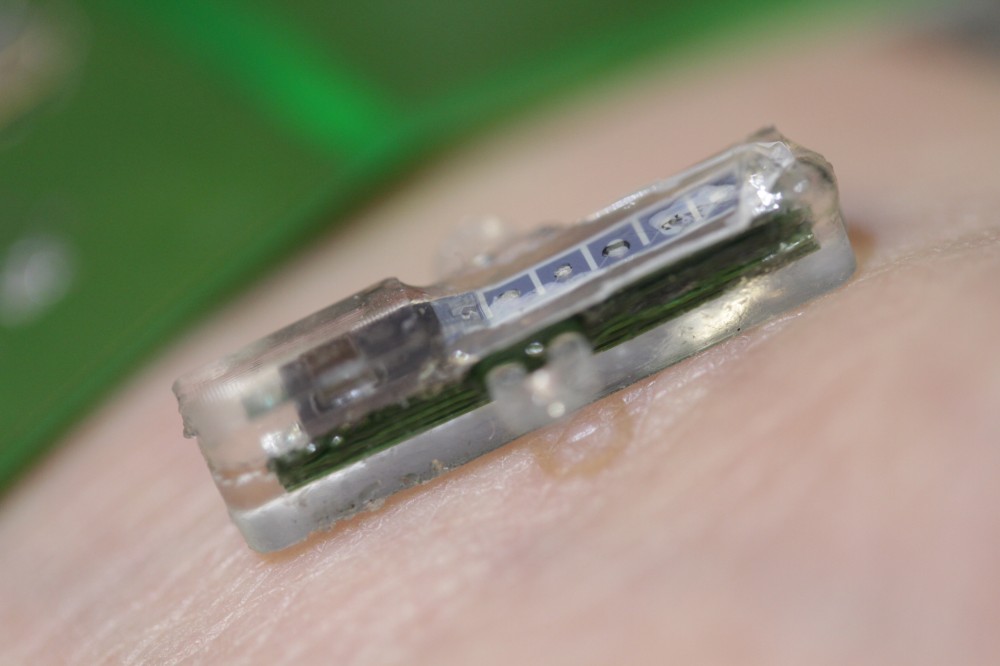
(credit: EPFL)
Towards personalized chemotherapy
The implant could be particularly useful in chemotherapy applications. Currently, oncologists use occasional blood tests to evaluate their patients’ tolerance to a particular treatment dosage. In these conditions, it is very difficult to administer the optimal dose.
De Micheli is convinced his system will be an important step towards better, more personalized medicine. “It will allow direct and continuous monitoring based on a patient’s individual tolerance, and not on age and weight charts or weekly blood tests.”
In patients with chronic illness, the implants could send alerts even before symptoms emerge, and anticipate the need for medication. “In a general sense, our system has enormous potential in cases where the evolution of a pathology needs to be monitored or the tolerance to a treatment tested.”
The prototype has already been tested in the laboratory for five different substances, and proved as reliable as traditional analysis methods.
The project brought together eletronics experts, computer scientists, doctors and biologists from EPFL, the Istituto di Ricerca di Bellinzona, EMPA and ETHZ. It is part of the Swiss Nano-Tera program, whose goal is to encourage interdisciplinary research in the environmental and medical fields. Researchers hope the system will be commercially available within 4 years.
Comments (17)
by What are the sensors?
They keep saying 5 sensors. What are the five sensors and how reliable would the data be?
I am guessing Glucose is one but what are the others?
by Dennis R.
In four years time, will the device really need to transmit the data to a “doctor”? Won’t our own devices be able to read and interpret the data for us? If not, there’s something wrong with this concept.
I agree with MikeB’s comment that the size seems too large– even though it would be a an immediate boon for some. Miniaturization should (hopefully) shrink the device over the next few years.
Of course, the data transmission can probably be hacked by an enterprising and/or criminal type. But I’m not sure how they would be able to identify the individual and leverage the information if they did obtain it. TomZarek makes an interesting point about such a device being a condition of hire. But it may be a moot point if the technology has the potential to keep us healthier. It would be in most people’s best interest to have such an implant to prevent disease. Employers would save money on employee medical insurance– they couldn’t eliminate insurance coverage of course– but their costs would be much lower and their employees would be healthier. That’s win-win.
by Jean-Philippe Martin
As a diabetic this is very interesting to me : continuous glucose monitor + insulin pump + software = artificial pancreas !
by Alexander Hayes
One step closer to Uberveillance ?
by Vin
Hypochondria here I come. I must admit though, it will be great to finally talk to my body and get what it thinks its up to.
by Neo
I do that all the time.
by Vin
Yeah, but do you do it with a tiny, portable personal device implanted just under skin, powered by a battery patch, that regurgitates numbers into your mobile?
by Greenplayer
A goal of 4 years, no sooner? Takes a week to get blood test results back that this can do in an instant, how can this not sell?
by Rob
Complain to the Department that drags it’s ass on new and better options for medical procedures.
This thing needs quick testing and if deemed safe get it out there not 4 years from now not 20 now.
by Bennie Beaver
A kind of device I’ve been waiting for. We need such devices to keep track of all facets of our blood, and transmit info to our own smart system, included with something like IBM Watson, to inform healthy people about their every day health care…how to eat and exercise, etc., etc…..If need be, to a doctor.
by Ian Clarke
“Researchers hope the system will be commercially available within 4 years.”
And when it is, I hope it will be even smaller, able to last indefinitely, and test every facet of your blood. We are pretty much left in the dark when it comes to our own health. A device like this sending data to an app on your phone would help immensely.
by Pete
RE A device like this sending data to an app on your phone would help immensely.
I think, in the future, it is also possible to use phones (or some other external computing device) as a remote controller (by human or/and by some form of AI inside the phone or the computer).
This device can become mobile, once it is miniaturized enough (so that it may move within capillaries, or at least the larger vessels).
Once it becomes mobile, it will need some form of remote control. It takes, I guess, another decade for nanocomputers to be developed (ones that can be installed on such micromachines so they don’t need remote control and can coordinate theirselves).
Kurzweil’s prediction of nanobots in human body will come true.
by MikeB
Very cool with some caveats: Small? That thing is _much_ bigger than an IV needle or microchip implant, so not close to ready for prime time. Opening and closing a wound is very very prone to complications, so there is a serious logistical complication. Not clear why the device couldn’t use fluids directed externally through the device; why embed in tissue?
NOT Cool: the comment that the radio transmits at a “safe” frequency. That is a blatant effort to placate, a CYA sales pitch of a half truth. The possible frequencies are limited and the figures suggest either cell phone or bluetooth frequencies. One may or may not agree that those are safe frequencies.
by TomZarek
How long before having one of these is demanded by an employer instead of as a condition of hire? In a society that has allowed routine invasion of privacy through drug screening this has a real potential for institutional abuse of individual liberty.
by TomZarek
EDIT: delete “instead of “. Sorry, I was high.
by Vin
Or we can argue that it will make the relative promise of individuals in the labour marketplace more transparent, benefiting both employee’s and employer’s individual needs. In a sense the ‘order of merit’ of people with respect to any given application becomes more precise and transparent? So labour becomes more appropriately distributed? Personally, i think work in current society is an abuse of individual liberty but that could be my laziness talking.
by alvaro
pretty amazing!